Ethernet and Wireless Data Loggers
Remote visibility has become a practical requirement in modern plants, utilities, laboratories, and field installations. When measurements need to be collected without frequent manual checks, Ethernet and Wireless Data Loggers help bridge the gap between the sensing point and the people who need timely data for monitoring, troubleshooting, and documentation.
These devices are commonly used when local-only logging is not enough. Instead of retrieving readings directly at the instrument every time, users can access stored data through networked or wireless communication methods, making it easier to monitor environmental conditions, pulse signals, and process variables across distributed assets.
Where Ethernet and wireless data loggers fit best
This category is especially relevant for applications where sensors are installed in cabinets, remote rooms, warehouses, utility areas, production lines, or outdoor monitoring points. Ethernet-connected loggers are often selected when a stable wired network is available and continuous access to logged data is important. Wireless models are useful when cabling is difficult, when the installation needs to stay flexible, or when the logger is deployed in mobile or hard-to-reach locations.
Compared with standalone units, these loggers support a more connected workflow. They can simplify trend review, alarm response, and data collection across multiple monitoring points, which is valuable in preventive maintenance, environmental compliance, facility monitoring, and process observation.
Common measurement types in this category
Ethernet and wireless models are available for different signal and sensing needs. In this selection, you will find examples focused on temperature and humidity monitoring, pulse input logging, and waterproof temperature measurement for submerged or wet environments. That range makes the category useful across both building systems and industrial process support tasks.
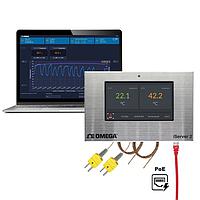
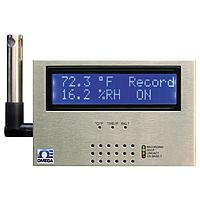
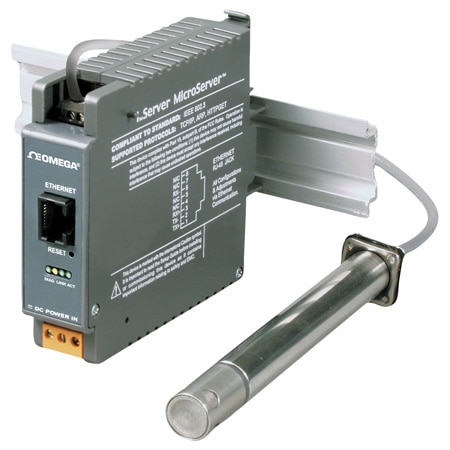
For fixed-site environmental monitoring, the OMEGA ITHX-D3 is a DIN rail mount temperature and humidity virtual chart recorder with Ethernet communication, making it suitable for panel-based installations. For pulse monitoring, the OMEGA OM-CP-RFPULSE2000A supports wireless and USB connectivity, which can be relevant for tracking event-driven signals. For water-related deployment, OMEGA MX2203 and MX2204 models provide Bluetooth data access in compact, submersible formats.
Ethernet vs. wireless: how to choose
The most important selection factor is the communication environment. Ethernet data loggers are often preferred when the logger is installed in a permanent location with available network infrastructure. They can be a practical choice for control panels, mechanical rooms, or validated monitoring points where wired communication offers straightforward integration and consistent access.
Wireless data loggers are better suited to applications where running cable is inconvenient or where deployment speed matters. Bluetooth-based units can be useful for local access by service personnel using mobile devices, while RF wireless loggers may fit systems that require communication with a compatible receiver or gateway. If your priority is broader connected monitoring, you may also want to review related temperature and humidity logging options for application-specific selection.
Examples from Dwyer and OMEGA
OMEGA appears strongly in this category with products that cover several connected monitoring scenarios. The ITHX-D3 is designed for temperature and relative humidity logging in a DIN rail format with Ethernet communication, which is useful when measurements need to be integrated into a cabinet or machine enclosure. The OM-CP-RFPULSE2000A addresses pulse logging with a wireless interface, while the MX2203 and MX2204 focus on compact Bluetooth-enabled temperature logging in wet or submerged conditions.
Dwyer is also an important name in data logging, especially for compact logging tasks involving temperature, humidity, voltage, current, thermocouple, and CO measurement. In this broader ecosystem, Dwyer DW-USB series models such as the DW-USB-1, DW-USB-2-HA, DW-USB-3, and DW-USB-4 show how application needs can vary between local USB retrieval and more connected logging strategies. When comparing categories, it helps to separate simple download-based logging from devices intended for networked or wireless access.
What to evaluate before purchasing
Communication type should be reviewed first, but it is only one part of the decision. Users should also consider the measured variable, installation style, memory capacity, alarm handling, enclosure suitability, power source, and how data will be accessed in daily operation. A logger that performs well in a lab, for example, may not be the right choice for a washdown area, remote outdoor point, or submerged application.
It is also important to think about the full monitoring workflow. Some users only need periodic data retrieval, while others need ongoing visibility, local display, mobile access, or network-based review. If the signal being tracked is electrical rather than environmental, a dedicated electric datalogger may be more appropriate. For counting or pulse-driven records, an event data logger can also be worth comparing.
Applications that benefit from connected logging
Connected data logging is widely used in HVAC support, storage monitoring, utility rooms, clean spaces, water-related testing, and distributed equipment supervision. Ethernet-based devices are often chosen where the installation is fixed and the data needs to be visible from a workstation or internal network. Wireless models can reduce installation effort in retrofit projects or support periodic service checks in locations where network cabling is not practical.
Bluetooth waterproof loggers are especially helpful when the logger must be placed close to the measurement point and later accessed without opening a sealed housing or disturbing the installation. Wireless pulse logging can also support operational review where a changing state, count, or pulse-based process must be documented over time. For a broader comparison of connected options, see the full Ethernet and wireless data logger range available in this category.
Choosing the right logger for long-term use
A good selection process starts with the actual operating environment. Consider whether the logger will be mounted on a DIN rail, wall, flat surface, or near a submerged measurement point. Then match the communication method to the maintenance routine: Ethernet for fixed network access, Bluetooth for close-range retrieval with a mobile device, or wireless systems for remote signal collection where supported infrastructure is available.
It also helps to choose a logger with enough onboard memory, a suitable measurement range, and practical alarm or status indication for the task. Models such as the OMEGA ITHX-D3, OM-CP-RFPULSE2000A, MX2203, and MX2204 illustrate how this category supports very different operating conditions, from panel monitoring to pulse tracking and waterproof temperature logging.
Final thoughts
When measurements need to be captured beyond the limits of manual spot checks, Ethernet and wireless loggers offer a more efficient way to collect and review data. The right model depends on the variable being measured, the communication method available on site, and how often data must be accessed.
By comparing installation style, connectivity, and sensing requirements together, buyers can narrow the selection to devices that truly fit the application. Whether the need is Ethernet-based environmental monitoring, wireless pulse logging, or Bluetooth access in wet environments, this category provides a focused starting point for building a more connected data collection workflow.
Get exclusive volume discounts, bulk pricing updates, and new product alerts delivered directly to your inbox.
By subscribing, you agree to our Terms of Service and Privacy Policy.
Direct access to our certified experts