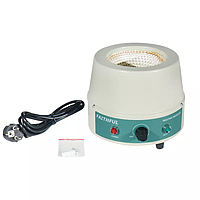
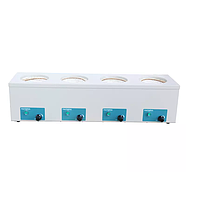
Heating Mantles
Consistent flask heating is a basic requirement in chemical synthesis, sample preparation, distillation, and many routine laboratory workflows. When open flame is not appropriate and direct contact heating may create hot spots, Heating Mantles offer a practical way to warm round-bottom flasks and reaction vessels more evenly while supporting repeatable temperature control.
On this page, you can explore laboratory heating mantle options for different flask sizes, heating capacities, and working formats. The range is especially relevant for labs that need dedicated solutions for single-flask reactions, larger reaction vessels, or parallel heating of multiple samples in the same setup.
Why heating mantles are widely used in laboratories
A heating mantle is designed to transfer heat around the lower body of a flask rather than concentrating it at one point. This helps reduce the risk of localized overheating and supports more stable process conditions, which is important in research, education, analytical preparation, and pilot-scale laboratory work.
Compared with general-purpose heating methods, a mantle is better matched to curved glassware. This makes it especially useful for reaction flasks used in organic chemistry, solvent handling, reflux systems, and controlled heating processes where the vessel shape matters as much as the heating performance.
Product range and typical configurations
This category covers both single-position heating mantles and multi-place models for laboratories that run repeated tests. Within the featured range, there are remote-controlled reaction flask mantles from 2 L up to 50 L, along with analog aluminum-case multi heating mantles for smaller flasks processed in parallel.
Examples include the DaiHan DH.WHM8222 for 2 L applications, DH.WHM8233 for 5 L, DH.WHM8226 for 10 L, DH.WHM8227 for 20 L, and larger-capacity options such as DH.WHM8234 at 30 L and DH.WHM8228 at 50 L. For batch work, models such as DH.WHM12393, DH.WHM12391, DH.WHM12295, DH.WHM12293, and DH.WHM12291 provide 3-place or 6-place heating layouts for smaller round-bottom flasks.
If you are building a broader thermal workflow, it may also be useful to review related laboratory tools such as burner and torch equipment for applications where a different heat source is more appropriate.
Key selection criteria before buying
The first point to verify is flask compatibility. Heating mantles are typically chosen around vessel volume, flask diameter, and bottom shape. A properly matched mantle improves contact around the vessel and supports better thermal uniformity, while a poor fit can reduce efficiency and process stability.
The second factor is heating power. In the highlighted product range, output spans from compact units around 550 W for smaller vessels up to 4000 W for larger reaction flasks. As vessel size increases, power demand generally rises as well, especially in applications involving larger liquid volumes, longer dwell times, or processes that need faster heat-up performance.
Control method also matters. Remote-controlled reaction flask mantles are helpful when users want more flexible temperature management around the apparatus, while analog multi-place units can be practical for routine and repetitive tasks. In busy labs, ease of operation, accessibility, and workflow consistency often influence the final choice as much as power rating.
Construction features that support laboratory use
Several featured models in this category use nickel-chrome coil-type heating elements, described as acid resistant and designed for long service life. This is relevant in chemical environments where exposure conditions and frequent operation place higher demands on durability.
Some larger models also use aluminum or powder-coated steel housings depending on capacity and design. In practical terms, enclosure design affects robustness, day-to-day handling, and integration into a lab bench or pilot setup. Certain listed products also mention support for an optional stainless-steel rod and compatibility with optional remote thermo control components and K-type thermo sensors, which can be useful when configuring a more complete reaction station.
For buyers already standardizing around one supplier, the broader DaiHan product range may help when matching heating equipment with other lab devices from the same manufacturer.
Single-flask versus multi-place heating mantles
Single-flask reaction mantles are usually the better choice for synthesis, distillation, or scale-up work where one vessel needs focused control. The 10 L to 50 L models in this category are more relevant for larger reaction volumes, while 2 L to 5 L sizes are often suitable for smaller bench-scale reactions and development work.
Multi-place heating mantles are more suitable when the priority is throughput. A 3-place or 6-place configuration can simplify comparative testing, educational laboratory sessions, or repetitive sample preparation using similar flask sizes. Instead of setting up multiple separate heaters, the user can manage several vessels in one organized layout.
This distinction is often more important than simply comparing wattage. In many labs, the best choice depends on whether the process is centered on one critical reaction or on running many similar tasks efficiently.
Applications in chemical and research workflows
Heating mantles are commonly used anywhere a round-bottom flask needs controlled and uniform heating. Typical environments include chemical laboratories, pharmaceutical R&D, materials research, and academic teaching labs. They are also relevant in setups involving reflux, solvent evaporation, reaction preparation, and liquid heating where vessel geometry is fixed by the process.
The larger remote-controlled DaiHan models can support reaction vessel heating in more demanding laboratory workflows, while the smaller multi-place units are well suited to repeated testing and standardized sample handling. Depending on the process, users may combine heating equipment with other support tools and accessories from categories such as laboratory carts and trolleys for safer movement of equipment and materials in the workspace.
Featured manufacturer examples in this category
Although several laboratory brands appear across the wider equipment portfolio, the products highlighted in this category are strongly represented by DaiHan. The listed range covers both large-capacity reaction flask mantles and bench-scale multi-place units, giving buyers a practical spread of options for different vessel volumes and lab routines.
For users comparing adjacent product ecosystems, you may also want to explore other DaiHan laboratory equipment if your requirement extends beyond flask heating into a broader bench or process setup. Keeping related equipment within one familiar ecosystem can simplify training, sourcing, and maintenance planning.
Choosing the right model for your process
A good starting point is to define the actual flask volume you use most often, then check the matching diameter range and the type of work being performed. For example, a lab running occasional 2 L to 5 L reactions will likely have different needs from a process lab heating 20 L to 50 L vessels or a teaching lab preparing multiple 250 ml to 1000 ml flasks at once.
It is also worth thinking about how the heating mantle fits into the full setup: support rods, sensors, temperature monitoring, available bench space, and how often the unit will be used. Looking at the workflow rather than only the headline specification usually leads to a better long-term purchasing decision.
Choosing among these heating mantle options comes down to vessel size, control preference, and the way your lab actually runs daily work. Whether you need a compact mantle for smaller reaction flasks or a larger remote-controlled unit for higher-volume processes, a well-matched configuration can improve heating consistency, workflow efficiency, and overall laboratory safety.
Get exclusive volume discounts, bulk pricing updates, and new product alerts delivered directly to your inbox.
By subscribing, you agree to our Terms of Service and Privacy Policy.
Direct access to our certified experts