Beakers
Reliable liquid handling starts with simple tools that are easy to read, easy to pour, and suitable for daily laboratory work. In research labs, quality control rooms, pilot plants, and educational settings, beakers remain one of the most frequently used pieces of labware for mixing, heating, transferring, and temporarily holding samples or reagents.
This category brings together beakers in different materials, sizes, and formats to support routine bench work as well as more demanding procedures. Whether you need glass beakers for general laboratory use, polymer options for lightweight chemical handling, or stainless steel vessels for robust environments, choosing the right format helps improve workflow, cleanliness, and handling safety.
Where beakers fit in everyday laboratory work
A beaker is often used as a general-purpose laboratory container rather than a precision measuring device. It is practical for preparing solutions, dissolving solids, collecting intermediate samples, heating liquids when material compatibility allows, and pouring contents into other vessels or instruments.
Graduation marks can support approximate volume checks, but beakers are typically selected for convenience and handling rather than analytical accuracy. In many workflows, they are used alongside transfer tools and supporting labware such as bottle top solvent pumps for reagent dispensing and other containers used in storage or sample preparation.
Common material choices and why they matter
The material of a beaker strongly affects durability, chemical resistance, temperature tolerance, weight, and visibility of contents. Glass beakers are widely chosen when users need transparency, clear scale markings, and good resistance to many common laboratory processes. They are especially suitable for observing color change, precipitation, or mixing behavior during routine work.
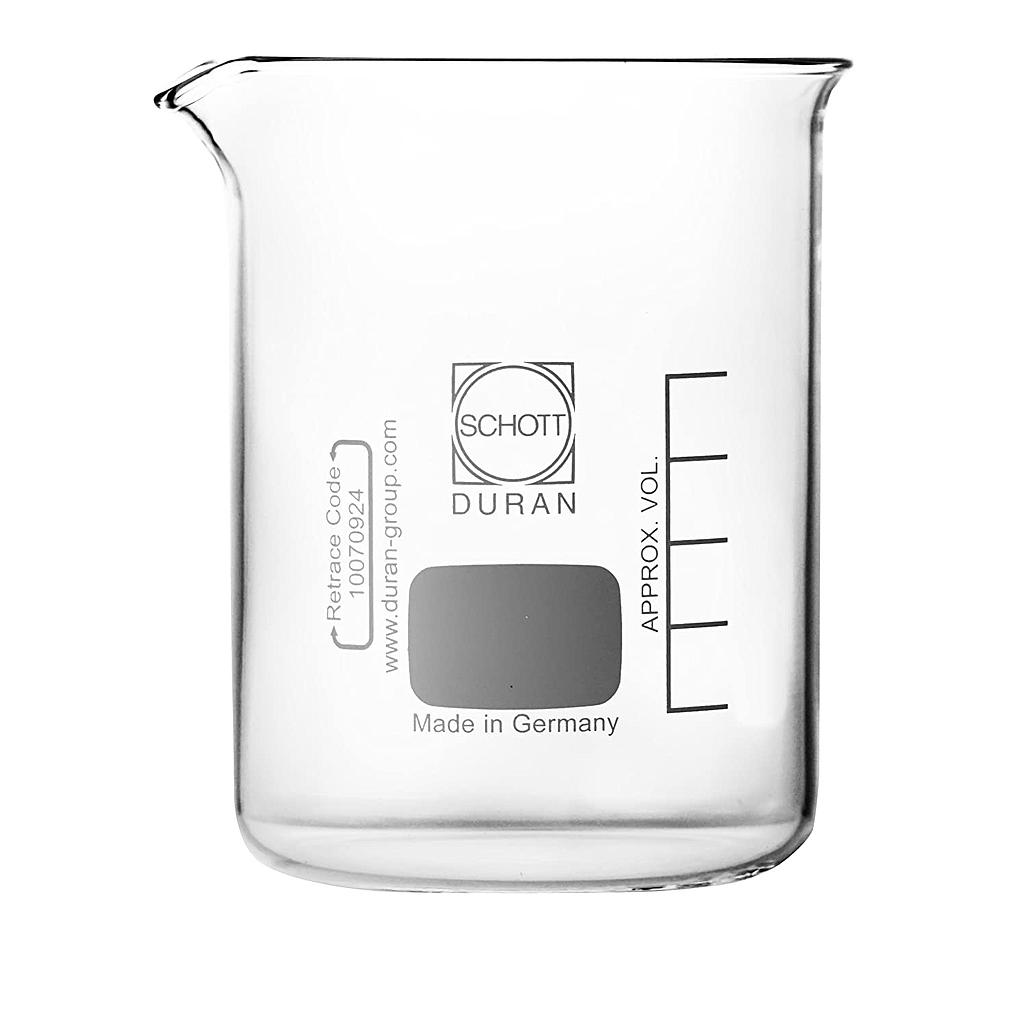
For example, the DURAN 211066807 low form glass beaker is a representative option for higher-volume applications, with features such as a readable graduation scale, a marking area, and a pouring spout. Polymer alternatives such as PP or PMP can be preferred when lower weight, easier handling, or impact resistance is important, while stainless steel beakers may be useful in harsher mechanical environments or specific process handling tasks.
Examples of beaker types in this category
This range includes several practical formats for different operating conditions. Glass models are represented by products such as the DURAN 211066807 low form beaker in 3000 ml capacity, which suits mixing and heating tasks where visibility of the liquid is important. Handled polymer vessels are also available, such as the VITLAB VI.481.941 PP hanger handled pitcher, which can support convenient manual pouring and transfer in lighter-duty applications.
For more rugged handling, stainless steel options from DaiHan appear in capacities including 2000 ml, 3000 ml, and 5000 ml, useful where mechanical strength and repeated handling are priorities. The category also includes PMP beakers from Kartell in sizes such as 1 l, 3 l, and 5 l, offering another route when transparency and lower weight need to be balanced with practical lab use.
How to choose the right beaker
The first step is to match the beaker to the actual task rather than selecting by volume alone. Consider the working liquid, expected temperature, how often the vessel will be moved, whether visual observation is necessary, and whether the beaker is mainly for mixing, temporary holding, or pouring. A low form beaker is often preferred for stability and general bench work, while a handled pitcher style may be more convenient for transfer tasks.
Capacity should also reflect real working volume, leaving enough headspace to avoid spills during mixing or heating. If the beaker will be used repeatedly in high-throughput routines, practical details such as spout design, graduation visibility, labeling area, and ease of cleaning can make a noticeable difference. Where approximate measurement is not enough, beakers should be paired with more precise volumetric tools rather than used as substitutes.
Application areas across labs and industrial settings
Beakers are used across chemical laboratories, water testing, food and beverage quality control, educational labs, and industrial process support. They are commonly involved in sample preparation, reagent dilution, warming liquids, collecting rinse fractions, and moving materials between storage and analysis steps. Their simplicity makes them valuable in both manual workflows and structured standard operating procedures.
In broader lab setups, they often work together with adjacent items such as laboratory bowls for preparation tasks or ampoules for specialized sample containment. This makes beakers less of a standalone purchase and more of a core part of an efficient labware ecosystem.
Points to review before purchasing
For B2B buyers, procurement teams, and laboratory managers, it is useful to compare not only capacity but also material compatibility, dimensions, cleaning requirements, and handling style. A beaker that is too small for the process can create overflow risk, while one that is oversized may reduce efficiency and make pouring less controlled.
It is also worth checking whether the application benefits more from glass, plastic, or stainless steel construction. Glass may suit observation and routine heating, PP or PMP can support lighter handling and reduced breakage concerns, and stainless steel can be practical where robustness matters more than transparency. Product selection should follow the operating environment, not just a preferred brand or familiar format.
Brands and product range available in this category
This category includes products associated with established labware manufacturers such as DURAN, VITLAB, DaiHan, and Kartell, with additional brand coverage across the wider range. The available selection supports different procurement preferences, from standard bench beakers to larger-capacity vessels used in preparation, transfer, or utility tasks.
Because laboratories rarely use one type of vessel for every process, a mixed-material portfolio can be useful. Teams may keep glass beakers for visibility and routine lab work, polymer beakers for lighter handling, and metal beakers for tougher service conditions. Reviewing the category by intended use usually leads to a better fit than focusing only on nominal volume.
Choosing beakers for a practical, efficient workflow
The right beaker supports cleaner transfer, smoother preparation steps, and more consistent day-to-day lab handling. By comparing material, size, shape, and application context, buyers can select vessels that fit real operating needs instead of defaulting to a one-type-fits-all approach.
If you are building or updating a labware set, this category provides a useful starting point for everyday liquid handling. A well-matched beaker range helps reduce handling issues, supports safer bench work, and integrates naturally with the rest of the laboratory process.
Get exclusive volume discounts, bulk pricing updates, and new product alerts delivered directly to your inbox.
By subscribing, you agree to our Terms of Service and Privacy Policy.
Direct access to our certified experts