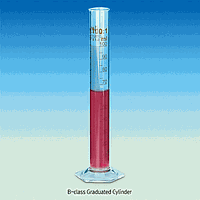
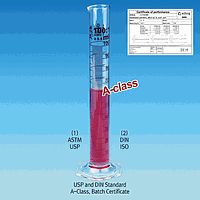
Cylinder
Accurate volume handling starts with simple tools that technicians and laboratory teams use every day. In routine preparation, sample transfer, dilution work, and educational or industrial lab tasks, a reliable Cylinder helps users measure liquids quickly while maintaining a practical balance between readability, durability, and workflow efficiency.
This category brings together graduated cylinders used across general laboratory environments, including glass and plastic options, a range of capacities, and formats suited to both bench work and frequent handling. Whether the priority is chemical resistance, easy cleaning, lower breakage risk, or clear graduation visibility, choosing the right cylinder depends on how the lab actually works.
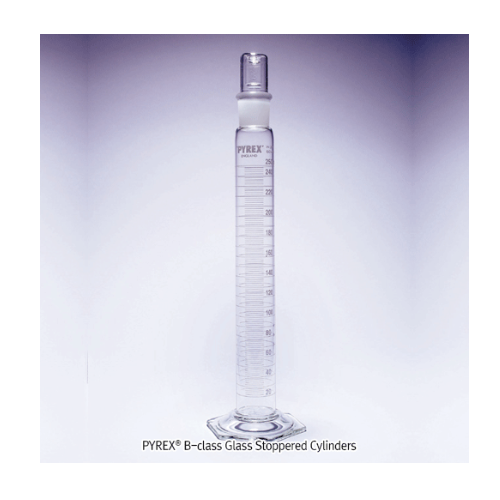
Where graduated cylinders fit in everyday lab work
A graduated cylinder is commonly used for volume measurement when the application needs better precision than a beaker, but does not necessarily require the tighter control of a volumetric flask or pipette. This makes cylinders useful for media preparation, reagent dispensing, process checks, and general liquid handling in laboratory support tasks.
In many settings, cylinders also support staging and transfer work before liquid moves into other containers or systems. They are especially practical when operators need a straightforward visual reading, a stable base, and faster handling across repeated measurement steps.
Common material choices and why they matter
One of the first selection points is material. Borosilicate glass cylinders are widely preferred when users need good thermal and chemical resistance, along with clear graduation marks and long-term dimensional stability. In this category, several SciLab models are described as A-Class and Boro 3.3, which reflects the type of construction many laboratories look for when consistency and clear readability are important.
Plastic cylinders also have a strong place in laboratory operations. For example, Kartell options in SAN or PP can be practical where lower weight, easier handling, or reduced breakage risk are priorities. In busy teaching labs, production support labs, or routine utility areas, these material differences can directly affect both safety and replacement frequency.
Choosing the right capacity and graduation range
The best cylinder size depends on the volume normally handled and the resolution required for the task. Smaller cylinders are often chosen when operators need finer graduation intervals for low-volume work, while larger cylinders are more efficient for bulk preparation, batching, or repeated transfers of larger liquid quantities.
This category includes examples across a broad working range, from compact models such as the SciLab SL.Cyl1001 Cylinder, A-Class, Boro 3.3, 5 / 0.1㎖ and SciLab SL.Cyl1003 Cylinder, A-Class, Boro 3.3, 25 / 0.5㎖, through mid-range sizes like the SciLab SL.Cyl1006 and SL.Cyl1007, up to larger formats including the SciLab SL.Cyl1008 and SL.Cyl1009. Larger plastic options such as the Kartell VI.645.91 Cylinder SAN, 1000 / 20.00㎖ and moulded designs like the Kartell KA.822 Cylinder mould pp 1l short may suit routine handling where robustness and convenience matter more than a glass format.
Examples from leading manufacturers in this category
Laboratories often standardize by supplier to simplify purchasing and maintain consistency across benches. Brands featured here include SciLab, Kartell, and Impact, with additional manufacturer coverage in the broader labware range such as DURAN, Pyrex, DaiHan, Glassco, and WITEG.
For example, the Impact 2139024 Cylinder tall form is relevant where a tall-form design is preferred for specific workspace or handling needs. SciLab products in A-Class borosilicate construction are suited to users seeking a more measurement-focused glass option, while Kartell cylinders provide practical polymer alternatives for everyday use in less fragile environments.
Key points to review before buying
When comparing products, it helps to look beyond nominal capacity alone. Buyers typically review the cylinder form factor, graduation readability, material compatibility with intended liquids, stability on the bench, and whether the application favors a glass or plastic body. For repetitive use, cleaning method and resistance to accidental impact can also be important.
It is also useful to consider how the cylinder fits into the broader liquid-handling workflow. If the task involves solvent transfer or repeated dispensing from stock containers, related tools such as a bottle top solvent pump may support safer and more efficient operation. For storage, transfer, or packaging steps around the same process, nearby labware categories such as bags can also be relevant depending on the workflow.
Typical application environments
Graduated cylinders are used in research labs, educational laboratories, quality control rooms, and industrial support environments where measured liquid volumes are part of standard procedure. They are common in sample preparation, buffer or reagent make-up, incoming inspection, and routine housekeeping tasks for wet chemistry work.
Because they are straightforward to use, cylinders are often selected for stations where multiple users share equipment and need a clear, intuitive measuring tool. In these cases, durability, legible markings, and the right capacity mix across the facility can matter just as much as nominal accuracy.
How to build a practical cylinder assortment
Instead of buying one size for every task, many labs benefit from keeping a small working set that covers low, medium, and high volume ranges. A combination of smaller A-Class glass cylinders for closer reading, plus larger plastic cylinders for utility use, often creates a more efficient and cost-conscious setup.
This approach can reduce handling errors, improve speed during preparation work, and help each team use the right tool for the right step. For facilities already organizing broader consumables and labware purchasing, adjacent categories such as ampoule products may also be part of the same sourcing plan when liquid preparation and containment are managed together.
Finding the right cylinder for your process
The right choice usually comes down to application type, volume range, material preference, and how demanding the daily handling environment is. A cylinder used for controlled measurement on a laboratory bench may not be the same one chosen for high-traffic educational use or routine industrial support work.
By comparing capacity, construction, and intended workflow, buyers can narrow the selection to models that are easier to use and better aligned with actual lab routines. This category is designed to support that process with a practical range of cylinder options from recognized laboratory brands and formats suited to everyday measuring tasks.
Get exclusive volume discounts, bulk pricing updates, and new product alerts delivered directly to your inbox.
By subscribing, you agree to our Terms of Service and Privacy Policy.
Direct access to our certified experts