Filtration & separation
Clean sample preparation often depends on choosing the right filtration setup, not just the right instrument. In laboratory workflows, filtration and separation consumables help remove particles, clarify liquids, retain analytes, and support repeatable downstream analysis. This makes Filtration & separation an important category for routine lab work, quality control, environmental testing, and general sample handling.
Within this category, users typically look for a practical combination of filter media, holders, vacuum components, and compatible bottles or accessories. The goal is not only to capture the target fraction, but also to maintain chemical compatibility, flow performance, and handling convenience across different applications.
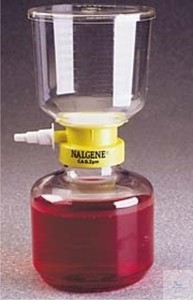
Where filtration and separation products fit in the lab
Laboratory filtration is used in both simple and highly controlled procedures. A basic step such as removing suspended solids from a solution can affect the accuracy of weighing, spectroscopic measurement, microbial work, or any later stage that depends on a cleaner sample matrix.
Separation tasks also vary widely. Some workflows rely on qualitative filter paper for routine clarification, while others require membrane filtration for finer particle retention or glass fiber media for higher loading capacity and faster flow. Because of that, this category serves as part of a broader labware ecosystem rather than a single-purpose product group.
Main product types in this category
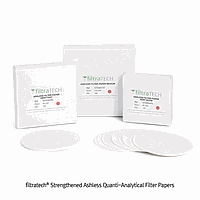
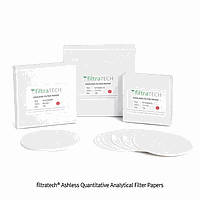
One of the core groups here is filter media. Products such as the Advantec 90mm Qualitative Filter Papers, Advantec quantitativeseries Quantitative Filter Paper, Advantec membraneseries Membrane Filter, and Advantec glassseries Glass Fiber Filter illustrate the range of filtration materials commonly selected according to particle retention, ash content expectations, loading behavior, and intended analytical method.
Another important group includes hardware and support parts for filtration assemblies. DURAN components such as filter heads and filter holder discs are used as part of a physical setup that secures filter media and helps direct flow through the chosen membrane or paper. In vacuum-based workflows, systems like the WITEG WaterVac 100 Vacuum Filtration System add controlled suction to improve throughput and consistency.
Collection vessels also matter in the overall setup. Bottles such as the Wheaton PU-coated clear bottles can support safe handling and collection in laboratory environments where durability and compatibility are part of the process requirement.
How to choose the right filter media
The first decision is usually based on what needs to pass through and what needs to be retained. Membrane filters are often selected when finer particle capture or more defined filtration performance is needed, while filter paper is typically suitable for routine gravimetric, preparative, or general clarification work. Glass fiber filters are often chosen when higher dirt-loading capacity or faster flow is beneficial.
Users should also think about sample type and operating conditions. Aqueous samples, solvents, viscous liquids, and particle-rich suspensions do not behave the same way during filtration. Diameter, mechanical strength, compatibility with holders, and whether the process is gravity-fed or vacuum-assisted can all influence the most suitable media.
For teams comparing brands and filter formats, exploring the broader Advantec range can be useful when standardizing laboratory filtration consumables across multiple procedures.
Filtration assemblies and vacuum workflow considerations
A filter medium performs best when the rest of the setup is matched to the task. Filter heads, holder discs, tubing, bottle connections, and receiving vessels all affect sealing, flow stability, and ease of cleaning. For this reason, filtration and separation should be viewed as a system decision rather than only a consumables purchase.
Vacuum filtration becomes especially useful when handling larger volumes or when faster throughput is needed. The WITEG WaterVac 100 Vacuum Filtration System is an example of a compact vacuum-assisted approach for liquid or air-related filtration tasks, while DURAN filter head and holder components can support assembly-level flexibility for different lab configurations.
When a workflow also involves manual solvent transfer or bottle-mounted liquid handling, related tools such as a bottle top solvent pump may help streamline adjacent preparation steps.
Common application areas
Filtration and separation products are used across many routine and specialized environments. In quality control labs, they support sample clarification before analysis. In environmental and water testing, they can be part of particle capture, residue preparation, or membrane-based sample processing. In academic and industrial laboratories, they are equally common in reagent preparation, media preparation, and cleanup steps.
Selection often depends more on process logic than on the label of the product itself. A routine particulate removal step may call for simple qualitative paper, while a method that needs defined retention or cleaner filtrate may move toward membrane-based formats. Hardware components then need to match the chosen media size and the overall handling volume.
Brand and component considerations
This category includes products associated with established laboratory names such as DURAN, Advantec, Wheaton, and WITEG. Each appears in a different role within the workflow: media selection, holder and head components, vacuum support, or collection bottles. Looking at the category this way helps buyers build compatible setups instead of selecting items in isolation.
For example, Advantec products shown here represent different filter media families, while DURAN items reflect assembly components that help physically support filtration. Wheaton bottles fit the collection and handling side of the process, and WITEG supports vacuum-assisted operation. This mix is useful for labs that need either replacement parts or a more complete filtration arrangement.
Practical buying points for B2B and laboratory users
For procurement teams, the most efficient approach is to define the filtration objective first: clarification, particulate retention, gravimetric work, membrane-based separation, or vacuum-assisted throughput. Then check compatibility across diameter, holder format, vessel connection, and required media type. This reduces mismatched orders and helps standardize recurring purchases.
It is also worth considering whether the need is for a full workflow or for spare parts only. A lab may only require replacement filter paper, but another may need holder discs, filter heads, vacuum support, and receiving bottles together. In either case, choosing from the same category can simplify sourcing and improve consistency across technicians and test methods.
If your process depends on clean, repeatable sample preparation, the right filtration and separation products can make a noticeable difference in both handling efficiency and analytical reliability. Reviewing media type, assembly compatibility, and workflow scale will usually lead to a more suitable selection than focusing on one component alone.
Get exclusive volume discounts, bulk pricing updates, and new product alerts delivered directly to your inbox.
By subscribing, you agree to our Terms of Service and Privacy Policy.
Direct access to our certified experts