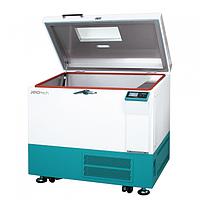
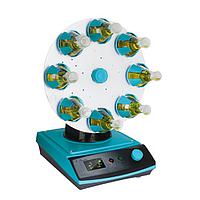
Shaking machine
Consistent sample agitation is essential in many laboratory workflows, from dissolving reagents and mixing small volumes to supporting culture preparation and routine analytical preparation. A well-matched shaking machine helps improve repeatability, reduce manual handling, and keep mixing conditions stable across batches.
In practice, the right setup is not only about the shaker itself. Platform size, motion style, load capacity, and the accessories used to hold flasks or tubes all affect day-to-day usability. This category brings together shaker equipment and related components for laboratories that need reliable, controlled shaking in research, quality control, and general lab operations.
Where shaking machines fit in the laboratory
Shakers are commonly used when samples need uniform motion over a defined time. Depending on the process, that may mean gentle agitation for biological work, reciprocating movement for broader vessel handling, or stable mixing for routine chemical preparation. In all cases, the goal is similar: maintain a controlled environment for sample movement without relying on manual shaking.
They are often part of a wider bench workflow alongside other sample-preparation tools. For applications that involve higher-shear blending rather than continuous shaking, users may also compare options in the laboratory blender range. This helps teams select equipment based on the actual mixing mechanism required, rather than treating every sample-preparation task the same way.
Key selection criteria before choosing a shaker
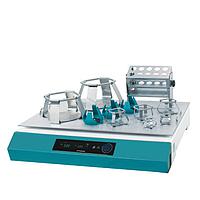
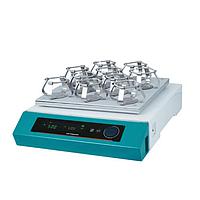
One of the first points to review is the shaking motion. Different lab procedures respond differently to orbital, reciprocating, rocking, or vortex-style movement. For this category, several highlighted products relate to reciprocating shaker configurations and their accessories, which are especially relevant when users need stable back-and-forth motion and consistent platform handling.
Platform dimensions and maximum load are equally important. A compact shaker may be suitable for smaller vessels and lighter daily use, while larger platforms support multiple flasks or racks in one run. The Lauda VS 15 B Varioshake shaker and VS 15 O Varioshake shaker, for example, illustrate a higher-capacity benchtop format with a 450 x 450 mm shaking platform, up to 15 kg load, and reciprocating motion up to 300 rpm.
Users should also consider timer settings, operating environment, and how frequently the shaker will be reconfigured. In a busy lab, quick changeover between flask clamps, tube racks, trays, and non-slip mats can be just as important as speed range alone.
Why accessories matter as much as the base unit
In many laboratories, the shaker base is only one part of the working system. The real flexibility comes from the accessories mounted on the platform. Flask clamps, tube block sets, perforated trays, and non-slip mats determine which vessel types can be secured safely and how efficiently the available platform area is used.
This is especially clear with examples from JEIOtech, where accessories such as the JEIOTECH AAA23551 Flask Clamp (100ml), AAA23556 Flask Clamp (300ml), and AAA23554 Flask Clamp (1000ml) support different flask volumes within the same shaker ecosystem. For tube-based work, the JEIOtech AAAJ4502 Tube Block Set with Cover (1.5 / 2.0 ml) and AAAJ4506 Tube Block Set with Cover (Φ12 mm) show how a shaker can be adapted for smaller vessels rather than only larger flasks.
Accessory choice directly affects safety and repeatability. A properly matched holder helps reduce vessel movement, uneven shaking, and accidental spills, which is particularly important when running multiple samples for extended periods.
Examples of shaker configurations in this category
Some products in this category represent complete shaker units, while others are clearly platform accessories intended to extend compatibility. That distinction is useful when planning a purchase. A lab replacing an existing tray or adding new vessel formats may only need the accessory, whereas a new installation may require the shaker, platform, and holders together.
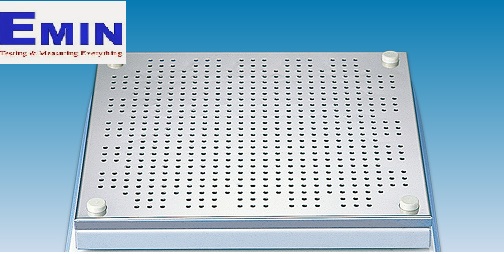
Among the representative items, Lauda A000044 and A000045 shaking trays provide perforated stainless-steel platforms for VS 8 models, allowing attachment of clamps and test tube racks. For broader tray-based setups, the Lauda A000049 Versatile shaker tray with 6 holders offers a more structured arrangement for securing different sample positions. Non-slip accessories such as Lauda A000042 and A000043 are practical when users need to place containers directly on the shaker surface without dedicated clamping.
This combination of base units and modular accessories makes the category relevant not only for new buyers, but also for laboratories expanding an existing shaker setup over time.
How to match a shaking machine to your application
The best starting point is the vessel type. If the workflow mainly uses Erlenmeyer flasks, flask clamps sized for the real working volume are usually more appropriate than a flat platform alone. If the lab handles microtubes or small sample tubes, a tube block or dedicated rack arrangement may provide better stability and easier loading.
Next, review the working load and batch size. A larger platform can improve throughput, but only if the shaker can maintain stable motion under the actual total weight. This becomes especially important for long-duration runs, where overloaded equipment may lead to inconsistent agitation or unnecessary wear.
Finally, think about workflow flexibility. Labs that frequently switch between vessel formats often benefit from modular platforms and interchangeable holders. Labs with one fixed routine may prefer a simpler configuration optimized around a standard tray or clamp set.
Brands commonly considered for laboratory shakers
This category includes representative products from manufacturers such as JEIOtech and Lauda, particularly in the form of shaker accessories and reciprocating shaker systems. Beyond the currently highlighted items, many buyers also explore established laboratory brands including Cole parmer, IKA, Heidolph, Hettich, ESCO, STUART, Yamato, and CISA depending on application type, platform format, and required lab standards.
Brand selection in B2B purchasing often depends less on name recognition alone and more on compatibility, service support, available accessories, and how well the product line fits the intended workflow. For that reason, it is often useful to evaluate the shaker as part of a broader lab equipment ecosystem rather than as a standalone bench instrument.
Practical buying tips for B2B laboratories
Before ordering, confirm the full configuration needed for actual use. A shaker may require a compatible tray, clamp set, tube holder, or mat to become operational for your sample format. This is a common source of purchasing delays when only the base unit is specified but the vessel-holding accessories are overlooked.
It is also worth checking installation space, bench load, and cleaning requirements. Stainless-steel trays and removable accessories can simplify maintenance in regulated or high-throughput environments. If the laboratory handles related preparation or transport steps around the shaker station, support equipment such as lab carts and trolleys may also improve workflow efficiency.
For teams managing multi-user environments, standardizing accessories across shaker platforms can make training easier and reduce setup errors. Clear matching between vessel type, holder type, and shaker model usually leads to better consistency than choosing by speed specification alone.
Choosing the right setup with confidence
A suitable laboratory shaker is defined by more than motion speed. The most effective choice balances platform size, load capacity, vessel compatibility, and the availability of practical accessories for everyday use. Whether the need is a reciprocating shaker for routine lab mixing or a replacement tray, clamp, or tube block for an existing unit, the right configuration supports safer handling and more repeatable results.
By comparing shaker platforms and accessories in the context of your real sample formats and workload, it becomes easier to build a setup that fits both current procedures and future expansion. This category is intended to support that process with equipment options suited to professional laboratory environments.
Get exclusive volume discounts, bulk pricing updates, and new product alerts delivered directly to your inbox.
By subscribing, you agree to our Terms of Service and Privacy Policy.
Direct access to our certified experts