
Soil Compaction Meter
Reliable assessment of soil resistance is essential when you need to understand root-zone limitations, trafficability, load-bearing behavior, or the presence of compacted layers below the surface. In agriculture, civil engineering, and geotechnical fieldwork, the right instrument helps turn a subjective soil check into measurable data that can support better decisions.
Soil Compaction Meter products in this category are used to measure penetration resistance and evaluate how dense or compact the soil profile is at different depths. Depending on the application, users may need a simple manual tool for quick field checks or a logging system for repeatable measurements, depth profiling, and location-based comparison.
Why soil compaction measurement matters
Compacted soil can reduce water infiltration, restrict root development, affect drainage behavior, and change the mechanical response of the ground under load. That is why compaction testing is relevant not only in crop management, but also in site preparation, sports field evaluation, and foundation-related investigations.
A soil compaction meter gives a practical way to compare conditions between locations, detect hardpan or plow sole layers, and monitor changes over time. When used consistently, it supports a more objective understanding of the soil profile than visual inspection alone.
Common instrument types in this category
This category includes several approaches to measuring penetration resistance. Manual hand penetrometers are often selected for direct field checks where portability and fast use are more important than advanced data handling. They are suitable for routine surveys, top-layer checks, and general comparison work.
For more structured measurement campaigns, logging instruments can store readings and support repeatable testing across multiple points. Products such as the Eijkelkamp Penetrologger PRO Soil penetrometer and the Eijkelkamp 06.15.SA Penetrologger with GPS illustrate this more data-oriented approach, where measurement storage and positional reference can be valuable for mapping or long-term monitoring.
There are also compact tools tailored to specific depth ranges or test conditions. For example, a top-layer hand penetrometer or pocket penetrometer may be useful where near-surface density checks are sufficient, while longer manual systems are more suitable when deeper compacted zones need to be identified.
Representative products and their practical roles
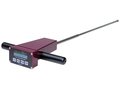
Within this range, the Spectrum Technologies 6120 Soil Compaction Meter is an example of an economical analog instrument for routine field use. Its role is straightforward: the rod is pushed into the soil and the resistance at the cone tip is displayed, helping users assess density changes with depth in a simple and accessible way.
The Eijkelkamp 06.01.SB Hand penetrometer and Eijkelkamp 06.02 Penetrograph standard set are better suited to users who need manual measurement of deeper profiles or more demanding field conditions. These kinds of tools are often relevant in geotechnical checks, agricultural compaction assessment, and studies related to trafficability or bearing behavior.
Where higher traceability is needed, instruments such as the Eijkelkamp 06.15.SC Penetrologger with GPS - CBR set can support more structured testing workflows. In addition to standard penetration resistance evaluation, some configurations are aligned with applications related to load bearing capacity and field comparison across multiple sites.
How to choose the right soil compaction meter
The first consideration is the intended application. If the goal is a fast qualitative or semi-quantitative check in agriculture or turf management, a manual meter may be enough. If the work involves repeated surveys, reporting, or location-based datasets, a logging instrument with measurement storage is usually the better fit.
Depth requirement also matters. Some instruments are optimized for top layers, while others are designed to investigate deeper compacted zones. Cone options, force range, and measurement scale should match the soil condition you expect to encounter, especially when moving between soft agricultural soils and more resistant ground in civil or geotechnical contexts.
It is also worth considering maintenance and accessory availability. Items such as the Spectrum Technologies 6106 Replacement Tip (1/2") and 6107 Replacement Tip (3/4") show that tip geometry and replacement parts can be an important part of the measurement ecosystem, particularly for users running frequent field tests.
Typical applications across field and laboratory workflows
In agriculture, these instruments are commonly used to investigate whether subsurface compaction is limiting plant growth, reducing root penetration, or affecting water movement. They can also help compare tillage results and assess whether the soil remains suitable for cultivation after machinery traffic.
In civil engineering and geotechnical work, a soil compaction meter supports quick evaluation of surface and subsurface resistance, especially when investigating trafficability, site access, or indicative ground behavior before more advanced testing. For broader sample collection and profile investigation, users may also work alongside soil samplers to correlate physical observations with compaction readings.
Where water movement through the ground is also part of the analysis, compaction data is often more useful when considered together with related tools such as a soil permeability meter. This combination can provide a clearer picture of how dense layers influence infiltration and drainage behavior.
Manual tools, digital logging, and supporting equipment
Choosing between manual and digital systems usually comes down to workflow. A manual device is often preferred for robustness, low training requirements, and quick spot checks. A digital or logging unit is more appropriate when you need stored readings, repeatability between operators, or structured measurement campaigns over many locations.
Some users will also need supporting test equipment beyond direct penetration measurement. For example, in more advanced soil mechanics and deformation studies, complementary systems may be found within other mud and soil testing equipment, where related apparatus can support broader laboratory analysis.
Brand preference can also influence selection. In this category, Spectrum Technologies is relevant for practical field meters and accessories, while Eijkelkamp is strongly represented in manual and logging solutions used in agricultural, environmental, and geotechnical applications.
What to evaluate before ordering
Before selecting a model, it helps to define the required measurement depth, the expected soil resistance range, and whether results need to be recorded for later analysis. Users should also consider portability, environmental exposure, and whether replaceable tips or alternative cones are needed for different soil conditions.
If your work includes routine field comparison, top-layer inspection, or compacted layer detection, the category offers options ranging from pocket and hand penetrometers to more advanced logging systems. The best choice is usually the one that matches the testing method, not simply the most feature-rich instrument.
A well-chosen soil compaction meter can improve consistency in field assessment and make soil condition data easier to interpret across seasons, sites, and projects. By selecting the right depth range, measurement style, and accessory setup, users can build a more reliable workflow for agricultural, environmental, or geotechnical soil evaluation.
Get exclusive volume discounts, bulk pricing updates, and new product alerts delivered directly to your inbox.
By subscribing, you agree to our Terms of Service and Privacy Policy.
Direct access to our certified experts