
UV meter
Accurate ultraviolet measurement is essential in environments where curing performance, sterilization intensity, material aging, and operator safety all depend on controlled UV exposure. On this page, you can explore a focused range of UV meter instruments used to measure UV intensity across different applications, from portable field checks to process-oriented radiometric monitoring.
UV measurement is not a one-size-fits-all task. The right instrument depends on wavelength range, required accuracy, expected intensity level, sensor format, and whether you need spot checks, data logging, or continuous monitoring. This category brings together practical options for industrial, laboratory, and technical inspection workflows.
Where UV meters are commonly used
UV intensity measurement is relevant in many technical processes. In UV curing, a meter helps verify lamp output and process consistency so coatings, inks, or adhesives receive the required energy. In maintenance and inspection work, it is used to check whether UV sources are still operating within an acceptable range.
These instruments are also used in environmental and safety assessments, laboratory testing, and specialized monitoring tasks. For broader optical and illumination checks, users may also compare requirements with a light meter when visible light measurement is needed alongside ultraviolet measurement.
Key differences between UV meters in this category
Not all UV meters measure the same part of the spectrum. Some handheld models focus on broad-band UVA or UVAB measurement, while others are designed for narrower bands or dedicated radiometric use. This matters because UV processes often depend on a specific wavelength region rather than total light alone.
Another important difference is measurement range. Lower-range instruments are useful for ambient or inspection-oriented readings, while higher-range models are more appropriate for high-output curing systems. Response time, sensor type, portability, and display resolution can also affect usability in production or lab settings.
Some models combine UV measurement with other parameters. For example, the TESTO 0572 2157 Lux And UV Probe supports both lux and UV readings, which can be useful when evaluating mixed lighting conditions. Other devices emphasize process-oriented radiometry, such as the Opsytec Dr.Grobel RM-12 Radiometer and matching sensor-based measurement setups.
Representative products and typical use cases
For general portable UV checking, instruments such as the PCE UV34 UV Light Meter and the LUTRON UV-340A UV LIGHT METER are suitable examples of handheld devices designed for direct field measurement. These types of tools are often selected for maintenance teams, incoming inspection, and routine verification of UV source performance.
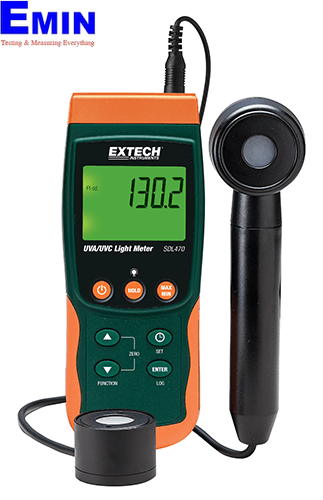
Where logging and traceability are more important, the EXTECH SDL470 UVA/UVC Light Meter/Datalogger adds data recording capability. That can be useful in validation work, troubleshooting intermittent process deviations, or documenting exposure levels over time rather than relying only on live readings.
For applications that require radiometric flexibility, Opsytec Dr.Grobel offers solutions such as the RM-12 Radiometer and the RM sensor UVA+ Radiometric Sensors. This type of setup is better suited to users who need sensor-based measurement matched to a defined wavelength window, especially in technical testing or controlled industrial processes.
There are also higher-range instruments intended for stronger UV sources. The OAI 308, OAI 308HT, and OAI 308T illustrate how some meters are positioned for more demanding intensity levels, while the JFE UV-10 shows that UV-based measurement can also extend into process monitoring applications beyond simple handheld spot checks.
How to choose the right UV meter
Start with the wavelength range you actually need to measure. If your process depends on UVA, UVC, or a defined band such as 330 to 450 nm, the instrument and sensor must match that requirement. Selecting a meter without checking spectral compatibility can lead to readings that are technically valid for the device but not useful for your process.
Next, consider the expected intensity level and working environment. A compact meter may be enough for periodic inspection, while high-output UV systems may require a wider measuring range or interchangeable probe arrangement. If measurement records are important for audits, process control, or quality documentation, a datalogging model may be the better fit.
It is also worth checking how the sensor is handled in practice. Remote probes, detachable sensors, and handheld integrated designs each support different workflows. If your team is comparing UV measurement with related optical checks, it may also be helpful to review nearby categories such as color sensors for broader sensing applications.
Handheld meters, probes, and radiometric systems
This category includes more than one product format, and understanding that difference can simplify selection. A handheld UV meter is often the easiest choice for quick verification, service work, and mobile use. These devices are typically favored when operators need direct readings with minimal setup.
Probe-based systems offer more flexibility when the sensing point and display unit need to be separated, or when multiple measurement tasks may require different sensor heads. Radiometric systems go a step further by supporting application-specific configurations, making them more suitable for users with defined spectral, geometric, or process constraints.
In practical terms, the best choice depends on whether you are doing routine checks, quality assurance, process development, or continuous monitoring. The product mix in this category supports each of those use cases without forcing every buyer into the same instrument type.
Leading manufacturers available in this range
Several established brands appear in this category, each serving slightly different user needs. You will find portable and inspection-focused solutions from brands such as TESTO, EXTECH, PCE, Triplett, CUSTOM, and LUTRON, while OAI and Opsytec Dr.Grobel are more relevant where radiometric measurement and higher-intensity process monitoring are part of the requirement.
JFE is also represented with a UV-based monitoring solution that fits more specialized process applications. Looking at the manufacturer ecosystem can help narrow down options by use case, especially if your purchasing criteria include sensor style, data handling, or the type of UV source being evaluated.
Practical buying considerations for industrial users
For B2B buyers, instrument selection is usually tied to workflow rather than only headline specifications. Consider who will use the device, how often it will be used, and whether readings must be repeatable across operators, sites, or maintenance intervals. Battery-powered portable units may be ideal for mobile service teams, while structured measurement tasks may justify a more configurable radiometric setup.
It is also useful to think about the broader inspection environment. If UV measurement is part of a wider optical verification process, adjacent tools such as camera tester equipment may be relevant in imaging or optical system evaluation workflows. A well-matched toolset can improve both measurement efficiency and result consistency.
Find a UV meter that fits your measurement task
A suitable UV meter should match the spectral range, intensity level, and working method of your application rather than just offering the highest reading range on paper. Whether you need a compact handheld checker, a probe-based solution, or a more specialized radiometer, this category is structured to support practical selection for technical and industrial users.
Review the available models, compare the intended measurement approach, and focus on the parameters that matter for your process. That way, you can choose an instrument that supports reliable UV measurement in real operating conditions.
Get exclusive volume discounts, bulk pricing updates, and new product alerts delivered directly to your inbox.
By subscribing, you agree to our Terms of Service and Privacy Policy.
Direct access to our certified experts
