Visible Light Transmittance Meter
When glass, film, plastic, or transparent panels need to be checked for optical performance, measurement quality matters just as much as the material itself. A Visible Light Transmittance Meter helps quantify how much visible light passes through a sample, making it easier to evaluate tint, transparency, process consistency, and compliance requirements in manufacturing, inspection, and laboratory work.
In practical terms, these instruments are used to compare materials, verify incoming goods, support quality control, and document optical properties with repeatable readings. Depending on the application, users may need a simple handheld meter for field checks or a more advanced benchtop instrument for transparency and haze-related analysis.
Where visible light transmittance measurement is used
Visible light transmittance is relevant anywhere transparent or semi-transparent materials affect product function, safety, or appearance. Typical use cases include automotive glass and window tint inspection, architectural glazing checks, plastic sheet production, display materials, packaging films, and laboratory evaluation of transparent components.
These measurements are often part of a wider optical testing workflow. In facilities that also evaluate overall illumination or source output, related tools such as a light meter may be used alongside transmittance instruments to build a fuller picture of optical performance.
What to look for in a Visible Light Transmittance Meter
Selection depends on sample type, required accuracy, and test environment. For routine inspection, users often focus on measurement range, repeatability, response time, and supported sample thickness. A compact unit is helpful for mobile work, while fixed instruments are better suited to controlled lab setups.
It is also important to consider measurement geometry, aperture size, data handling, and calibration approach. If you are testing coated films or transparent plastics with stricter reporting requirements, memory capacity and interface options such as USB or LAN can be important for traceability and documentation.
Handheld and benchtop options for different workflows
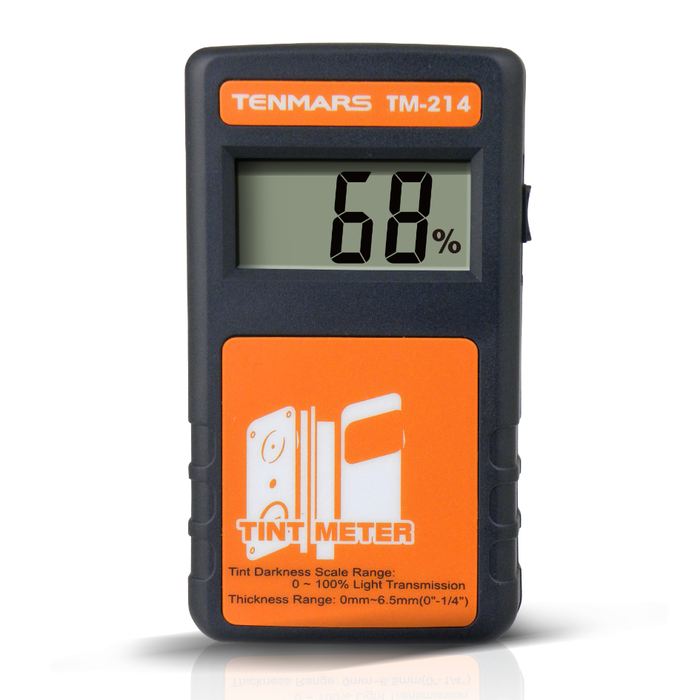
Portable models are useful when operators need quick pass/fail checks directly on installed glass or incoming material. For example, the Triplett TNM50 Tint Meter is a compact solution designed for measuring transmittance from 0 to 100% on samples up to 6.5 mm thick, with a short response time that suits field inspection and routine shop-floor verification.
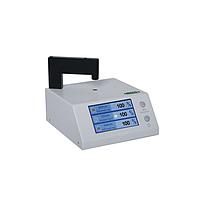
For more controlled analysis, benchtop instruments can support higher repeatability and more advanced optical assessment. The Karg haze-gard i Transparency Meter is one example of a lab-oriented device with defined measuring geometry, memory storage, and interface connectivity, making it suitable where transparency measurement must be documented more formally.
Understanding transmittance, transparency, and related optical values
Although these terms are often used together, they are not always interchangeable. Transmittance generally refers to the percentage of incident light passing through a material, while transparency measurement may involve a more specific optical evaluation under defined geometry and illuminant conditions. In some applications, users also need to assess haze because two materials can show similar transmittance while producing different visual clarity.
This is why instrument choice should reflect the actual inspection goal. If the main requirement is checking visible light passage through tinted glass, a straightforward transmittance meter may be enough. If visual appearance, scattering, or optical quality must be characterized in more detail, the test setup may need to be expanded with other optical instruments such as color sensors or complementary transparency analysis equipment.
Examples of instruments in this category ecosystem
This category includes direct transmittance measurement solutions as well as instruments that support broader optical measurement environments. The Triplett TNM50 is oriented toward practical tint and transmission checks, while the Karg haze-gard i fits applications where transparency readings are part of a more structured quality process.
For users working in optical labs, photometric integration, or detector-based measurement systems, the Gigahertz-Optik range provides additional context. Models such as the P-9710-1, P-9710-2, and P-9710-4 high-end optometers, the P-9802 multi-channel light meter, the X1-RM rack-mount meter, and the TR-9600-2 time data logger optometer are not simple window tint meters, but they are relevant in advanced optical setups where detector signals, pulse behavior, multi-channel measurement, or system integration are required.
Similarly, devices like the PLL-1701 linear signal amplifier and the P-9801-V01, P-9801-V02, and P-9801-V03 high class current amplifiers serve a supporting role in detector-based optical measurement chains. They are especially relevant when the application extends beyond standalone transmission testing into signal conditioning, data acquisition, and synchronized measurement environments.
How to choose the right model for your application
Start with the material and test location. For installed glazing, automotive tint, or quick production checks, a handheld meter with simple operation is usually the most practical option. For lab work on films, sheets, and transparent components, a benchtop platform may be the better fit because it provides more controlled measurement conditions and better data management.
Next, define the level of reporting you need. If the task is basic acceptance testing, clear digital readings and good repeatability may be enough. If the results will support validation, comparative material studies, or multi-parameter optical testing, then interface options, stored readings, and compatibility with a larger optical measurement workflow become more important. In some environments, this may also connect naturally with adjacent tools such as a UV meter for broader spectral evaluation.
Why measurement consistency matters
In B2B settings, one of the main challenges is not only obtaining a reading but obtaining a reading that is repeatable across operators, batches, and test locations. A consistent transmittance measurement process helps reduce disputes in incoming inspection, improves comparability between production lots, and supports clearer technical communication between suppliers and end users.
That is particularly important for applications involving coated glass, tinted films, transparent polymers, and optical components where small differences in light passage can affect usability or acceptance. Choosing the right instrument, using the correct sample positioning, and aligning the meter with the actual inspection requirement are all part of achieving dependable results.
Find a suitable Visible Light Transmittance Meter for your process
This category brings together instruments for checking how visible light passes through transparent materials, from straightforward portable tint meters to more advanced optical measurement solutions. Whether the priority is fast field inspection, quality control in production, or more structured lab evaluation, the right choice depends on sample type, measurement method, and required documentation level.
By comparing application needs with instrument format, repeatability, interfaces, and supporting optical workflow requirements, buyers can narrow the shortlist more efficiently and select a Visible Light Transmittance Meter that fits real operating conditions rather than specifications alone.
Get exclusive volume discounts, bulk pricing updates, and new product alerts delivered directly to your inbox.
By subscribing, you agree to our Terms of Service and Privacy Policy.
Direct access to our certified experts