Accelerator Cards
When edge inference, vision processing, or AI-assisted workloads start to outgrow the CPU budget of an embedded system, adding dedicated acceleration hardware becomes a practical next step. Accelerator Cards help offload compute-intensive tasks, improve responsiveness, and support compact system designs where performance-per-watt matters as much as raw throughput.
In embedded and industrial environments, these modules are often selected for applications such as machine vision, object detection, intelligent video analytics, robotics, and localized AI processing. The category brings together PCIe-based acceleration options in compact form factors that can be integrated into embedded computers, industrial PCs, and custom platforms without redesigning the full system architecture.
Where accelerator cards fit in embedded system design
Unlike general-purpose processors, accelerator hardware is built to handle specific compute patterns more efficiently. In practice, that means lower latency for inference tasks, better energy efficiency, and the ability to run AI or signal-processing functions closer to the data source instead of pushing everything to a server or cloud environment.
For embedded developers, this is especially useful when system size, thermal limits, and interface compatibility are constrained. Many products in this category use familiar interfaces such as PCIe and compact standards like M.2 or mPCIe, making them easier to integrate into existing platforms alongside related communication modules or software stacks used in embedded deployments.
Common form factors and interface options
A major selection factor is the physical and electrical interface. In this category, examples include mPCIe modules and several M.2 variants such as key A+E, key B+M, and key M. These formats are widely used in embedded computing because they support compact layouts while still providing access to PCIe bandwidth for high-speed data transfer.
For example, the Hailo HMP1RB1C2GA and HMP1RB1C2GAE use an mPCIe full-mini format, while modules such as HM218B1C2KA, HM218B1C2KAE, HM218B1C2LA, and HM218B1C2FA move into M.2-based implementations with different lane configurations. This matters because available PCIe lanes, board space, and host connector type will directly influence which card can be used without mechanical or platform-level changes.
Representative products in this category
Several listed products illustrate how this category serves different integration scenarios. Hailo modules are prominent examples for embedded AI acceleration, with options spanning mPCIe and M.2 designs as well as commercial and extended-temperature variants. Models such as HM218B1C2FA and HM218B1C2FAE are aimed at systems that can support larger M.2 modules and higher PCIe lane counts, while HM218B1C2KAE and HM218B1C2KB suit more compact A+E keyed implementations.
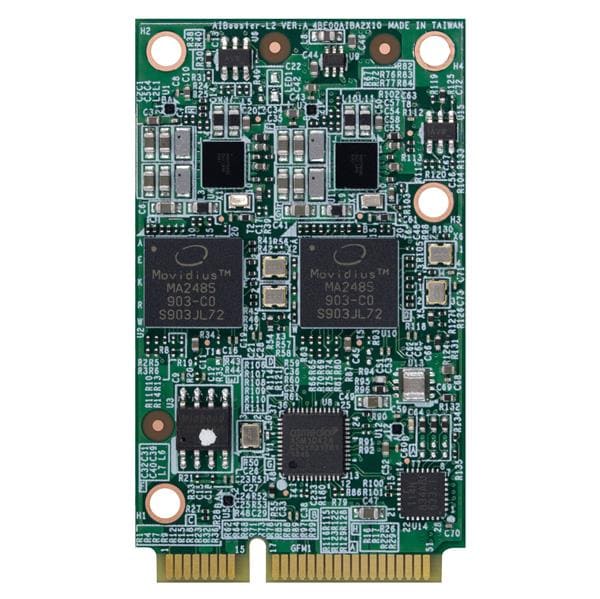
There are also alternatives that reflect different accelerator architectures. The NexCOBOT 10E000AIB04X0 is an mPCIe accelerator card based on dual Intel Movidius Myriad X VPU, while the Coral G313-06329-00 is built around an Edge TPU approach. These examples show that accelerator selection is not only about size and connector type, but also about matching the card architecture to the target inference framework, workload profile, and deployment environment.
How to choose the right accelerator card
The most effective way to narrow down options is to start with the host system. Check the available slot type, supported PCIe lanes, mechanical clearance, thermal design, and operating temperature requirements. A module that fits electrically but not thermally, or physically fits but uses the wrong keying, can create unnecessary integration delays.
Next, align the card with the software and workload. Some systems need compact inference acceleration at the edge, while others require broader I/O access or compatibility with a larger embedded AI stack. If your project also depends on middleware, drivers, or development tools, it can help to review related embedded software resources early in the design cycle rather than treating hardware and software as separate decisions.
Temperature range, power, and deployment conditions
In industrial and semi-industrial installations, environmental suitability can be as important as compute capability. This category includes both standard commercial temperature options and extended-temperature models rated from -40 to 85 °C. That distinction is important for outdoor cabinets, transportation systems, factory equipment, or edge devices exposed to wider ambient variation.
Power and thermal behavior also deserve attention in compact systems. Several listed modules are designed for relatively low power dissipation, which supports fanless or space-constrained designs, but the full system still needs proper thermal planning. Enclosure airflow, neighboring components, and sustained inference load can all affect long-term reliability, especially in 24/7 deployments.
Accelerator cards versus other acceleration approaches
Some projects benefit more from pluggable modules than from larger add-in cards or fully custom AI hardware. Compact accelerator modules are often a strong choice when designers want to preserve the base embedded platform and add dedicated processing through an existing PCIe-connected slot. This can shorten development time and simplify future upgrades.
At the same time, if your application requires a different physical format, broader expansion capability, or a more traditional card-based implementation, it may be worth comparing this category with related acceleration hardware options already used in embedded systems. The right choice usually depends on available space, serviceability, and how tightly the accelerator must be integrated into the overall platform.
Typical use cases in industrial and embedded applications
AI inference at the edge is one of the most common reasons to deploy accelerator cards. Typical examples include smart cameras, automated inspection stations, people or object counting, machine condition monitoring, and robotics subsystems that need fast local decision-making without relying on cloud processing.
These modules can also support system designers building proof-of-concept platforms or scaling an existing application to production hardware. In those cases, compact PCIe-connected acceleration helps bridge the gap between algorithm development and deployable embedded solutions, especially when paired with suitable I/O, networking, and control hardware.
What to review before ordering
Before selecting a part, it is worth verifying five basics: form factor, host interface, operating temperature, mechanical dimensions, and expected software compatibility. These checks often determine whether deployment is straightforward or whether additional adaptation work will be needed.
If you are comparing models such as mPCIe-based HMP1RB1C2GAE versus M.2-based HM218B1C2KAE or HM218B1C2FAE, think beyond the connector alone. Lane count, card length, enclosure layout, and the surrounding embedded ecosystem can all shape the final decision. For projects that also involve conversion and sensor-related data paths, related data conversion modules may also be relevant during system planning.
Choosing an accelerator module is ultimately about balancing compute needs with integration reality. This category is most useful when you need compact, PCIe-connected acceleration for embedded or industrial platforms and want options across different form factors, temperature ranges, and AI hardware approaches. A careful review of interface, environment, and software fit will make it much easier to identify the right accelerator card for a stable long-term design.
Get exclusive volume discounts, bulk pricing updates, and new product alerts delivered directly to your inbox.
By subscribing, you agree to our Terms of Service and Privacy Policy.
Direct access to our certified experts