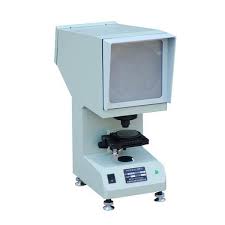
Screen diameter: 180mm
Work table size
+Square table size: 110×125mm
+Diameter of round table: 90mm
+Table glass diameter: 70mm
Work table travel:
+lengthways: ±10mm
+crosswise: ±10mm
+go up and down: ±12 mm (no scale)
Swivel range of the table: 0~360°(no scale)
Instrument magnification rate: 50x
Magnification of objective lens: 2.5x
Projection objective magnification rate: 20x
Light source(halogen tungsten lamp): 12V 100W
Power: 220V 50Hz
Overall dimensions: 515×224×603mm(L×W×H)
Weight: about 18kg
Brief introduction of main uses and functions:
The CST-50 type Charpy projector is designed to meet the requirements of GB/T229-1994 for metal Charpy impact testing. It is specifically developed to assess the quality of V-type and U-type gaps in impact test specimens. This optical instrument utilizes projection methods to magnify the contours of the V and U gaps on the test samples by 50 times, projecting them onto a screen. By comparing the projected gaps with standard models, it determines whether the tested samples meet the required gap standards. Its advantages include ease of operation and intuitive comparison.
Working principle:
The projector's light source emits light, which is directed through a condenser onto the object being measured. The magnified outline of the object is then projected onto a screen using an objective lens. With the instrument set for single projection as needed, the light passes through a series of optical elements to illuminate the worktable. Through further optical transformations, the notch outline of the tested sample is clearly projected onto the screen. This process results in a positive image that accurately reflects the position of the actual sample on the projection screen.