Pearlescent paint creates a changing visual effect that can vary with the viewing angle. This makes color evaluation more involved than it is for a conventional solid-color coating. In applications such as automotive finishes, electronics housings, and high-end furniture, teams need a way to assess not only an apparent color at one position, but also the way the finish changes across relevant angles.
Why pearlescent paint requires multi-angle measurement
Pearlescent coatings can contain mica flakes that influence reflected light. As the observation angle changes, the finish may show changes in color and appearance. A single-angle colorimeter may not capture this full effect, which can complicate production color checks and touch-up paint matching.
Multi-angle spectrophotometers are intended to collect spectral information at multiple measurement geometries. The resulting data can be expressed using color metrics such as CIE Lab and LCh, helping teams move from visual comparison toward measurable color information. For pearlescent finishes, a practical measurement approach should consider angle coverage, consistent results between readings and instruments, and suitability for the actual part geometry and work environment.
CHN SPEC multi-angle spectrophotometer capabilities
The CHN SPEC MC series is positioned for portable multi-angle color measurement across basic inspection, advanced color management, and higher-demand research and quality-control work. According to the available product information, the series uses blue-enhanced full-spectrum LED sources, concave gratings, and dual-array CMOS sensors. The stated spectral range is 400–700 nm, with a 10 nm wavelength interval.
For applicable models, the source describes Bluetooth and USB connectivity, rechargeable battery operation, and support for color-space conversions. These features can be relevant when measurements are performed on production floors, vehicle surfaces, or shaped components rather than only in a laboratory. Certain higher-end configurations are also described as supporting analysis of sparkle and graininess, adding texture-related information to color evaluation.
Choosing among MC03, MC06, and MC12
MC03 for fundamental pearlescent paint checks
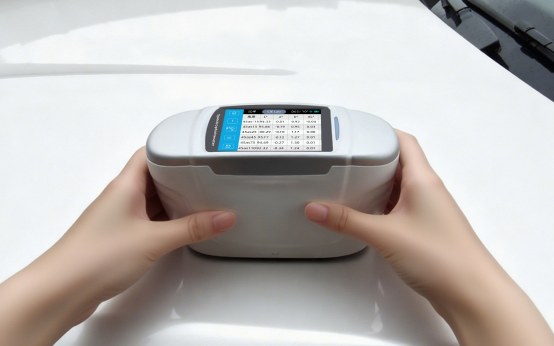
MC03 is presented as an option for basic scenarios, including small and medium coating factories and paint matching. It has three measurement angles and a 45° receiver. The source states a 2.5-second measurement time and output of parameters including Lab* and ΔE. Its pressure-contact design is intended to help the instrument fit curved painted surfaces. Bluetooth connectivity and battery operation support mobile sampling needs.
MC06 for expanded color-travel assessment
MC06 increases the measurement configuration to six angles. It is intended for more advanced management of mid- to high-end pearlescent paints, where color travel at different perspectives is an important consideration. The available information cites integrating-sphere diffuse-angle detection technology and an inter-instrument agreement value of ≤0.2. It also identifies use cases such as automotive-part inspection, coating formulation optimization, and irregular workpieces including cosmetic packaging.
MC12 for demanding R&D and quality inspection
MC12 is the series’ flagship model in the supplied information. It uses seven light sources and dual receivers to provide measurement at 12 key angles, stated to span from 45as-15° to 15as80°. The model is intended for automotive OEM exterior-part inspection and high-end pearlescent paint research and development. Listed functions include sparkle and color-sparkle quantification, eight color spaces, more than 10 color-difference formulas, and a built-in color camera preview and positioning function.
Building a consistent color-control workflow
Instrument selection should begin with the finish being evaluated and the decisions measurement data must support. Basic color-difference control may require a different approach from formulation development, multi-site production monitoring, or strict appearance verification. Teams should also account for part shape, the angles that matter to final appearance, and how measurement records will be managed.
Within the CHN SPEC MC series, MC03, MC06, and MC12 provide progressively broader angle coverage and functions for pearlescent paint measurement. Using a structured multi-angle workflow can help manufacturers compare finishes more consistently and make color-control decisions using repeatable measurement data.