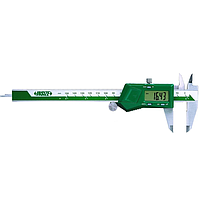
Digital Caliper
Accurate dimensional checks often need to happen quickly, directly at the machine, on incoming parts, or during final inspection. In those situations, a Digital Caliper is a practical measuring tool because it combines familiar caliper versatility with a clear electronic display, making routine measurement faster and easier to read.
On this page, you can explore digital calipers used for measuring outside dimensions, inside dimensions, and depth across a wide range of industrial and workshop applications. This category includes standard handheld models for general mechanical work as well as longer-range and more specialized versions for larger parts or specific measuring tasks.
Where digital calipers are commonly used
Digital calipers are widely used in machining, fabrication, maintenance, quality control, tool rooms, educational workshops, and general industrial measurement. They are suitable when operators need a fast check of shaft diameters, plate thickness, slot width, internal bore size, or depth without moving to a more complex measuring station.
Compared with purely mechanical reading methods, the digital display helps reduce reading errors and supports quicker checks during repetitive work. For buyers comparing different caliper types, it may also be useful to review vernier calipers or a dial caliper depending on operator preference and measurement environment.
Typical construction and measuring functions
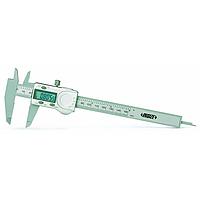
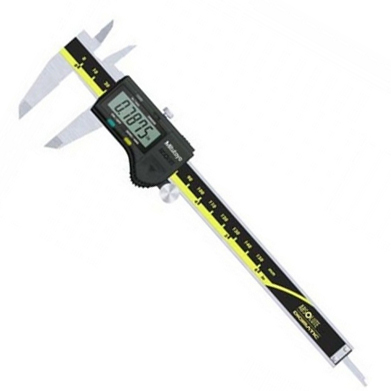
A digital caliper usually includes outside measuring jaws, inside measuring jaws, a slider, a beam, a locking mechanism, and a depth rod. This layout allows one tool to handle several common dimensional checks, which is why digital calipers remain a standard choice in many workshops and inspection areas.
In day-to-day use, the same instrument can measure external size, internal diameter, step dimensions, and depth. Many models in this category also feature mm/inch reading, and some examples include a friction wheel for smoother controlled movement during measurement.
How to choose the right measuring range
One of the first selection points is measuring range. For general engineering work, 0-150 mm and 0-200 mm models are common because they cover many routine parts while remaining compact and easy to handle. When larger components need to be checked, 0-300 mm and extended-range calipers become more suitable.
Examples in this category reflect that range of needs. Mahr offers models such as the Mahr 4103013 for 0-150 mm work and the Mahr 4103206 for 0-200 mm measurement, while MOORE & WRIGHT also appears with longer-range options including 0-300 mm and even large carbon fibre calipers for 0-600 mm, 0-1000 mm, and 0-1500 mm applications.
Resolution, accuracy, and practical buying considerations
In industrial purchasing, it is important to separate resolution from actual measurement accuracy. Many digital calipers display in 0.01 mm or 0.0005 inch increments, which is well suited to general dimensional inspection, setup checks, and workshop measurement. However, the acceptable error limit still depends on the instrument design, measuring range, and intended use.
Several products shown here follow this common resolution level, including Mahr and MOORE & WRIGHT models with 0.01 mm / 0.0005 inch readability. For standard workshop checks, that is often appropriate. If the application involves a very specific geometry rather than general inside/outside measurement, users may also need to look at more specialized tools such as diameter measurement calipers.
Representative brands and product examples in this category
This category includes products from established measuring tool manufacturers such as Mahr, MOORE & WRIGHT, Proskit, and Kroeplin. Each brand serves slightly different use cases, from standard shop-floor calipers to specialized external digital measuring instruments.
For example, the Mahr 4103303, 4103305, and 4103307 cover 150 mm, 200 mm, and 300 mm ranges respectively, with friction wheel operation and common digital resolution for routine precision work. Proskit PD-151 provides a compact 150 mm electronic caliper format for general metric and inch measurement, while Kroeplin K1R10 is a more application-specific external digital caliper intended for tube wall thickness measurement rather than general-purpose jaw measurement.
Features that can matter in daily operation
Beyond range and display, practical design details affect usability. A friction wheel can help the operator move the slider more smoothly, especially when checking multiple parts in sequence. A rectangular depth rod may be useful for depth measurement tasks where stable contact matters.
Power supply is another simple but important point. Some models here use CR2032 batteries, while others use LR44 or AAA batteries depending on the product design. In B2B environments with multiple instruments in service, standardized battery handling can make routine maintenance easier.
Matching the caliper to the application
For general fabrication, maintenance, and incoming inspection, a standard 150 mm or 200 mm digital caliper is often the most practical choice. It covers the majority of routine tasks while remaining lightweight and convenient for technicians who need a reliable all-purpose measuring tool.
For larger workpieces, frame structures, or longer dimensions, a 300 mm or larger model may be necessary. Where the job involves unusual geometry, limited access, or a dedicated inspection point, a specialized digital caliper design can be more suitable than a standard handheld version. Selection should always be based on part size, required tolerance, measurement frequency, and working conditions.
Choosing with confidence
A good digital caliper should fit the actual measurement task rather than simply offering the widest range or the most features. For many buyers, the right decision comes down to balancing range, readability, handling comfort, and application type across production, maintenance, or inspection workflows.
Whether you need a compact general-purpose model, a longer-range instrument, or a more specialized external measuring solution, this category provides a structured starting point for comparing options from recognized manufacturers and selecting a tool that matches your measurement process.
Get exclusive volume discounts, bulk pricing updates, and new product alerts delivered directly to your inbox.
By subscribing, you agree to our Terms of Service and Privacy Policy.
Direct access to our certified experts