
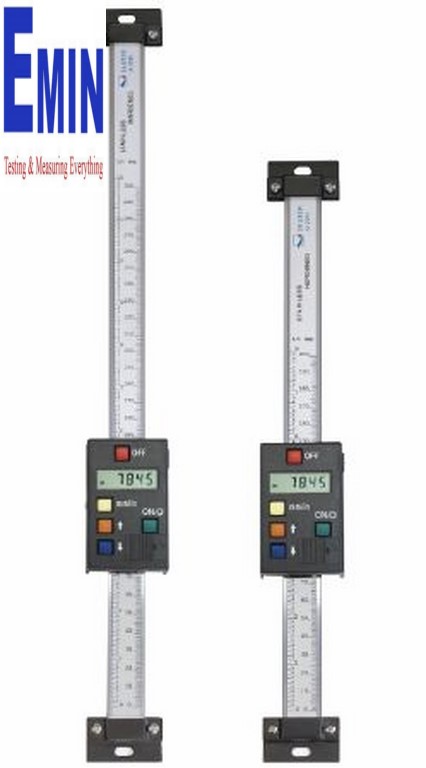
Digital length gauge
Accurate linear measurement is a basic requirement in machining, assembly, fixture setup, and dimensional inspection. When the task calls for fast digital readout, stable repeatability, and easier data interpretation than purely mechanical scales, a digital length gauge becomes a practical choice for both shop-floor use and integration into measuring systems.
This category brings together instruments and related components used to detect, display, or extend linear measurement signals in industrial environments. Depending on the application, that may mean a standalone gauge sensor, a linear scale for machine positioning, a display unit for digital measurement input, or supporting accessories that help build a complete measurement setup.
Where digital length gauges are used
In production and maintenance environments, linear measurement is often needed not only for final inspection but also for in-process control. Digital gauges are commonly used to monitor displacement, travel, height variation, part positioning, and dimensional consistency during machining, assembly, and quality checks.
These devices are relevant across machine tools, jig and fixture systems, automated stations, and laboratory measurement benches. In some workflows, they complement other tools such as dial indicators for comparative checks, while in others they work alongside callipers for general dimensional verification.
Typical product types in this category
The category covers more than one format of measurement device. A digital length gauge may refer to a linear gauge sensor that converts displacement into an electrical signal, a linear scale mounted on equipment to track movement, or a display and counter unit that receives digital input from a connected measuring head.
For example, the Onosokki GS series includes gauge sensors for different measuring ranges and installation needs. Models such as the Onosokki GS-7710A pencil type linear gauge sensor are suited to compact arrangements, while versions like the GS-4830A, GS-5051A, and GS-5101A address longer travel requirements. On the system side, the MITUTOYO AT113-250 Linear Scale and MITUTOYO 542-007 Display Unit EC Counter illustrate how sensing and display components can be combined in a broader measurement solution.
What to consider when selecting a digital length gauge
The right choice depends first on the required measuring range and resolution. Short-stroke applications such as small displacement checks may benefit from a compact sensor, while machine-axis or fixture travel monitoring may need a longer measuring span. Resolution should match the level of control required in the process, but it should also be considered together with system stability and actual operating conditions.
Installation constraints are equally important. Mounting orientation, stem diameter, contact point format, cable routing, and available space can all affect which gauge is practical. If the measurement point is exposed to coolant, dust, or oil mist, protection level also matters. Some Onosokki models in this category are designed with ingress protection features that make them more suitable for demanding industrial environments.
Another key factor is signal compatibility. A sensor may need to connect to a dedicated display, controller, or data acquisition unit. In that context, products such as the MITUTOYO 542-007 Display Unit EC Counter and MITUTOYO 09AAA033A Extension Cable show the importance of selecting not only the measuring head but also the correct supporting interface and connection accessories.
Examples from leading manufacturers
MITUTOYO is well known for precision measurement equipment and offers relevant components in this category, including linear scales, display units, and accessories for system expansion. The AT113-250 Linear Scale is an example of a dedicated linear measurement element, while the 542-007 display unit supports reading and handling digital measurement input from compatible devices.
Onosokki is strongly represented in applications where a robust displacement sensor is needed. The GS-7710A pencil type linear gauge sensor offers a compact form for constrained spaces, while the GS-5050A, GS-5051A, GS-5100A, and GS-5101A provide options across different ranges and resolutions. For buyers comparing compact handheld or benchtop dimensional tools, brands such as VOGEL and MOORE & WRIGHT also appear in the wider measurement landscape shown by products like the VOGEL BC.12115 Digital Micrometer and the MOORE & WRIGHT MW522-01 Digital Combination Set.
How these devices fit into a measurement system
A digital length gauge is often only one part of the complete setup. In practical use, the sensor, scale, cable, counter, mounting hardware, and software or display logic must work together. That is especially true in production lines where measurement data may be used for pass/fail judgement, machine compensation, or process monitoring rather than simple manual reading.
This is why system planning matters as much as the nominal specification of the sensor itself. A high-resolution gauge will not deliver useful results if it is poorly mounted, connected to an incompatible reader, or exposed to vibration beyond what the installation can manage. For applications focused on wall thickness or material section checks, a dedicated thickness meter may be more appropriate than a general linear gauge.
Standalone inspection versus machine integration
Some buyers need a digital length gauge for direct inspection at a bench or on a fixture, while others are selecting components for installation on machine tools or semi-automatic equipment. These are related but different use cases. Standalone inspection places greater emphasis on operator visibility, ease of zero setting, and straightforward handling. Integrated systems place more emphasis on signal stability, repeatability, mounting geometry, and communication with other equipment.
The existing product mix in this category reflects that distinction. A display-oriented unit such as the Samyon DN-2 Multi-purpose Digital Display supports visible numeric reading, while linear scales and gauge sensors are better aligned with embedded measurement or machine-mounted feedback tasks. Matching the product type to the workflow is usually more important than choosing purely by range or resolution alone.
Practical buying guidance for B2B users
For engineering, maintenance, and purchasing teams, the most efficient way to shortlist products is to start with the measurement task itself: what motion needs to be measured, over what distance, at what repeatability level, and under what environmental conditions. From there, it becomes easier to decide whether you need a compact probe-style gauge, a longer linear scale, a compatible display unit, or an accessory such as an extension cable.
It is also worth reviewing whether the application overlaps with other measuring methods already in use. In some inspection routines, a micrometer category product may be better for direct outside dimension checks, while digital length gauges are more effective for displacement, travel, or comparative measurement inside a fixture or machine setup.
Choosing the right category for your application
This selection is most useful for users who need digital displacement or length measurement in an industrial context, especially where readable output, repeatable positioning, or system integration is important. The available products span sensors, scales, display hardware, and accessories, making the category suitable for both replacement needs and new measurement setups.
If you are comparing options, focus on measuring range, resolution, installation method, environmental suitability, and interface compatibility as a complete package. A well-matched digital length gauge can improve measurement consistency, simplify operator workflow, and support more reliable dimensional control across production and inspection tasks.
Get exclusive volume discounts, bulk pricing updates, and new product alerts delivered directly to your inbox.
By subscribing, you agree to our Terms of Service and Privacy Policy.
Direct access to our certified experts
