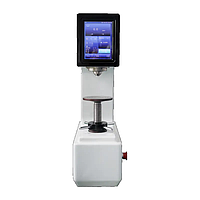
Rockwell Hardness tester
When repeatable hardness control matters in production, incoming inspection, or laboratory testing, the Rockwell method remains one of the most practical choices. It is widely used because results are obtained quickly, the procedure is standardized, and the measured value is easy to compare across materials, batches, and production stages.
Rockwell Hardness testers are designed to evaluate a material’s resistance to indentation by applying a minor load followed by a major load, then converting indentation depth into a hardness value. In day-to-day industrial work, this makes the method especially useful for steel, hardened parts, cast materials, non-ferrous alloys, and many routine quality control tasks.

How the Rockwell method fits industrial testing
The Rockwell test is valued for its balance of speed and simplicity. Instead of requiring optical measurement of the indentation, the tester reads hardness from the penetration depth under controlled force. That helps reduce operator dependency and supports faster decision-making on the shop floor.
Different scales such as HRA, HRB, and HRC are used depending on the indenter and test force. In practical terms, this allows one testing principle to cover a wide range of materials, from softer metals to hardened steels. For applications that need other portable or field-oriented approaches, users may also compare options such as an ultrasonic hardness tester or Leeb and handheld hardness meters.
Why Rockwell testers are widely used
A major advantage of this category is fast routine testing. In manufacturing environments where many samples must be checked each shift, Rockwell equipment helps verify process consistency without slowing production. This is particularly relevant for heat-treated parts, machined components, forged pieces, and incoming raw materials.
Another benefit is the broad availability of scales and fixtures. Many systems support common Rockwell ranges and use either a diamond cone indenter or ball indenter depending on the material. As a result, the same tester can often support multiple quality tasks, from basic acceptance checks to more formal laboratory reporting.
Common types of Rockwell Hardness testers
This category typically includes manual, digital, and automatic systems. Manual models are often preferred where testing frequency is moderate and simplicity is important. They are commonly used in workshops, training environments, and quality control stations that do not require advanced data handling.
Digital and automatic models are better suited to higher throughput and traceability. Features such as touchscreen displays, dwell time setting, built-in printers, and communication interfaces can help standardize operation and simplify record keeping. In some cases, users who need wider scale coverage may also evaluate a universal hardness tester for broader material testing requirements.
Representative products in this category
Several product lines illustrate how this category serves different working environments. The NOVOTEST range includes models such as the NOVOTEST TS-R and NOVOTEST TS-R-C2, which reflect the classic bench-top Rockwell format for standard hardness control. For users needing additional scale flexibility, the NOVOTEST TS-SR-C2 extends into superficial Rockwell testing alongside conventional Rockwell scales.
Other examples include the METROLOGY RHT-9000M manual tester for straightforward mechanical operation, the KMT KHRS-150 digital model for electronic readout and output functions, and the Trojan HRS-150ZD automatic system for more automated testing workflows. In established laboratory and industrial environments, MITUTOYO models such as the HR-300 and HR-320MR-PK1 are also relevant examples within the broader Rockwell ecosystem, along with accessories like the MITUTOYO 19BAA073 diamond indenter.
What to consider when choosing a tester
The first point is the material range and hardness scale you need to cover. HRC is common for hardened steels, while HRB and other scales may be more appropriate for softer metals or different alloy groups. It is important to match the indenter type, force range, and scale availability to the actual parts being tested rather than choosing by display type alone.
Sample size also matters. Maximum specimen height, throat depth, and available anvils affect whether the machine can handle the geometry of your workpieces. Flat samples are straightforward, but cylindrical or irregular parts may require V-anvils or specific fixtures. If your process needs consistent verification over time, using suitable standard blocks for hardness tester calibration and routine checks is equally important.
Finally, consider how the data will be used. For basic workshop testing, an analog or simple digital unit may be sufficient. For audited production, traceability, or lab documentation, functions such as printer output, RS-232 communication, memory, and statistical review can be much more valuable than the basic hardness reading alone.
Accessories and supporting components
A Rockwell testing setup is more than the main frame. Indenters, anvils, test blocks, protective covers, and output accessories all contribute to repeatable performance. This is especially relevant when replacing wear items or maintaining consistency across multiple test stations.
For example, a dedicated component such as the MITUTOYO 19BAA073 diamond indenter plays a supporting but essential role in the measurement chain. Likewise, hardness blocks supplied with many systems are necessary for verification and day-to-day confidence in results. Selecting the right accessory set can make operation more stable and reduce avoidable variation in readings.
Typical application environments
Rockwell Hardness testers are commonly found in machine shops, heat treatment facilities, metallurgical labs, tool rooms, and incoming inspection departments. Their role is not limited to final inspection; they are also useful during process setup, production monitoring, and comparison of material conditions before and after treatment.
Because the method is well established and efficient, it is often chosen where operators need quick, standardized hardness data without a complex testing sequence. Whether the priority is routine production control or more formal reporting, the category offers options ranging from robust manual units to digital and automated systems with expanded functionality.
Final thoughts
Choosing the right Rockwell solution depends on the materials you test, the scales you use most often, the size of your samples, and how much documentation your workflow requires. A simpler manual machine can be effective for stable routine checks, while digital or automatic models are often more suitable for traceability, higher throughput, and broader testing coverage.
By comparing tester type, supported scales, fixture compatibility, and verification needs, it becomes easier to select equipment that fits real production conditions. This category brings together practical options for users who need dependable hardness measurement as part of a consistent quality control process.
Get exclusive volume discounts, bulk pricing updates, and new product alerts delivered directly to your inbox.
By subscribing, you agree to our Terms of Service and Privacy Policy.
Direct access to our certified experts