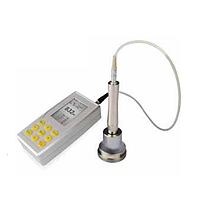
Ultrasonic hardness tester
When hardness needs to be checked directly on finished parts, large components, or surfaces that are difficult to move to a bench tester, a portable solution becomes much more practical. Ultrasonic hardness tester models are widely used for fast verification in production, maintenance, incoming inspection, and field service, especially where repeatable measurements and convenient handling are both important.
Compared with fixed systems, this category is suited to users who need mobility without losing access to common hardness scales such as HV, HRC, and HB. It is also a useful option when testing different part geometries, verifying treated surfaces, or collecting results across multiple locations in a plant or job site.
Where ultrasonic hardness testing fits in daily inspection work
UCI hardness testing is commonly selected when users need a handheld method for checking metal hardness with good flexibility in orientation and access. In many workshops and industrial environments, it supports routine quality control on machined parts, weld zones, heat-treated areas, shafts, dies, and other components where portability matters.
This method is particularly relevant when the test object is already installed, too large to relocate, or available only for limited inspection time. For buyers comparing technologies, this category sits naturally alongside Leeb and handheld hardness meters, with each approach serving different surface and material conditions.
Key advantages of ultrasonic hardness testers
One of the main benefits of this category is the ability to perform measurements in many positions while keeping the instrument compact and easy to carry. Several products in this range support 360° measuring direction, battery operation, onboard memory, and data transfer, which helps technicians document results in the field instead of writing them down manually.
Another advantage is broad scale conversion. Depending on the model, users may work with values in Vickers, Rockwell, Brinell, and sometimes tensile strength units, making the devices useful in mixed inspection workflows. This is important for manufacturers and maintenance teams who need quick interpretation of results without changing instruments for every hardness scale.
Typical product options in this category
The category includes a range of portable testers from brands such as NOVOTEST, MOORE & WRIGHT, and PCE. For example, the NOVOTEST T-U3 Hardness Tester is focused on UCI probe measurement, while the NOVOTEST T-UD3 Combined Hardness Tester adds broader flexibility by combining UCI and Leeb capability in one device. That type of option can be useful for teams handling varied materials and part sizes across different jobs.
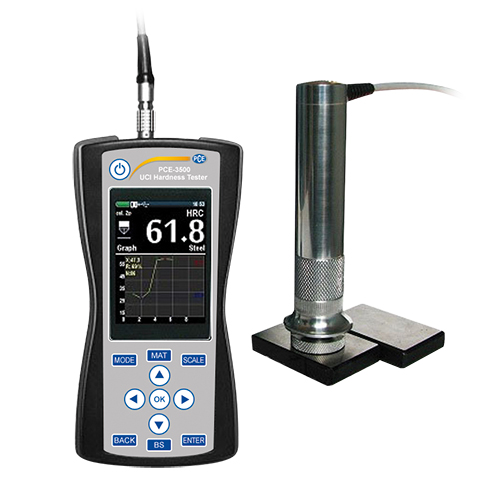
For users looking at different probe styles and operation modes, models such as the MOORE & WRIGHT MWT-3200 Motorised Ultrasonic Hardness Tester and MWT-3250 Manual Ultrasonic Hardness Tester illustrate how selection can depend on preferred test handling, reporting needs, and the hardness scales used in daily work. PCE options such as the PCE 3500 or PCE 5000 UCI Hardness Tester are also relevant for buyers prioritizing portable measurement with data storage and standard field functions.
What to consider before choosing a model
The first point is the required test load and probe type. Some applications benefit from lighter or heavier UCI probe loads depending on part size, surface condition, and the hardness range being evaluated. If your workflow involves only UCI measurement on suitable metallic materials, a dedicated ultrasonic tester may be the most direct choice. If inspection conditions change frequently, a combined device may be easier to integrate into the wider process.
The second point is the measurement range and output scales you actually need. Not every team uses the same units in production records or customer reports, so it helps to confirm whether the instrument supports HRC, HB, HV, HRB, HRA, MPa, or additional scales that are relevant to your specifications. Data handling is also worth reviewing, especially if your team wants USB export, SD card storage, cloud synchronization, or connection to mobile devices.
Material compatibility should also be checked carefully. Many portable UCI models are pre-calibrated for steel, while some support additional materials or user calibration. If your inspection program includes stainless steel, brass, aluminum, copper alloys, cast materials, or multiple heat-treatment states, that requirement should be matched early in the selection process rather than after purchase.
Applications across manufacturing, maintenance, and QA
In production environments, ultrasonic hardness testers are often used for in-process verification after heat treatment, machining, or finishing. They help confirm whether a part falls within specification before it moves to the next stage, reducing rework and supporting faster release of inspected batches.
In maintenance and asset integrity work, portable hardness measurement is valuable when checking installed equipment, heavy components, or locations where conventional bench testing is not practical. This can include inspection of structural elements, machine parts, tools, and repaired areas where a quick hardness check contributes to service decisions.
For laboratories and quality departments, this category can also complement broader test capabilities. If you need to compare handheld UCI instruments with other methods, it may be useful to review universal hardness testers or, for fixed-scale workflows, a dedicated Rockwell hardness tester.
Why reference blocks and verification matter
Portable instruments are most useful when measurement confidence is maintained over time. Routine checking with a suitable reference piece helps confirm that the tester is operating correctly and that readings remain consistent before important inspection work begins.
That is why many buyers also consider access to standard blocks for hardness testers as part of the complete setup. Verification accessories are not just add-ons; they support traceable practice, operator confidence, and more reliable acceptance decisions in production or field inspection.
Choosing the right category for your workflow
If your priority is portable UCI measurement on metal components, this category offers a focused starting point with models designed for handheld use, multiple hardness scales, and practical data functions. Products such as the NOVOTEST UCI Wireless Hardness Tester or NOVOTEST LAB UCI PRO show how wireless connectivity and app-based workflows can support inspection teams that need faster reporting in the field.
For users who expect to alternate between UCI and rebound-based methods, a combined instrument such as the NOVOTEST T-UD3 may be worth comparing. The right choice depends less on brand count or feature lists alone, and more on the real testing environment: material type, part geometry, required scale, reporting process, and how often the instrument will be used away from the lab.
Final notes
A well-chosen ultrasonic hardness tester can make hardness verification faster, more flexible, and easier to document across production and service tasks. By focusing on probe configuration, supported scales, material suitability, and data workflow, buyers can narrow the selection to models that fit real inspection conditions rather than generic specifications.
Whether you need a straightforward UCI unit or a more versatile portable tester for mixed applications, this category is designed to support practical hardness measurement where mobility and efficiency matter.
Get exclusive volume discounts, bulk pricing updates, and new product alerts delivered directly to your inbox.
By subscribing, you agree to our Terms of Service and Privacy Policy.
Direct access to our certified experts