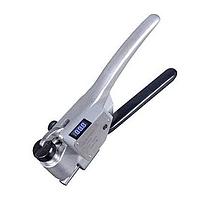
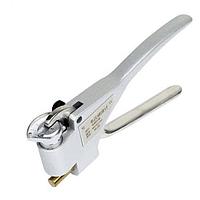
Webster Hardness tester
Portable hardness checks are often needed long before a sample can be sent to a lab. In fabrication, incoming material inspection, and on-site quality control, a compact tester helps operators verify whether aluminum alloys, brass, copper alloys, or certain steel materials fall within the expected hardness range without interrupting the workflow. That is where the Webster Hardness tester remains a practical option.
Compared with larger bench instruments, this category is especially useful when fast comparative checks, repeated field measurements, and simple mechanical operation matter more than full laboratory testing conditions. It is commonly chosen for lightweight metal sections, profiles, sheets, and parts that need convenient hardness confirmation near the production line.

Where Webster hardness testers fit in hardness measurement
A Webster tester works on an indentation-based measurement principle and is designed for portable use. In practice, it is well suited to applications where users need quick hardness evaluation on non-ferrous metals and selected steel materials, especially when mobility and simple operation are important.
This makes the category different from larger stationary systems such as a Rockwell hardness tester, which is generally preferred for more controlled bench testing. For field work or checks on installed parts, however, a Webster format can be easier to carry, faster to position, and more convenient for routine inspection.
Common material groups and typical model selection logic
One of the key reasons buyers compare products in this category carefully is that different Webster models are intended for different material groups and hardness ranges. Selection is not only about portability; it also depends on whether the test piece is aluminum alloy, soft brass, red brass, harder brass grades, or stainless steel.
For example, the Mikrosize iWeb-20, iWeb-20a, and iWeb-20b models are presented for aluminum alloy measurement, with a range shown as 25~110 HRE / 58~131 HV. For soft naval brass and red brass, the Mikrosize iWeb-BB75 and iWeb-BB75b target 18~100 HRE, while the iWeb-B75 and iWeb-B75b are intended for hard or semi-hard brass and ultra-hard aluminum alloy at 63~105 HRE. For cold-rolled steel plate and stainless steel, the iWeb-B92 is listed with a 50~92 HRB range.
Because of that, users should match the instrument to the material type and hardness scale range before ordering. Choosing the wrong version can lead to poor suitability even if the tester itself is functioning correctly.
What affects measurement accuracy in real use
Portable testing is convenient, but the reading quality still depends heavily on the sample condition. One of the most important factors is material stiffness during indentation. If the workpiece is too thin, unsupported, or easy to flex, part of the applied force can contribute to bending instead of producing a stable indentation. In that case, the result may appear lower than the true hardness.
A rigid backing plate or stacked sample arrangement can help reduce this effect when testing thin material. Surface condition also matters: oil, dirt, oxidation, or residue can interfere with indenter contact and distort the reading. In routine inspection, a clean and stable contact surface is often just as important as the tester model itself.
Users should also remember that conversion between scales is usually a reference tool rather than an absolute replacement for controlled laboratory testing. If traceability or formal certification is required, it may be more appropriate to compare options in the universal hardness tester category or use a lab-grade method.
Practical operating habits for more consistent results
Even a well-matched instrument can produce scattered readings if the test method is inconsistent. The tester should be positioned correctly, the contact should be stable, and the operating force should be applied in a repeatable way. On irregular or poorly supported parts, variation between readings tends to increase.
It is good practice to measure at multiple points on the same part instead of relying on a single impression. This helps identify local variation in the material and provides a more realistic view of hardness consistency. Regular checks using the supplied hardness block are also important, especially in environments where the tester is used frequently across different operators or locations.
For ongoing verification, many buyers also keep a standard block for hardness tester available as part of their inspection routine. This supports day-to-day confidence in the instrument and helps detect drift before it affects production decisions.
Representative products and brand context
Within this category, Mikrosize is the main brand highlighted in the current product selection. Its lineup covers several common Webster testing needs, from aluminum alloy checks to brass, copper alloy, stainless steel, and cold-rolled steel applications.
Examples include the Mikrosize iWeb-20 series for aluminum alloy, the iWeb-BB75 series for soft naval brass and red brass, the iWeb-B75 series for harder brass and ultra-hard aluminum alloy, and the iWeb-B92 for cold-rolled steel plate and stainless steel. These products illustrate how Webster testers are often organized by application-specific geometry and hardness range rather than as one universal handheld tool for every metal.
When to choose a Webster tester over other portable hardness methods
A Webster tester is typically selected when the priority is fast, simple, on-site hardness checking on suitable metal materials. It is a strong fit for production environments that need frequent comparative testing and straightforward operator handling without moving parts back to a bench instrument.
That said, it is not always the best choice for every hardness task. If the work involves broader material types, heavier components, or a different portable testing principle, it can be useful to review the Leeb and handheld hardness meter range as well. Leeb-type devices are often considered for other field hardness scenarios where impact-based measurement is more appropriate.
Short FAQ
Can a Webster hardness tester be used on stainless steel?
Some models in this category are intended for stainless steel, such as the Mikrosize iWeb-B92 for cold-rolled steel plate and stainless steel. Compatibility should always be checked against the listed material group and hardness range.
Why do readings change on thin material?
Thin samples can deform or bend during testing, which affects indentation depth and may lower the indicated hardness. Proper backing support can improve measurement stability.
Is one reading enough for inspection?
Usually no. Taking several readings across the sample is a better practice because it reduces the risk of making a decision based on a local anomaly or unstable contact point.
Choosing the right Webster hardness tester for your workflow
The best approach is to start with the material you test most often, then confirm the matching hardness range, operating environment, and level of repeatability you need. In many workshops, a Webster tester is valued not because it replaces every hardness method, but because it provides a fast and practical way to screen parts directly where production or inspection happens.
With the right model selection, proper surface preparation, and routine checking against a reference block, this category can support reliable day-to-day hardness control for aluminum, brass, copper alloy, stainless steel, and related applications.
Get exclusive volume discounts, bulk pricing updates, and new product alerts delivered directly to your inbox.
By subscribing, you agree to our Terms of Service and Privacy Policy.
Direct access to our certified experts