Angle Gage Block
Accurate angle setting is essential in machining, inspection, tool setup, and precision measurement. When a job requires repeatable angular reference rather than estimation, Angle Gage Block products provide a practical way to build, verify, and transfer known angles in workshops, quality labs, and production environments.
In this category, users typically look for angle reference tools that help with setup consistency, fixture alignment, comparator work, and dimensional inspection. Depending on the task, that may mean a simple pair of angle standards, a multi-piece block set for flexible combinations, or a gauge designed for checking specific angular profiles and thread forms.
What angle gage blocks are used for
Angle standards are used when a technician needs a known angular value that can be relied on during setup or verification. Unlike general-purpose measuring tools used for quick reading, these items are often chosen to establish a reference angle for machines, jigs, cutting tools, sine setups, or inspection procedures.
They are especially useful in applications where repeatability matters more than speed. A known angle can be transferred to a workpiece, used to compare a finished part, or combined with other standards in a measurement workflow. In precision environments, this helps reduce setup variation and improves confidence in angular accuracy.
Common product types in this category
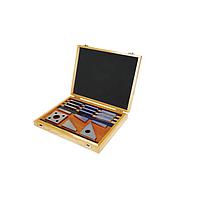
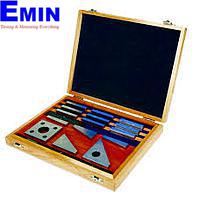
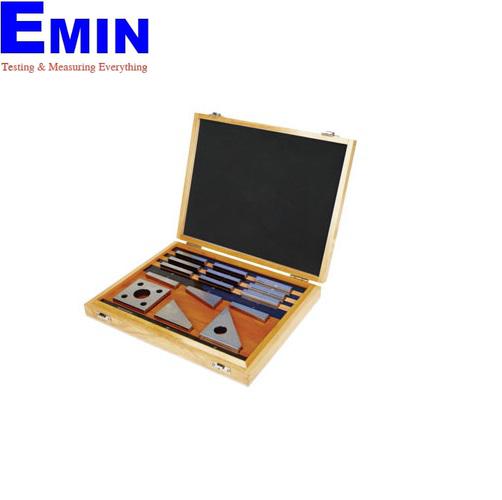
This category can include more than one style of angular reference tool. A classic example is the angle block set, where individual blocks are supplied in defined increments and can be selected to create the target angle needed for a given setup. Products such as the MITUTOYO 981-101 Angle Block Set (10 pcs/set) and MITUTOYO 981-102 Angle block set (12 pcs/set) fit this use case well, offering a structured range of preset angles for inspection and toolroom work.
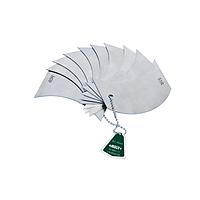
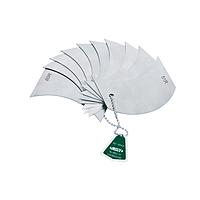
Another format is the sample corner or angle master used as a direct reference for common geometry. The MITUTOYO 981-103 Set of sample corner 2 pieces is a good example of a compact angular standard intended for checking and comparison tasks. For users dealing with profile verification rather than block building, tools such as the Niigata Seiki AG-22 ANGLE GAUGE provide a leaf-based approach to checking angles across a practical measuring range.
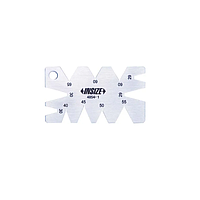
There are also task-specific gauges that support related angle and form inspection. The MOORE & WRIGHT MW200 Screw Cutting Gauges, for example, are relevant where thread cutting geometry and included angles need to be checked against common thread forms.
How to choose the right angle reference tool
The best choice depends on how the angle will be used in practice. If the goal is to create repeatable setups from standard increments, a multi-piece angle block set is typically the most flexible option. If you only need to verify a few standard corners or compare workpieces against fixed geometry, a dedicated sample corner set may be more efficient.
Range and resolution also matter. A broader set with smaller increments supports more combinations and finer setup control, while a simpler set may be sufficient for common workshop angles. Material hardness is also relevant because these tools are expected to maintain geometry during repeated handling and contact use.
Users working across several inspection tasks may also benefit from combining angular standards with other reference tools. For example, a setup involving bore or fixture verification may lead naturally to complementary tools such as pin gauges or setting rings, depending on the geometry being checked.
Representative brands and product options
This category includes products from established metrology brands such as MITUTOYO, MOORE & WRIGHT, and Niigata Seiki. Each brand appears in slightly different use cases, which is helpful for buyers comparing tools by inspection method rather than by brand name alone.
MITUTOYO is represented here by both fixed-angle references and angle block sets, which makes it relevant for users building a structured angular standard toolkit. Niigata Seiki offers a practical angle gauge format for routine checking, while MOORE & WRIGHT supports profile and thread-related inspection where angle verification is tied to cutting geometry.
For procurement teams and technical buyers, this mix is useful because it reflects real shop-floor needs: not every application needs the same type of angular reference, even when all of them fall under the same category.
Typical applications in machining and inspection
Angle gage blocks and related angular standards are commonly used in toolrooms, maintenance departments, quality control stations, and production lines. They help with machine setup, checking cutter geometry, inspecting chamfers or bevels, verifying fixture angles, and supporting comparator or bench inspection work.
They are also valuable when inspection must be consistent across shifts or operators. A physical angle reference reduces interpretation and makes it easier to train users on pass/fail comparison methods. In environments where multiple dimensional standards are used together, angle tools often work alongside pitch gages or other mechanical reference instruments to support broader inspection routines.
Why angular standards matter in a measurement system
In many manufacturing workflows, dimensional accuracy is not only about length, diameter, or height. Angular error can affect fit, cutting performance, sealing, assembly alignment, and overall part function. That is why reference-based measurement remains important even in facilities that also use digital measuring equipment.
Angle standards provide a stable baseline for checking geometry without depending solely on visual estimation or instrument interpretation. Used correctly, they improve repeatability, help standardize setups, and support better measurement discipline across routine and specialized tasks.
Selection tips for B2B purchasing
For industrial buyers, it helps to define the use case before comparing products. Consider whether the tool will be used mainly for calibration-style reference, direct part comparison, machine setup, or thread and profile inspection. That choice will narrow the range quickly and prevent overbuying or selecting a format that does not fit the workflow.
It is also useful to think about who will use the tool and how often. A metrology lab may prefer a broader set for flexibility, while a production area may benefit from simple, durable angle references for repeated checks at standard values. Reviewing the available products in this category with those practical questions in mind usually leads to a better fit than comparing by price or brand alone.
Whether you need fixed angular references, a configurable block set, or a gauge for checking specific profiles, this category brings together tools designed to support accurate and repeatable angle verification. Choosing the right option starts with the inspection method you use today and the level of consistency your process needs tomorrow.
Get exclusive volume discounts, bulk pricing updates, and new product alerts delivered directly to your inbox.
By subscribing, you agree to our Terms of Service and Privacy Policy.
Direct access to our certified experts