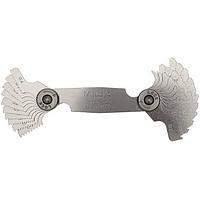
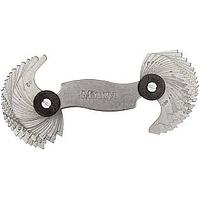
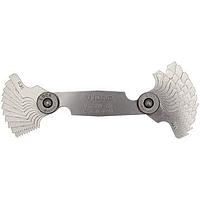
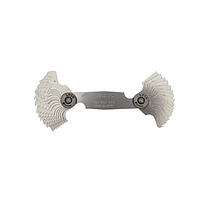
Pitch Gage
Accurate thread identification matters when inspecting machined parts, checking fasteners, or setting up cutting and repair work. A Pitch Gage is a simple but highly practical tool for comparing thread form and pitch directly on a component, helping technicians and quality teams confirm whether a thread matches the required standard before moving to the next step.
In workshop measurement, maintenance, and incoming inspection, pitch gages are often used alongside other reference tools to reduce mistakes and speed up verification. This category brings together thread pitch gages for common metric, Unified, Whitworth, and mixed applications, with options suited to both routine shop-floor use and more detailed dimensional control.

Where pitch gages are used in practice
A pitch gage is typically used to identify the spacing and profile of a thread by matching one of its leaves against the thread being checked. This is useful in maintenance environments where original documentation may be missing, in production where operators need quick thread confirmation, and in quality control when sorting parts by thread type.
These tools are commonly applied to both internal and external threads, depending on the gage design and access to the part. They are especially helpful for distinguishing between similar-looking standards, such as metric and Unified threads, or for checking whether a worn or damaged thread still corresponds to an intended form.
Common thread systems covered in this category
The selection in this category reflects the thread systems most often encountered in industrial work. Metric pitch gages are widely used for machinery, tooling, and general assembly, while Unified and American National variants remain relevant for imported equipment and legacy components. Whitworth thread forms are also important in maintenance and retrofit work involving older systems.
Several examples from MOORE & WRIGHT illustrate this range clearly. The MOORE & WRIGHT 809 Screw Pitch Gauges focus on ISO Metric threads, while the 801 version covers S.I. Metric with a broader blade count. For inch-based applications, the 806 Unified and 799 American National models support thread checking across commonly used imperial standards.
How to choose the right pitch gage
The first selection point is the thread standard you need to inspect. If your work is mainly metric, a dedicated metric set is often the most efficient choice. For mixed environments, a combination gage can be more practical because it reduces the need to switch between separate tools during troubleshooting or inspection.
The second point is the available measurement range and blade count. A wider range generally helps when handling varied parts, while a more focused set may be sufficient for repetitive production tasks. For example, the MITUTOYO 188-122 Metric Screw Pitch Gages set and Mitutoyo 188-121 set are suited to metric checking, while the Niigata Seiki M28 Metric and Unified Screw Pitch Gages Set is useful when both metric and Unified thread forms may appear in the same workflow.
If you frequently deal with multiple standards, a mixed-format tool such as the MOORE & WRIGHT 804 Screw Pitch Gauge or the VOGEL 471016 thread gage can help cover broader inspection needs. In contrast, a single-standard option like the Shinwa 73795 metric thread gage is often a straightforward choice for shops working almost entirely in metric threads.
Dedicated sets vs. mixed-thread gages
Dedicated sets are often preferred when process consistency is high. In a production line that only manufactures metric parts, a metric-only pitch gage can make checking faster and easier because the operator is not sorting through unnecessary leaves. Models such as the MITUTOYO 188-153 Metric Screw Pitch Gages and MOORE & WRIGHT 809 are good examples of this focused approach.
Mixed-thread gages are more flexible in service, repair, and aftermarket environments. When incoming parts may come from different suppliers or machine standards, a gage that supports SI Metric, Whitworth, or Unified patterns can save time and reduce the risk of misidentification. This is particularly useful for maintenance teams working across older and newer equipment in the same facility.
What to look for in daily use
In practice, usability matters just as much as range. Clear leaf markings, a durable steel body, smooth leaf edges, and a compact folding design all contribute to easier handling at the bench or on site. A well-made pitch gage should allow the user to compare thread forms quickly without excessive play or hard-to-read markings.
For broader dimensional checking, pitch gages are often part of a wider inspection setup. Depending on the task, users may also reference tools such as pin gauges for bore verification or a setting ring where comparative checking and calibration support are needed in the measurement workflow.
Representative manufacturers in this category
This category includes well-known names used in industrial metrology and workshop measurement. MITUTOYO offers metric thread pitch gage sets suited to routine inspection and machine shop applications. MOORE & WRIGHT provides a broad selection across metric, Unified, Whitworth, and American National thread forms, making it a strong fit for mixed-standard environments.
Niigata Seiki, Shinwa, and VOGEL add further options for users who need specific blade configurations or wider cross-standard coverage. Rather than choosing by brand alone, it is usually better to match the gage to your actual thread standards, frequency of use, and the variety of parts handled in your process.
Using pitch gages effectively
To use a pitch gage, the operator selects a leaf and places it against the thread until the profile matches without visible gaps. The best result comes from checking on a clean, undamaged section of the thread and confirming that both pitch spacing and thread angle align properly. This method is quick, but it still depends on careful visual comparison and good handling practice.
For more complete thread inspection, a pitch gage is often only the first step. Once the pitch is identified, additional measurement tools may be used to verify major diameter, minor diameter, or fit, depending on the application. If you need adjacent tools for thread-related comparison, you can also explore other precision reference tools used in broader mechanical measurement workflows.
Find the right pitch gage for your inspection needs
Choosing the right thread pitch gage comes down to the standards you work with, the range you need to cover, and whether your tasks are repetitive or highly varied. A dedicated metric set may be enough for consistent production, while mixed-standard sets are often more efficient for maintenance, repair, and incoming inspection.
Within this category, you can compare compact metric gages, broader multi-standard sets, and brand-specific options from established manufacturers. A suitable pitch gage helps make thread checking faster, more reliable, and easier to repeat across daily industrial measurement tasks.
Get exclusive volume discounts, bulk pricing updates, and new product alerts delivered directly to your inbox.
By subscribing, you agree to our Terms of Service and Privacy Policy.
Direct access to our certified experts