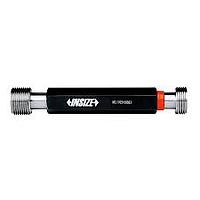
Thread Plug Gauge
In thread inspection, a quick visual check is rarely enough. When internal threads must be verified consistently on the shop floor or during final quality control, a Thread Plug Gauge provides a practical pass/fail method that helps maintain dimensional conformity without slowing down production.
This category brings together gauges used to check internal thread accuracy in machined parts, tooling components, and production batches. It is especially relevant where repeatability, operator independence, and straightforward acceptance criteria matter more than complex measurement routines.
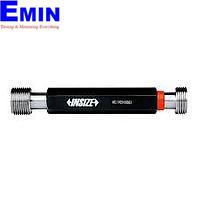
Why thread plug gauges are widely used in manufacturing
Internal threads can be difficult to evaluate reliably with general-purpose measuring tools alone. A thread plug gauge is designed to verify whether a threaded hole meets the required limit condition, making it a common solution in precision machining, component inspection, and incoming or outgoing quality control.
The main advantage is speed with consistency. Instead of relying on interpretation-heavy measurement steps, operators can confirm whether the thread accepts the GO side and rejects the NO-GO side according to the intended tolerance logic. For many industrial environments, this is an efficient way to control threaded features before assembly.
Typical applications for this category
Thread plug gauges are commonly used in workshops producing parts with internal metric threads, maintenance environments handling replacement components, and production lines where threaded holes must fit mating fasteners or assemblies correctly. They are also useful in inspection departments that need a robust method for repetitive checking across multiple parts.
Because this category focuses on internal thread verification, it fits well in processes where dimensional compliance must be checked directly at the point of manufacture. In broader inspection workflows, these gauges are often used alongside tools such as pitch gages for thread identification and related reference items for setup or validation.
How to choose the right thread plug gauge
Selecting the correct gauge starts with the thread specification of the part being checked. The nominal thread size, pitch, and tolerance class all matter, and they must match the drawing or inspection requirement. Choosing the wrong designation can lead to false rejection or acceptance, even if the gauge itself is in good condition.
It is also important to consider the inspection environment. High-frequency use in production may call for durable gauges suited to repeated handling, while a quality lab may prioritize traceability and reference management. If your workflow includes setting or checking other gauging elements, related products such as setting rings and pin gauges may also support broader dimensional control.
Representative products in this range
This category includes practical examples for different thread sizes and inspection requirements. Among them are the OJIYAS M3X0.5 6H GPNP Screw Thread Limit Pluge Gauge, the SOKUHANSHA M16x1.5 6H GPNP Screw Thread Limit Pluge Gauge, and the SOKUHANSHA M40x2 GPIP II Screw Thread Limit Pluge Gauge.
These examples show the range of thread formats and limit styles that may be encountered in actual production. Smaller sizes can be relevant in precision components, while larger thread gauges support inspection of heavier-duty parts. Rather than treating all gauges as interchangeable, buyers should align the selected item with the exact thread form required by the application.
Brands commonly associated with thread gauging
Within this category context, manufacturers such as Mahr, MITUTOYO, Niigata Seiki, ISSOKU, OJIYAS, and SOKUHANSHA are relevant reference points for buyers sourcing thread inspection tools. Different users may prioritize different factors, such as availability, familiarity with a brand standard, or compatibility with existing inspection practices.
For applications that require expansion into a wider gauging setup, it can be useful to review adjacent precision measurement brands already used in your facility. The goal is not simply to match a manufacturer name, but to build a reliable inspection process around stable, repeatable thread verification.
Good practice for use and handling
A GO/NO-GO inspection method only works properly when the gauge is clean, undamaged, and used with the correct technique. Dirt, burrs, excessive force, or worn threads on the gauge or workpiece can all affect the result. For that reason, gauges should be handled as inspection standards rather than general workshop tools.
Regular checking, careful storage, and clear separation between in-use and reference gauges help reduce avoidable inspection errors. In controlled environments, users may also combine thread plug gauges with other standard elements from the wider standards and gauging ecosystem, including products from specialist suppliers such as SOKUHANSHA when thread-specific inspection is a regular part of production.
Where this category fits in a broader measurement workflow
Thread plug gauges are only one part of a complete dimensional inspection strategy. Before pass/fail checking, teams may need to identify thread pitch, confirm hole preparation, or verify adjacent dimensions that affect thread functionality. After inspection, accepted parts move forward with greater confidence for assembly, shipment, or further machining.
That is why this category is especially valuable for B2B buyers who need dependable tools for repeat inspection tasks rather than one-time measurement. When used correctly, thread plug gauges support process consistency, reduce subjective judgment, and help standardize acceptance criteria across operators and production shifts.
Find the right gauge for your thread inspection task
Choosing a thread plug gauge is ultimately about matching the inspection tool to the thread specification and the realities of your production process. Whether you are checking fine internal threads, larger industrial sizes, or recurring components in batch production, the right gauge supports faster inspection with clearer decisions.
Explore the available range in this category to compare suitable options for your thread size, tolerance requirement, and inspection workflow. A well-selected thread inspection tool can make day-to-day quality control more efficient while helping maintain confidence in every threaded part you release.
Get exclusive volume discounts, bulk pricing updates, and new product alerts delivered directly to your inbox.
By subscribing, you agree to our Terms of Service and Privacy Policy.
Direct access to our certified experts