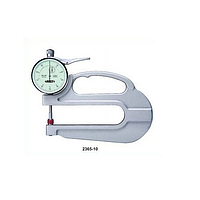
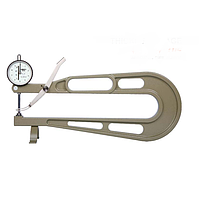
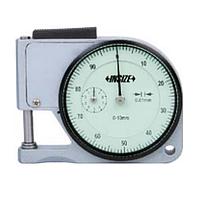
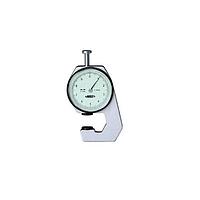
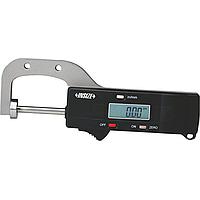
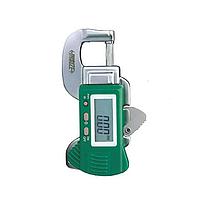
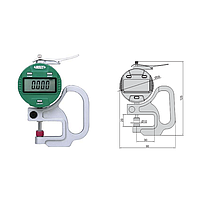
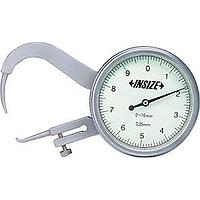
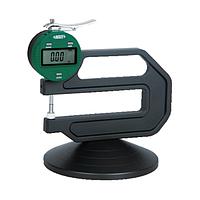
Thickness Gage
Accurate thickness control affects product quality, material cost, and process consistency in many industrial environments. Whether you are checking metal sheet, rubber, paper, film, coated parts, or formed components, a Thickness Gage helps verify dimensions quickly and repeatably at the point of inspection.
Within this category, you will find mechanical and digital instruments designed for direct contact measurement of material thickness. These tools are widely used in manufacturing, incoming inspection, laboratory work, maintenance, and quality control where operators need fast readings without setting up complex test systems.

Where thickness gages are commonly used
Contact thickness gages are practical when the material can be reached directly and a fast manual measurement is needed. Typical applications include checking sheet metal, plastic parts, rubber products, paper, textiles, soft materials, tubes, and coated surfaces during production or final inspection.
They are also useful for comparing thickness variation across a batch, confirming whether a part stays within tolerance, and detecting wear or compression effects on flexible materials. In applications where the part cannot be accessed from both sides or the material must be tested non-destructively through one surface, an ultrasonic thickness gage may be a better fit.
How a contact thickness gage works
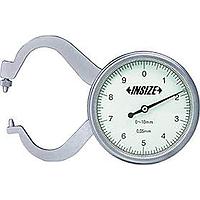
Most instruments in this group use a spring-loaded measuring system with two contact points that close on the sample. The reading is displayed on a dial or digital indicator, allowing the user to determine the thickness based on the displacement of the contact point. This method is straightforward, fast to repeat, and suitable for many shop-floor tasks.
The quality of the result depends not only on resolution, but also on measuring force, contact geometry, throat depth, and how well the instrument matches the material being tested. For soft or easily deformed samples, stable contact pressure becomes especially important because excessive force can change the result during measurement.
Key selection factors before you buy
Choosing the right model starts with the material and the inspection task. A thin film, soft rubber sheet, rigid metal strip, or curved pipe section may all require different contact shapes or instrument designs. The first step is to confirm the expected measuring range, then check whether the resolution and stated accuracy are appropriate for your tolerance level.
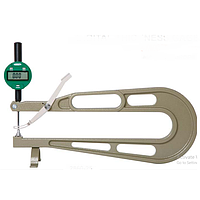
Another practical factor is throat depth. A shallow throat may work for edge measurements, while deeper frames are more suitable when the measuring point is farther from the edge of the workpiece. Models such as MOORE & WRIGHT MW455-15, MW455-25, and MW455-35 illustrate how similar range and resolution can still serve different inspection positions because of different throat depths.
For applications that demand finer readings, digital or high-resolution models are often preferred. If your process requires sub-micron or very tight micron-level control, it is worth reviewing instruments from MITUTOYO that offer higher resolution options for more detailed thickness verification.
Examples from leading manufacturers in this category
This category includes well-known brands used in industrial measurement. MOORE & WRIGHT offers practical dial thickness gauges such as the MW455-15D and MW455-25D, both covering 0-10 mm with 0.01 mm resolution. These models are suitable for routine dimensional checks where simplicity and quick manual operation are important.
MITUTOYO is a strong choice when users need dependable metrology performance across different ranges and resolutions. Examples include the MITUTOYO 7301A and 7321A for 0-10 mm measurement, as well as the MITUTOYO 547-401A with 0.001 mm division and the 7327A for very small range measurement where fine detail matters.
TECLOCK adds useful application-specific options. The TECLOCK PF-11A constant pressured thickness measuring instrument is relevant for materials where controlled measuring force improves repeatability, while the TECLOCK TPD-617A digital pipe gauge is better aligned with pipe or curved surface inspection tasks. For other material-testing environments, ELCOMETER products such as the E124---3MC can be relevant when compact metric thickness checking is needed.
Mechanical, digital, and constant-pressure options
A standard dial thickness gage is often the best starting point for general workshop use. It is easy to read, requires minimal setup, and works well for frequent manual spot checks. Mechanical designs remain popular because they are robust and familiar to operators in production and QC settings.
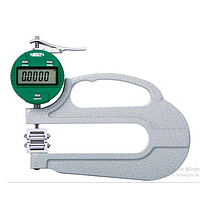
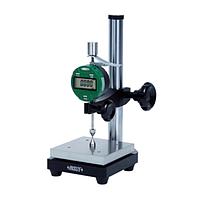
Digital thickness gages are helpful when users want clearer readout, finer resolution, or easier result interpretation. In some workflows, a digital display also reduces reading errors compared with analog scales. The TECLOCK TPD-617A and MITUTOYO 547-401A are good examples of instruments that support more precise reading needs.
For soft, elastic, or pressure-sensitive materials, a constant-pressure instrument can improve consistency between operators and measurement points. The TECLOCK PF-11A is a representative example in this category, especially where measurement force should stay controlled to avoid distorting the sample during contact.
Good measurement practice for reliable results
Even a high-quality thickness gage performs best when basic measurement discipline is followed. The contact faces and sample surface should be clean, the instrument should be zero-checked when applicable, and the part should be positioned squarely between the anvils or measuring contacts. These simple steps help reduce avoidable variation.
For soft materials, avoid squeezing the sample beyond the intended measuring force. For thin metal or formed parts, make sure the contact point is placed on the exact inspection location defined by the drawing or control plan. If several operators use the same instrument, clear measurement procedure and periodic verification are just as important as the tool specification itself.
It is also useful to consider the broader measurement workflow. If the inspection requirement involves coatings, wall thickness in service, or one-sided access, another technology from the wider thickness meter range may be more suitable depending on the part and test method.
Which type is right for your application?
If you mainly inspect flat materials near the edge and need a simple manual tool, a standard dial thickness gage in the 0-10 mm class will cover many day-to-day tasks. If your inspection point sits farther inside the part, selecting the correct frame and throat depth becomes more important than choosing by range alone.
If you need finer reading capability, digital models with 0.001 mm division can be more appropriate. If the material is soft or easily compressed, constant-pressure designs deserve closer attention. And if the shape is non-flat, such as tubing, specialized models like a pipe gauge are often the safer option than trying to adapt a general-purpose tool.
Find a suitable thickness gage for routine QC and process control
The products in this category support a wide range of practical industrial measurement tasks, from simple incoming inspection to more controlled quality checks on finished parts. By focusing on material type, measuring range, resolution, contact style, and throat depth, buyers can narrow the options to instruments that genuinely fit the job.
If you are comparing models, it helps to start with the inspection method rather than the brand alone. A well-matched thickness gage will make daily measurement faster, more repeatable, and easier to standardize across production, QA, and laboratory environments.
Get exclusive volume discounts, bulk pricing updates, and new product alerts delivered directly to your inbox.
By subscribing, you agree to our Terms of Service and Privacy Policy.
Direct access to our certified experts