Laser Source
Stable, well-matched light sources are central to many optical measurement, imaging, and photonics workflows. Whether the task involves interferometry, OCT development, spectroscopy, component characterization, or lab integration, choosing the right Laser Source affects signal quality, repeatability, system architecture, and long-term usability.
This category brings together laser sources and closely related optical source platforms used in technical environments. It also includes selected supporting items that matter in real integration work, from standalone lasers to swept-source platforms and interface components used around laser diode assemblies.
Where laser sources fit in optical systems
In industrial and research settings, a laser source is rarely chosen by wavelength alone. Engineers usually evaluate the source together with coherence behavior, output stability, sweep capability, beam characteristics, interface requirements, and how the source will interact with detectors, optics, and acquisition hardware.
That is why this category is relevant across multiple optical workflows. A red HeNe laser may be suitable for alignment or general laboratory use, while swept lasers and swept-source OCT platforms are more appropriate for depth-resolved imaging, optical sensing, and advanced inspection systems. In broader test setups, these sources are often used alongside tools such as an optical analyzer or an optical power meter to verify output behavior and overall system performance.
Main product types in this category
The range represented here spans several practical source families. Conventional continuous-output lasers are included for applications that need a stable optical beam with predictable characteristics. A good example is the MKS N-LHR-131 HeNe Laser, a 633 nm red source that fits common laboratory and optical alignment needs where beam quality and stable operation are important.
For integration at the component level, this category also covers hardware used around laser emitters, such as the THORLABS S038S laser diode socket for Ø3.8 mm, 3-pin devices. While it is not a laser source by itself, it plays a practical role in mounting and connecting laser diodes during development, prototyping, and test fixture assembly.
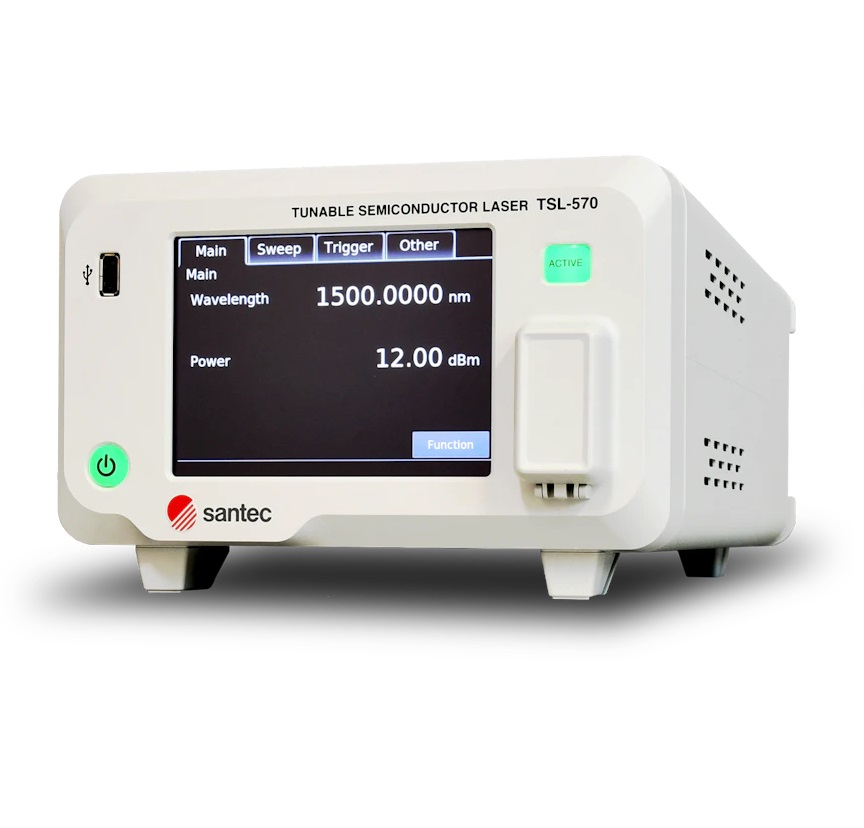
Another major group is swept-source laser technology, especially for OCT and optical measurement. The Santec HSL series and related systems address applications that need tunable or swept operation, long coherence length, and fast acquisition-oriented performance rather than a simple fixed-wavelength beam.
Swept lasers for OCT, sensing, and advanced measurement
When the application depends on depth profiling or wavelength-swept data capture, source behavior becomes more specialized. Products such as the Santec HSL-2100, HSL-20, HSL-10, and HSL-1 VCSEL Swept Source are intended for use cases including SS-OCT, interferometry, optical sensing, spectroscopy, and even FMCW LiDAR-related workflows as indicated in the available product context.
These types of sources are commonly selected for their tuning range, sweep speed, coherence properties, and compatibility with signal acquisition methods. In practice, that means they can support imaging and measurement tasks where fixed-wavelength lasers are not sufficient, especially when the system needs fast scanning, repeatable wavelength behavior, or long imaging range.
Within the same ecosystem, the Santec STS Swept Test System and WSL-110 tunable laser extend the category beyond imaging alone. They are relevant for optical component characterization, DWDM-related evaluation, and photonic testing workflows where controllable wavelength output is part of the measurement method.
Integrated OCT source systems for faster deployment
Not every project starts from discrete optical building blocks. Some teams need a more complete source-and-imaging platform that reduces development time and simplifies early validation. For that reason, this category also includes systems such as the Santec IVS-2000-ST, IVS-2000-LC, IVS-2000-HS, and IVS-1000-VCSEL.
These systems are useful when the goal is to move more quickly from concept to imaging or inspection. Depending on the model, the product context highlights suitability for industrial in-line inspection, 3D shape measurement, anterior chamber imaging, cardiovascular and endoscopic imaging, ophthalmic applications, and samples with high water content.
From a selection standpoint, integrated OCT systems can make sense when users want a more structured starting point for evaluation, proof-of-concept work, or application development without assembling every optical subsystem separately.
How to choose the right laser source
A practical selection process starts with the application, not the catalog. If the requirement is beam alignment, benchtop optics, or a visible reference source, a compact HeNe laser may be the logical path. If the project centers on swept measurements, OCT imaging, or tunable optical testing, then swept or tunable laser platforms are more relevant.
It also helps to define the measurement environment clearly. Consider whether the system needs fixed output or wavelength scanning, whether long coherence length matters, how the source will be coupled into the optical path, and whether the project involves standalone source selection or a broader source-plus-measurement architecture. In many maintenance or field-fiber contexts, complementary instruments such as an OTDR meter or an optical fault locator may sit beside source equipment in the workflow, even though they solve different problems.
For development teams working with laser diodes, mechanical and electrical compatibility should not be overlooked. Socket type, lead geometry, insulation material, and mounting constraints can all affect test reliability and assembly convenience.
Representative manufacturers in this category
MKS, THORLABS, and Santec are the main manufacturers highlighted here, each representing a different part of the optical source landscape. MKS is represented in this category by a HeNe laser for stable visible output. THORLABS appears through a practical laser diode socket component used in integration and prototyping tasks.
Santec has the broadest presence in the current selection, covering swept sources, tunable laser platforms, swept test systems, and complete OCT systems. This makes the brand particularly relevant for users working on imaging, photonic characterization, and wavelength-dependent optical measurement.
Rather than comparing brands in abstract terms, it is usually more useful to match the manufacturer’s available product type to the intended workflow: bench optics, diode integration, swept-source imaging, or tunable optical test.
Typical applications and buying intent
Buyers landing in this category often have one of several concrete goals. Some need a source for a photonics bench or alignment setup. Others are selecting a swept laser for OCT development, evaluating a tunable source for optical component testing, or sourcing a compatible support part for laser diode handling.
That mix makes this category relevant to R&D labs, medical imaging developers, industrial inspection teams, photonics integrators, and technical procurement groups. The most effective way to narrow the options is to start with the end use, then filter by source behavior, optical format, and integration level instead of relying only on product naming.
Find a source that matches the system, not just the wavelength
A suitable laser source should fit the full measurement or imaging chain, from optical architecture and acquisition method to packaging and day-to-day operation. In this category, that may mean a visible HeNe laser for stable lab use, a diode socket for source integration, a swept source for OCT or sensing, or a more complete OCT system for faster evaluation and deployment.
By focusing on application requirements first, it becomes easier to compare the available options and identify the right balance of performance, usability, and integration effort for your optical project.
Get exclusive volume discounts, bulk pricing updates, and new product alerts delivered directly to your inbox.
By subscribing, you agree to our Terms of Service and Privacy Policy.
Direct access to our certified experts