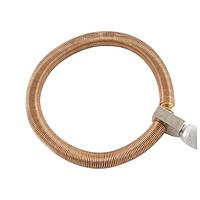
Holiday detector
Protective coatings only perform as intended when the film is continuous. Even a tiny void, pinhole, or discontinuity can allow moisture, chemicals, or corrosion to reach the substrate, which is why holiday detector testing is a standard step in many coating inspection workflows. For manufacturers, coating contractors, and quality teams, selecting the right detector helps reduce rework and improve confidence before a coated part, tank, pipe, or lining goes into service.
This category brings together instruments used to locate defects in non-conductive coatings applied over conductive substrates. The range includes compact portable units, higher-voltage systems for thicker linings, and accessories such as probe components and battery packs that support day-to-day inspection work.
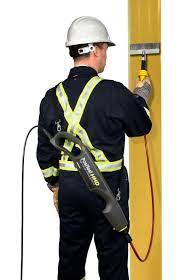
Why holiday detection matters in coating inspection
A holiday detector is used to identify breaks in a coating layer that may not be visible during routine visual checks. In practical terms, this means finding pinholes, voids, cracks, or thin areas before they become failure points in service. The method is widely used for coated steel structures, tanks, pipelines, vessels, and other assets where barrier performance is critical.
Holiday testing is often part of a broader inspection sequence. Before testing for discontinuities, users may also verify film build with a coating thickness meter, then confirm whether the applied system is within the intended range for the selected test voltage. This makes the process more consistent and helps avoid under-testing or over-stressing the coating.
How a holiday detector works
The basic principle is straightforward: the instrument applies a controlled high-voltage output through a probe electrode as it passes across the coated surface. When the coating is sound, the electrical path is interrupted. If the probe reaches a pinhole or another discontinuity that exposes the conductive substrate, the circuit completes and the unit signals the defect with a lamp, buzzer, or both.
In this category, you will find low-frequency pulse discharge and DC high-voltage types, depending on the model. The right choice depends on coating thickness, surface geometry, test conditions, and the level of portability required. Electrode style also matters, since brush-type probes, radial electrodes, and flexible probe arrangements each suit different inspection scenarios.
Typical equipment options in this category
Portable models are useful when operators need mobility around large assets or field installations. For example, the SANKO HOLYSTAR 5N is intended for lower-voltage applications, while the HOLYSTAR 15N expands the range for thicker coatings. For broader voltage coverage, the SANKO TRK-330N and TO-250D provide higher output ranges suited to more demanding lining inspection tasks.
Users looking for another portable format may also consider TQCSheen units such as the LD8503 and LD8504, which cover different voltage ranges and include audible and visual indication. Accessories remain important in routine work as well. The ELCOMETER T99920022-1 right-angled wire brush probe supports probe access in harder-to-reach areas, while the ELCOMETER T99923482 rechargeable lithium ion battery pack is relevant for compatible Elcometer systems where battery management is part of daily operation.
How to choose the right model
The first selection factor is the coating thickness range you need to inspect. Lower-voltage models are generally used for thinner coatings, while thicker or more robust protective linings require higher available voltage. Product examples in this category reflect that spread, from instruments such as the SANKO TO-5DP for lower ranges up to systems like the TQCSheen LD8503 or SANKO TRK-330N for higher-voltage applications.
Next, consider the work environment. Battery-powered instruments can be advantageous for field inspection and movement around large structures, whereas AC-powered units may suit fixed inspection stations or workshop use. Probe design, cable length, alarm type, and overall instrument size also influence usability, especially when testing curved surfaces, confined areas, or long production runs.
It is also worth considering the rest of the inspection workflow. If the goal is complete coating quality verification, holiday testing may be complemented by adhesion testing and, where relevant, hardness checks after curing. Choosing instruments that fit your process can simplify training and improve repeatability.
Applications across industry
Holiday testing is commonly used anywhere a protective coating serves as a corrosion barrier. Typical examples include internal tank linings, coated pipe sections, structural steel, chemical processing equipment, marine components, and fabricated metal parts that must resist aggressive service conditions. The same logic applies in both factory QA and site inspection during installation or maintenance.
Different applications place different demands on the equipment. Large flat surfaces may favor wider brush electrodes for faster coverage, while weld zones, edges, corners, and nozzles can require more precise probe control. That is why accessory availability and electrode compatibility are often just as important as the detector’s voltage range.
Manufacturers and ecosystem considerations
This category includes products and accessories from established names such as ELCOMETER, TQCSheen, and SANKO. Rather than focusing only on one device, many buyers evaluate the wider ecosystem: probe options, replacement parts, power accessories, and how easily the instrument fits into existing inspection practice.
For teams managing coating quality across multiple checkpoints, holiday detection is only one part of a complete test regime. Surface verification may also involve coating hardness testers or other coating inspection tools depending on the material system and acceptance criteria. Looking at the full workflow usually leads to a better purchasing decision than comparing voltage range alone.
Good practice when reviewing product details
When comparing models on this page, focus on practical criteria: output range, alarm method, power source, portability, included probe type, and suitability for the coating system under inspection. These factors directly affect whether the instrument will be convenient and reliable for your actual job conditions.
It is equally important to match the detector to the coating specification and test procedure used by your organization or client. A higher voltage range is not automatically better for every application. The best fit is the one that aligns with coating thickness, substrate conductivity, geometry, and inspection method while remaining manageable for the operator.
Find the right holiday detector for your inspection process
Whether you need a compact unit for routine coating checks, a higher-voltage detector for thicker protective linings, or supporting accessories for an existing setup, this category is designed to help narrow the options. Reviewing the intended coating thickness, power preference, probe style, and inspection environment will usually point you toward the most suitable choice.
A well-matched holiday detector supports more reliable defect detection and helps strengthen the overall coating quality process. If you are building a broader inspection toolkit, this category can also be considered alongside coating thickness, adhesion, and hardness measurement equipment to create a more complete testing workflow.
Get exclusive volume discounts, bulk pricing updates, and new product alerts delivered directly to your inbox.
By subscribing, you agree to our Terms of Service and Privacy Policy.
Direct access to our certified experts