Paint Applicator
Uniform film preparation is a critical step in coating inspection, product development, and routine quality control. When a test panel starts with an inconsistent wet film, later results such as thickness, adhesion, hardness, drying behavior, or surface appearance become harder to interpret. This is why Paint Applicator tools remain essential in laboratories, production support, and coating evaluation workflows.
This category focuses on equipment used to apply controlled paint or coating films on test charts and panels. It includes both manual applicators for defined film builds and automatic systems that improve repeatability when speed, stroke, and substrate holding need tighter control. For users comparing methods, this page helps clarify where each type of applicator fits and what to consider before selecting a setup.
Why controlled film application matters
In coating laboratories, the applicator is more than a simple spreading tool. It directly affects the consistency of the wet film, which then influences curing, gloss development, hiding power, and many other measured properties. A stable application process reduces operator-to-operator variation and makes comparison between batches more meaningful.
Controlled application is especially important when results will be checked later with instruments such as a coating thickness meter or verified through mechanical performance tests. If the initial film laydown is uneven, downstream testing can no longer reflect the coating material alone; it also reflects application error.
Common paint applicator formats in this category
This category covers both manual applicators and automatic film applicators. Manual tools are often preferred for straightforward drawdowns, formulation comparison, and small-scale testing. They are compact, practical, and suitable when the operator wants direct control over the application step.
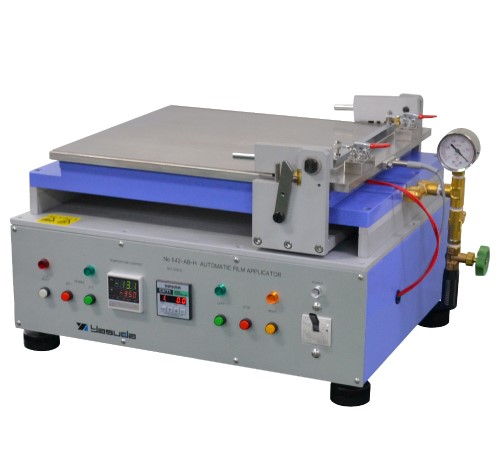
Automatic systems are designed for higher repeatability. They move the applicator at a controlled traverse speed and over a defined stroke length, helping standardize the drawdown process across multiple panels. In many coating labs, these systems are used when consistency is critical for development work, specification checks, or comparative product testing.
Within the available examples, compact and standard automatic units from TQCSheen illustrate different workflow needs. A model such as the TQCSheen AB3652 Automatic Film Applicator Compact is suitable where a smaller footprint and adjustable speed are useful, while the AB4400 and related standard platforms are better suited to broader panel sizes and more demanding routine work.
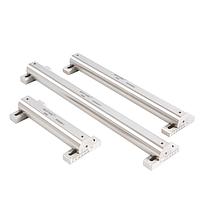
Manual cube applicators for defined wet film preparation
For many laboratories, a cube applicator is still a practical choice for preparing repeatable films without moving to a motorized platform. These tools are commonly selected when the goal is to create a specified wet film thickness on a test chart for comparison, screening, or routine QC checks.
Examples in this category include the TQCSheen AB3710 and AB3711 cube applicators, along with narrower 25 mm versions such as AB3706, AB3707, and AB3708. These products show how users can choose different film widths or target thickness ranges depending on the coating material, substrate size, and internal test method. The key advantage is repeatable wet film build with a straightforward operating method.
Manual applicators can be a good fit for labs that need flexibility, lower setup complexity, or occasional drawdowns. They are also useful when the coating system does not justify a fully automated workflow but still requires better consistency than freehand application.
Automatic film applicators for repeatability and process control
When testing volume increases or internal methods demand tighter control, automatic applicators offer clear benefits. Traverse speed, stroke length, and panel positioning can be kept consistent from one sample to the next, reducing the influence of operator technique. This is valuable for R&D teams, production labs, and technical service departments comparing multiple formulations under the same application conditions.
Products such as the TQCSheen AB4420, AB4320, AB4220, and AB4120 represent different platform configurations, including versions supplied without a bed or with glass, perforated vacuum, or double-channel vacuum beds. These differences matter because substrate holding and bed construction affect how securely the test chart is positioned during drawdown. For some methods, a heated solution such as the TQCSheen AB4430 Heated Perforated Vacuum Bed or the AB4400 system can also support testing where temperature control is part of the process.
In practice, the right automatic setup depends on the chart size, substrate thickness, applicator style, and whether vacuum holding or heating is required. The category structure helps buyers compare these options without treating every laboratory requirement as identical.
How to choose the right paint applicator
Selecting a paint applicator starts with the actual testing routine. If the work mainly involves occasional drawdowns, a manual applicator may be enough. If the goal is to improve reproducibility across many panels or operators, an automated unit is usually easier to standardize.
Useful selection points include:
- Application method: manual cube applicator or automatic film applicator
- Film width and target thickness: aligned with your internal method and chart size
- Panel or substrate size: important for bed dimensions and usable stroke length
- Substrate holding: glass bed, perforated vacuum bed, or double-channel vacuum support
- Temperature requirement: relevant for workflows needing heated beds
- Repeatability needs: especially important for comparative testing and formal QC
It is also helpful to think about the tests that follow the drawdown stage. If your workflow continues with adhesion testing or checks surface resistance with coating hardness testers, better film uniformity at the start usually leads to more reliable evaluation later.
Typical applications in coating laboratories and industry
Paint applicators are used across paint, ink, varnish, resin, and related coating environments. In research and formulation work, they help teams compare flow, leveling, opacity, and drying behavior from one sample to another. In quality control, they provide a standard way to prepare panels before inspection or acceptance testing.
They are also relevant when validating a coating system for a specific substrate or process window. A controlled drawdown can support later inspection for visual defects, thickness distribution, adhesion, hardness, or even discontinuities depending on the coating type and substrate. In some workflows, users may also review complementary tools such as a holiday detector when coating continuity is part of the broader inspection process.
Brands and product ecosystem
This category includes equipment from established names in coating test equipment, with TQCSheen strongly represented in the current product selection. The available range shows a practical ecosystem: compact automatic applicators, standard motorized platforms, heated vacuum beds, and manual cube applicators that support different levels of control and throughput.
ELCOMETER, NOVOTEST, and Yasuda are also relevant manufacturer references within the wider coating and paint testing landscape. Depending on the application, buyers may evaluate applicators alongside other coating inspection instruments from these brands to build a more complete lab setup.
Finding the right setup for your workflow
The best choice is usually the one that matches your test method, sample volume, and need for repeatability rather than simply choosing the most advanced unit. A compact automatic applicator may be enough for routine panels, while a larger standard platform with vacuum or heating can be more appropriate for demanding development or specification work. Manual cube applicators remain a sensible option when simplicity and defined film thickness are the main requirements.
By comparing application style, bed configuration, and downstream testing needs, you can build a more reliable coating evaluation process from the first drawdown onward. Explore the products in this Paint Applicator category to find a setup that fits your laboratory routine, substrate format, and coating control objectives.
Get exclusive volume discounts, bulk pricing updates, and new product alerts delivered directly to your inbox.
By subscribing, you agree to our Terms of Service and Privacy Policy.
Direct access to our certified experts