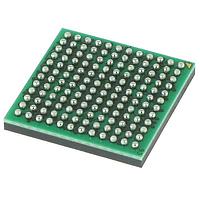
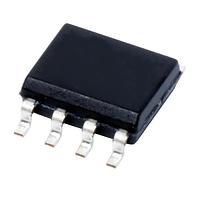
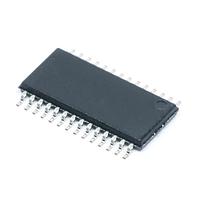
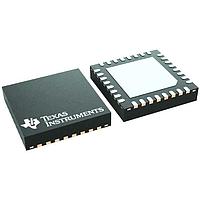
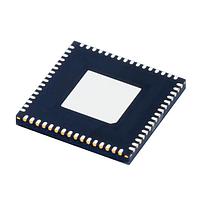
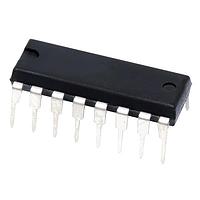
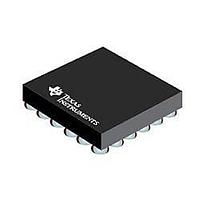
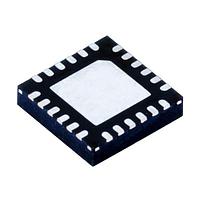
Data Converter ICs
Precise signal conversion is a core requirement in embedded electronics, industrial control, instrumentation, and connected devices. When analog signals from sensors need to be measured, processed, or transmitted in digital form, Data Converter ICs provide the link between the physical world and digital systems.
This category focuses on integrated circuits used to convert analog signals into digital data, digital values back into analog outputs, or both within a single device. These components are widely used in measurement chains, control boards, data acquisition modules, user interfaces, and mixed-signal designs where accuracy, speed, interface type, and channel configuration all matter.
Where data converter ICs fit in a system
In practical designs, converters sit between sensors, processors, communication controllers, and output stages. An ADC captures information such as voltage, current, temperature, pressure, or position from the analog domain, while a DAC recreates a controlled analog signal for actuation, reference generation, or waveform output.
Because these devices are often part of a larger signal chain, engineers also evaluate nearby functions such as conditioning, filtering, and gain. In many designs, converter selection goes hand in hand with related components like amplifier ICs for front-end signal preparation or active filter devices for noise reduction before sampling.
Common converter types in this category
This product group typically includes analog-to-digital converters, mixed-signal devices, and application-specific converter ICs. Some parts are built for straightforward single-channel acquisition, while others integrate multiplexers, sample-and-hold stages, programmable gain, selectable addressing, or serial interfaces to simplify board design.
Within the examples available here, several Maxim Integrated devices illustrate typical options. Parts such as the MAX1227BEEE+T and MAX1065BEUI+ represent SAR-based conversion for applications that need relatively fast sampling and efficient interfacing, while the MAX1402EAI+ shows how sigma-delta architecture can be useful when higher resolution and low-speed precision are more important than throughput.
Key selection criteria for engineers and buyers
The right converter depends less on headline specifications alone and more on how the device fits the application. Resolution, sampling rate, input type, channel count, architecture, and supply voltage should be evaluated together, especially in industrial and embedded environments where noise, board space, and interface compatibility can affect real-world performance.
For example, a 12-bit SAR device such as the MAX1228BEEP+T may suit multiplexed measurement tasks where moderate speed and compact integration are priorities. By contrast, a device like the MAX1402EAI+, with sigma-delta architecture and PGA-related capability, may be better aligned with lower-bandwidth signals that require finer measurement granularity. Interface choice also matters: SPI, I2C, and parallel output options influence firmware complexity, pin count, and system timing.
Another important factor is signal topology. Some converters support single-ended inputs, while others also handle differential or pseudo-differential measurement. That distinction becomes especially relevant in sensor systems, isolated measurement paths, or electrically noisy installations.
Examples from leading manufacturers
This category includes products from established semiconductor suppliers used across industrial, embedded, and electronic design applications. Maxim Integrated is strongly represented in the current selection, with devices covering SAR and sigma-delta conversion, multiple input configurations, and integrated data acquisition functions.
Infineon also appears in this range with the CY8CTMA460AS-33T touch panel controller, showing how conversion and signal interpretation can be embedded inside user-interface oriented mixed-signal devices. More broadly, this category sits within a semiconductor ecosystem that also includes suppliers such as Analog Devices, Microchip, Intersil, Broadcom, and Cirrus Logic, depending on design priorities and platform preferences.
Typical applications across industrial and embedded design
Data acquisition is one of the most common use cases. Converter ICs are used to read sensor outputs in machine monitoring, environmental measurement, laboratory instrumentation, and embedded control platforms. Multi-input devices can simplify systems that need to collect values from several analog channels without adding substantial external circuitry.
They are also common in control and interface applications. A mixed-signal part such as the MAX1257BETM+, which combines ADC and DAC-related functionality in a data acquisition system context, can help reduce component count where both measurement and analog output are needed. In interface-driven products, touch and position sensing solutions may rely on converter-related processing as part of a broader signal interpretation path.
For projects that combine acquisition, storage, and processing, engineers may also review adjacent categories such as memory ICs or specialized ICs to complete the wider architecture.
Architectures and interfaces in practical terms
SAR converters are often selected for their balance of speed, power efficiency, and implementation simplicity. In the current product examples, devices such as MAX1363EUB+, MAX1362EUB+, MAX1280BEUP+, and MAX1290AEEI+ reflect the kind of flexibility engineers look for when selecting input count, serial or parallel communication, and supply range.
Sigma-delta converters, on the other hand, are typically favored for precision measurement of slower-changing signals. Their strengths often become more relevant in instrumentation and sensor applications where noise performance and effective resolution are key. Interface format should be considered just as carefully as architecture, since SPI, I2C, and parallel buses affect not only hardware routing but also software integration and system scalability.
How to evaluate the product range efficiently
When comparing parts in this category, it helps to start with the signal source and required output behavior rather than the component name alone. Define the expected input range, whether the signal is single-ended or differential, how many channels are needed, and how often the system must sample or update. That narrows the field quickly and avoids over-specifying the converter.
Next, confirm electrical compatibility with the rest of the design, including analog and digital supply rails, package constraints, and controller interface support. For B2B sourcing teams, this approach also makes it easier to align engineering needs with procurement requirements, especially when comparing lifecycle, preferred manufacturers, and assembly considerations across multiple projects.
Choosing the right data converter for your design
A suitable converter is rarely chosen on resolution alone. The best fit usually comes from balancing measurement accuracy, speed, interface simplicity, channel density, and the needs of the surrounding analog front end. Whether the application involves sensor acquisition, mixed-signal control, or embedded human-machine interaction, this category provides a practical starting point for identifying devices that match the architecture of the end system.
By reviewing converter type, interface, and signal requirements together, buyers and design engineers can shortlist parts more effectively and build a more reliable signal chain from the start.
Get exclusive volume discounts, bulk pricing updates, and new product alerts delivered directly to your inbox.
By subscribing, you agree to our Terms of Service and Privacy Policy.
Direct access to our certified experts