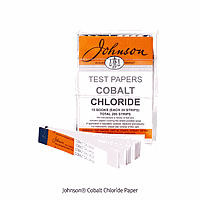
Moisture Detecting Papers
When a quick visual indication of moisture is more practical than setting up an electronic instrument, test papers can be an efficient solution. In packaging checks, storage control, laboratory handling, and routine inspection work, a simple color-changing strip often helps teams verify moisture presence quickly and with minimal training. That is where Moisture Detecting Papers fit well within a broader humidity measurement workflow.
These papers are commonly used when the goal is fast screening rather than continuous data logging. They can support incoming goods inspection, process checks, sealed environment verification, and basic condition monitoring where a go/no-go indication is sufficient.
Where moisture detecting papers are typically used
In many industrial and laboratory environments, moisture does not need to be measured with a full instrument every time. Sometimes the priority is to confirm whether humidity or condensation is present inside packaging, containers, storage spaces, or around sensitive materials. In these situations, moisture-sensitive paper offers a direct and easy-to-read method.
Typical use cases include checking dry storage conditions, monitoring transport packaging, verifying exposure in enclosed spaces, and supporting maintenance or quality control tasks. For applications that require a broader range of paper-based indicators, readers may also review moisture detecting papers as part of a wider selection within humidity monitoring products.
How these papers work in practice
The principle is straightforward: the paper is treated with a chemical indicator that reacts when exposed to moisture or a target substance related to humidity testing. The result is usually a visible color shift or a clear change in appearance, allowing operators to identify whether the tested condition is present.
This approach is especially useful in workflows where speed matters. Instead of powering a meter, waiting for stabilization, or interpreting multiple parameters, personnel can perform a quick visual check and move on. For many routine inspections, that simplicity is a practical advantage.
Representative products in this category
This category includes solutions from Johnson Test Papers, a manufacturer known for specialist indicator papers used in testing and inspection tasks. The range shown here illustrates how paper-based indicators can support different moisture-related checks depending on the testing objective.
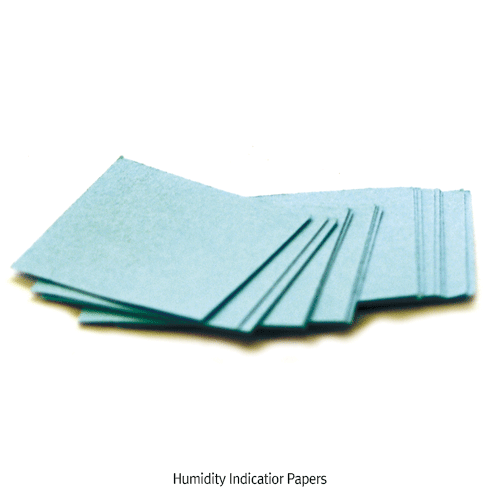
Examples include the Johnson Test Papers J2.016.95 Test Paper humidity, 30x30mm and the Johnson Test Papers J2.015.1 Test Paper Cobalt Chloride, for Miosture 200Strip. For environments where visual indication of specific chemical conditions is relevant, the Johnson Test Papers J2.017.1 Test Paper Lead Acetate, for Sulphide 200Strip shows how test papers can also play a role in broader analytical or process-monitoring routines. Rather than replacing all humidity instruments, these products are often used as a convenient first-line check.
When to choose test paper instead of a moisture meter
The best choice depends on the level of accuracy and documentation required. If the task calls for a rapid visual indication, low setup effort, and easy field use, test papers can be the more efficient option. They are also useful in spot checks where operators simply need to know whether moisture exposure has occurred.
By contrast, if the application requires numeric readings, trend monitoring, or measurement across varying material types, an electronic meter may be more appropriate. For example, agricultural or material-specific testing may be better served by instruments such as a moisture meter for agriculture or a multifunction moisture meter, depending on the process and measurement depth needed.
Key selection points for B2B buyers
When selecting moisture detecting papers, it helps to begin with the actual inspection task. Consider what needs to be detected, how the result will be interpreted, and whether the paper is intended for occasional verification or routine operational use. This makes it easier to choose a format that aligns with your workflow rather than focusing only on the product name.
Other practical considerations include handling convenience, strip format, storage conditions, and how clearly the result can be read by operators on the shop floor or in the lab. In many organizations, the right selection is the one that integrates smoothly into existing QA, maintenance, or incoming inspection procedures.
How moisture detecting papers fit into a broader humidity control strategy
Paper indicators are most valuable when used as part of a layered approach. They can support screening and quick checks, while dedicated instruments handle quantitative measurement and documentation. This combination is common in industrial environments where different departments need different levels of detail.
For example, a visual indicator may be used to confirm exposure during storage or transport, while a meter is used later for deeper investigation. In material-focused applications such as environmental and field checks, solutions like a soil moisture meter may be more suitable for obtaining direct measurement data from the tested medium.
Practical advantages in routine inspection workflows
One reason these products remain relevant is their operational simplicity. They are easy to distribute across inspection points, convenient for field technicians, and useful where electrical devices are unnecessary or impractical. This can help reduce inspection time for basic moisture presence checks.
They are also well suited to decentralized workflows, where multiple operators need a consistent and fast way to perform the same screening task. In that sense, moisture detecting papers support standardization as much as they support measurement.
Choosing the right category for your application
If your requirement is a quick visual indication of moisture presence, this category offers a practical starting point. It is particularly relevant for packaging checks, storage verification, laboratory handling, and routine quality inspections where simplicity and speed are more important than full instrument-based measurement.
For buyers comparing different humidity testing methods, the right solution depends on whether the job calls for indication, screening, or detailed measurement. Moisture detecting papers are a useful part of that decision process, especially when a straightforward visual result is enough to support the next action.
Get exclusive volume discounts, bulk pricing updates, and new product alerts delivered directly to your inbox.
By subscribing, you agree to our Terms of Service and Privacy Policy.
Direct access to our certified experts