EV Charging Cables
Reliable vehicle charging starts with the cable assembly. In both public infrastructure and private charging installations, the cable has to handle repeated mating cycles, outdoor exposure, electrical load, and daily handling without becoming the weak point of the system. That is why many buyers compare not only connector formats, but also protection rating, cable length, current capacity, and installation style before selecting a product.
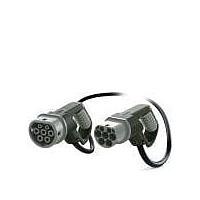
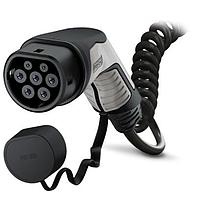
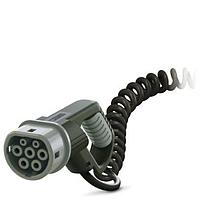
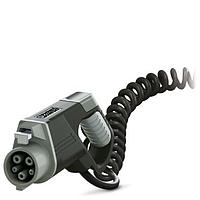
EV Charging Cables in this category cover both AC and DC charging applications, including assemblies with vehicle-side connectors and open cable ends for integration into charging equipment. This makes the range relevant for EV charger manufacturers, charging station integrators, maintenance teams, and industrial buyers sourcing parts for mobility infrastructure.

AC and DC charging cable options for different charging architectures
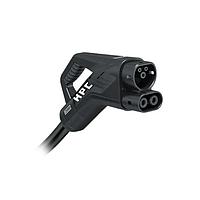
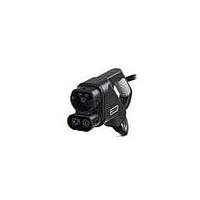
One of the first selection points is whether the application requires AC charging or DC charging. AC cable assemblies are common in residential, commercial, and destination charging, where the onboard charger in the vehicle manages power conversion. DC assemblies are typically used in fast-charging stations, where higher power transfer and a different connector architecture are required.
Examples in this category reflect that split clearly. For AC charging, products such as the ITT Cannon ACS3-T1-048-2BK-076A-2C1 and PHOENIX CONTACT 1622044 support established charging interfaces and installation needs. On the DC side, assemblies like the ITT Cannon DCI2-T2-250-UBK-031A-070 and PHOENIX CONTACT 1236824 are intended for charger-side integration where direct current delivery and robust connector systems are essential.
Connector standards and compatibility matter
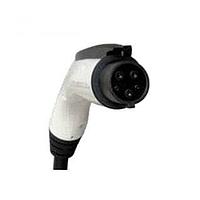
Charging cable selection is closely tied to connector type and regional charging standards. Within this category, buyers will find solutions associated with Type 1, Type 2, CCS Type 2, NACS SAE J3400, and GB/T-related formats. These interface differences are not cosmetic; they define mechanical fit, charging mode, and the intended vehicle or infrastructure ecosystem.
For example, the Adam Tech CA #EV-AC-32AS-5M is positioned around NACS SAE J3400 AC charging, while PHOENIX CONTACT and ITT Cannon examples in the range show Type 1, Type 2, and CCS Type 2 implementations. For teams building or servicing charging equipment, confirming connector compatibility early helps avoid mismatch at the installation stage and supports smoother integration with the rest of the charging hardware.
Key selection criteria for industrial and infrastructure buyers
Beyond connector format, a charging cable should be evaluated as a complete operating component. Current rating and voltage rating determine whether the assembly fits the charger design and expected charging profile. Cable length affects user reach, routing, and handling, while jacket material and ingress protection influence long-term durability in indoor or outdoor environments.
Several products here illustrate those differences. The ITT Cannon ACS3-T1-080-2WH-046A-2C1 is an AC option with a higher current rating than many standard consumer-oriented cables, while the Weidmuller 2791340000 provides a 3-phase AC configuration with plug-to-plug construction. For applications exposed to weather or demanding site conditions, buyers often compare IP ratings such as IP44, IP54, IP55, or IP67 depending on installation risk and operating environment.
Materials, protection, and field durability
In real-world charging use, the cable jacket and sealing performance affect service life just as much as the electrical interface. Many assemblies in this category use TPE or TPU-based jacket materials, which are commonly selected for flexibility, handling, and environmental resistance. This matters in charging stations where cables are repeatedly bent, coiled, dragged, or exposed to temperature variation.
Ingress protection is another practical buying factor. IP44 products may suit many covered or managed installations, while IP67-rated assemblies can be more appropriate where stronger resistance to dust and water ingress is needed. Buyers comparing product families from PHOENIX CONTACT and ITT Cannon will notice that protection level, connector style, and cable construction vary according to the intended charging scenario.
Use cases across charger manufacturing, integration, and maintenance
This category is relevant for more than end-user cable replacement. Open-end cable assemblies are especially useful in charger production and retrofit projects, where the cable must be terminated into the charging station rather than supplied as a finished consumer lead. That makes them suitable for OEM charger builds, infrastructure rollout, service replacement, and specialized integration work.
For instance, the Adam Tech CA #EV03HT-001-6M and PHOENIX CONTACT 1236824 represent DC charging cable formats that support charger-side installation concepts. In contrast, AC products such as PHOENIX CONTACT 1409952 or 1623236 are more aligned with established AC charging interfaces. If your project also includes signal or communications wiring alongside power assemblies, related cable types can be explored in Ethernet / Networking Cables where appropriate for connected charging systems.
How to compare products in this category efficiently
For a practical shortlist, start with the charging method and connector family required by the vehicle or charger platform. Then compare current handling, cable length, phase configuration where applicable, and environmental protection. This step-by-step approach is often more useful than filtering only by brand or by a single specification.
It is also worth checking whether the assembly is supplied as a vehicle connector with open cable end, plug-to-plug cable, or a format intended for fixed charging infrastructure. In broader sourcing projects, buyers sometimes review this category alongside other EV charging cable options to compare AC and DC formats, installation styles, and connector ecosystems before finalizing a BOM.
Representative manufacturers and product examples
This selection includes products from established suppliers used in industrial connectivity and charging applications, including Adam Tech, PHOENIX CONTACT, ITT Cannon, and Weidmuller. Each brings different strengths in connector design, charging interface coverage, and infrastructure-oriented cable assemblies. Rather than focusing on a single brand, many B2B buyers evaluate which product best matches the charger topology, target market, and installation environment.
Representative examples include the Adam Tech CA #EV-AC-32AS-5M for NACS-related AC charging, the ITT Cannon DCI2-T2-250-UBK-031A-070 for high-power DC charging scenarios, and the PHOENIX CONTACT 1623512 for GB/T-related AC charging applications. These examples show the breadth of the category without reducing it to one standard or one deployment model.
Choosing the right EV charging cable for your application
The right cable is usually the one that fits the electrical design, connector standard, operating environment, and installation method at the same time. A product that looks similar at a glance may differ significantly in current rating, phase support, protection level, or intended charger integration style. That is why careful comparison at category level is useful before narrowing down to an exact part number.
Whether you are sourcing for charger manufacturing, infrastructure upgrades, or replacement needs, this category provides a practical starting point for comparing EV charging cable assemblies across major interface types and use cases. Reviewing the application first, then matching the cable to the charging architecture, will lead to a more reliable and maintainable selection.
Get exclusive volume discounts, bulk pricing updates, and new product alerts delivered directly to your inbox.
By subscribing, you agree to our Terms of Service and Privacy Policy.
Direct access to our certified experts