Rheostats
When a circuit needs simple, direct adjustment of current or resistance under real operating conditions, a manually adjustable power resistor is often the practical choice. In control panels, test benches, legacy equipment, and industrial electronics, rheostats remain useful wherever a robust rotary adjustment element is preferred over a more complex electronic control method.
This category brings together panel-mount wirewound options used for manual regulation, load adjustment, and tuning tasks. For engineers, buyers, and maintenance teams, the key is not just finding a variable resistor, but choosing the right combination of resistance range, power handling, mounting style, and physical size for the application.

Where rheostats fit in practical circuit design
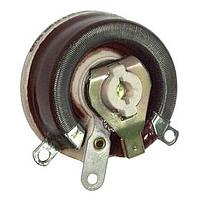
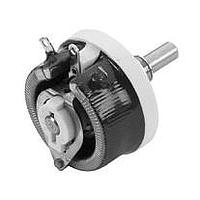
A rheostat is typically used as a two-terminal variable resistor to adjust current flow in a circuit. Unlike small trim components intended for light-duty board-level tuning, many rheostats are built for panel mounting and manual operation, making them suitable for equipment that requires repeated adjustment by an operator or service technician.
They are commonly selected for power control, calibration setups, motor and heater adjustment, lamp dimming in suitable designs, and educational or laboratory circuits. Because this category sits alongside broader resistor products, it is especially relevant when a fixed resistance value is not enough and the application calls for controlled variation by hand.
Typical construction and performance characteristics
Many products in this range use a wirewound element, a well-established design approach for handling higher power levels than standard small-signal variable resistors. Wirewound construction helps make rheostats suitable for applications where heat dissipation, durability, and stable operation matter more than compact PCB integration.
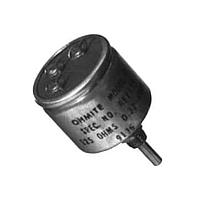
The featured portfolio includes panel-mount, rotary-adjusted parts with solder lug terminations and operating temperature ranges extending from -55 °C to 320 °C. These characteristics are often important in industrial environments, maintenance panels, and equipment exposed to variable ambient conditions.
How to choose the right rheostat
The first step is to match the device to the electrical role it will perform. Resistance value affects the adjustment range, while power rating determines how much energy the unit can safely dissipate during operation. A low-resistance rheostat may be appropriate for current control in certain circuits, while higher resistance values can be useful where finer adjustment over a wider range is needed.
Mechanical considerations are just as important. Panel cutout, shaft access, enclosure depth, lug connection style, and operator handling all influence selection. In applications where other passive parts interact closely with the adjustable resistance path, it may also be useful to review related capacitor options or inductor solutions as part of the wider circuit design.
- Resistance range: choose based on the intended adjustment window and circuit behavior.
- Power rating: ensure adequate dissipation margin under real load conditions.
- Mounting format: panel-mount types are often preferred for operator access.
- Termination style: solder lugs are common for secure wiring in equipment builds.
- Physical size: check available panel space and enclosure clearance.
Examples from the current range
The available selection includes multiple Vishay rotary rheostats suited to different load and adjustment requirements. For lighter-duty control tasks, the Vishay RT012AS22R0KN offers a 12 W format with a compact panel-mount design. For mid-range applications, models such as the Vishay RT025AS1000KB and Vishay RT025AS56R0KB illustrate how the same general form factor can be adapted to different resistance values.
Where higher power dissipation is required, the Vishay RT055AS5601KB provides a 55 W option, while the Vishay RT100AD3300KB extends into a 100 W class for heavier-duty use cases. These examples show why selecting by part number alone is rarely enough; resistance value, wattage, and mechanical envelope need to be considered together.
Manufacturer context and sourcing considerations
Among the brands represented in the broader passive component ecosystem, Vishay is especially relevant here because the representative products in this category come from its rheostat range. For buyers managing maintenance stock or production sourcing, that consistency can simplify comparison across similar mechanical styles with different resistance values and power ratings.
At the same time, rheostat selection should remain application-driven rather than brand-driven. The best fit depends on expected load, duty cycle, thermal conditions, and how the operator will interact with the control in daily use. In many projects, this category is part of a wider passive component bill of materials that may also include filters, fixed resistors, and other supporting parts.
Common use cases in industrial and technical environments
Rheostats are still widely used in serviceable equipment where a visible, manual adjustment point is an advantage. That includes training rigs, legacy machine retrofits, bench testing, power dissipation experiments, and control panels where technicians need immediate tactile adjustment without software layers or digital interfaces.
They can also be useful in prototyping and maintenance work, where circuit behavior needs to be explored under changing resistance conditions before a final design is fixed. In these cases, a durable panel-mounted component often provides better usability than smaller adjustment elements intended mainly for infrequent calibration.
Why this category matters for B2B buyers
For procurement teams and engineers, a well-structured rheostat category saves time by narrowing the selection to products intended for real manual adjustment and power handling. Instead of sorting through general-purpose passive parts, buyers can focus on components built for rotary control, panel installation, and higher-load operation.
If your application requires a manually adjustable resistor that can withstand practical electrical and thermal demands, this range offers a clear starting point. Reviewing resistance value, power rating, mounting method, and available space together will usually lead to a better selection than choosing on nominal ohms alone.
Whether the requirement is for new equipment, repair work, or lab use, the right rheostat should balance electrical performance with mechanical usability. A careful comparison of the available models in this category will help you identify a component that fits both the circuit and the installation environment.
Get exclusive volume discounts, bulk pricing updates, and new product alerts delivered directly to your inbox.
By subscribing, you agree to our Terms of Service and Privacy Policy.
Direct access to our certified experts