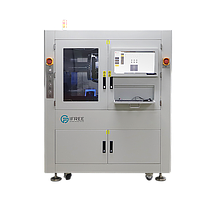
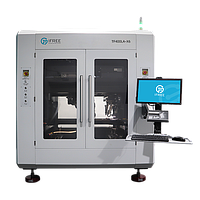
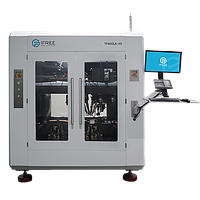
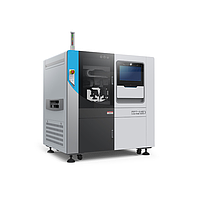
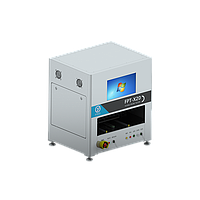
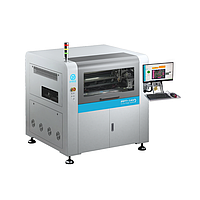
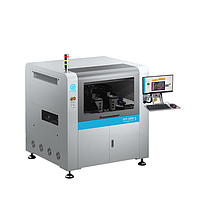
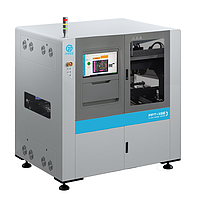
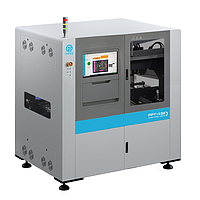
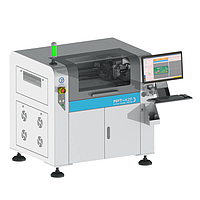
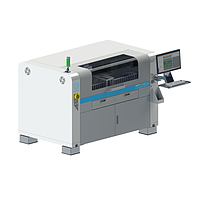
Board Test & Inspection System (BTIS)
Reliable electronics manufacturing depends on more than assembly speed. Boards and electronic modules also need to be checked at the right stages, with the right inspection method, so faults can be found early and production quality can remain consistent. This is where Board Test & Inspection System (BTIS) solutions become important across modern assembly and inspection lines.
This category brings together equipment and related tools used to inspect solder quality, verify PCB integrity, support fault diagnosis, and improve traceability in electronics production and repair workflows. Depending on the process step, BTIS may involve optical inspection, flying probe testing, power-off signature analysis, short-circuit localization, or robotic vision for product-level inspection.

Where BTIS fits in the production and quality process
Board testing and inspection is rarely a single-step activity. In practice, manufacturers often combine multiple methods to check solder paste deposition, verify assembled boards, isolate defects, and confirm product appearance or dimensional quality before shipment. The result is a more controlled process with fewer escapes to downstream stages.
For example, solder paste quality can be evaluated before reflow, while electrical contact and net verification may be handled by a flying probe tester. Later in the line, robotic or camera-based systems can inspect finished assemblies or device surfaces for visible defects and traceability features such as labels or barcodes.
Common inspection approaches in this category
Optical and vision-based inspection is used when manufacturers need fast, repeatable checks for shape, position, surface condition, or coating quality. A representative example is the TRI TR7007D Solder Paste Inspection system, which is designed to detect issues such as insufficient paste, excess paste, missing paste, bridging, and shape deformity while also measuring parameters such as height, area, volume, and offset.
For broader automation tasks, systems from Vitrox illustrate how robotic vision can be applied beyond bare PCB inspection. Models such as V9i, V910i, and V920i show how vision platforms can support coating inspection, SSD final inspection, cosmetic checks, dimensional measurement, and multi-sided product verification in automated environments.
Electrical and fault-focused testing addresses a different problem: finding board-level defects that are not always visible. Power-off diagnostic tools and signature analysis systems help compare good and faulty boards without fully energizing the unit under test, which can be valuable in troubleshooting and repair benches as well as service environments.
Examples of BTIS equipment and supporting tools
The category includes both complete inspection systems and supporting components used in test ecosystems. On the system side, the Huntron 2800 is relevant for power-off testing on the electronic repair bench, while the ProT Ar-Ge (FADOS) FADOS9F1 combines fault detection and oscilloscope-related functionality for diagnostic work.
For multilayer PCB fault isolation, the Polar Toneohm 950 is aimed at locating short circuits, which is especially useful when troubleshooting inner-layer or plane-related issues. In production test environments, Takaya accessories such as the LS-457-01 probe wire, LS-458-01 probe wire, SA941-46616PO probe socket, and xxx-00221 probe pin play a supporting role in keeping a flying probe setup operating correctly and consistently.
Some users also evaluate this category alongside a broader vision inspection system offering when the requirement extends from PCB-level inspection to product-level appearance checks or automated defect recognition.
How to choose the right BTIS solution
The most practical starting point is the inspection objective. If the main concern is solder paste deposition, a dedicated SPI platform is more suitable than a general vision station. If the goal is board troubleshooting, signature analysis, power-off comparison, or short detection may be more relevant than high-speed inline imaging.
The second factor is where the system sits in the process. Inline inspection usually prioritizes throughput, repeatability, and integration with conveyors or handling equipment. Bench-top or repair-oriented tools place more value on accessibility, diagnosis support, and operator-guided fault localization. If transport and material flow are part of the project, related infrastructure such as a conveyor system may also influence final equipment selection.
A third consideration is the type of defect or measurement that matters most. Some applications focus on cosmetic defects, missing material, or positional errors. Others require electrical behavior comparison, layer short detection, or dimensional measurement. Choosing the wrong inspection principle can create blind spots, even if the machine itself is highly capable.
Typical applications across industries
BTIS solutions are widely used in electronics manufacturing services, OEM and ODM environments, and repair or failure-analysis workbenches. In PCB assembly, they help reduce defect propagation between paste printing, component placement, reflow, and final inspection stages. In product assembly, they also support quality verification for finished electronic devices and subassemblies.
Automotive electronics is one clear example where visual quality, dimensional consistency, and defect traceability are all important. Some applications may overlap with larger automation projects, including systems used to automate automobile production lines, where board inspection and product inspection need to work as part of a connected manufacturing cell.
Why a mix of inspection methods is often necessary
No single test method can cover every failure mode. Optical systems are strong at identifying visible defects and geometric variation, but they may not reveal all electrical issues. Power-off test tools can highlight abnormal signatures or shorts, yet they do not replace process inspection earlier in the line. That is why many manufacturers build a layered strategy around process control, defect screening, and troubleshooting support.
In practical terms, a production line may use SPI to catch paste-related issues, flying probe testing for electrical verification, and robotic vision for end-of-line confirmation. Support tools and consumable test parts, such as Takaya probe accessories, then help maintain measurement stability over time. This combination often leads to better fault coverage than relying on a single inspection step.
Working with leading manufacturers in this category
This category features solutions and accessories from established names including Vitrox, Huntron, Polar, Takaya, TRI, and ProT Ar-Ge (FADOS). Each of these manufacturers is associated with a different part of the board test and inspection workflow, from solder paste inspection and robotic vision to troubleshooting, short-circuit localization, and flying probe support.
When comparing options, it is worth looking beyond product names alone. Focus instead on the inspection method, target defect type, board or device format, and how the equipment fits into your existing production or service process. That approach usually leads to a more efficient and scalable BTIS setup.
Conclusion
Choosing a suitable Board Test & Inspection System (BTIS) starts with understanding what needs to be detected, when the check should happen, and how the result will be used in production or repair. From solder paste inspection and robotic vision to signature analysis, short-circuit localization, and flying probe support, this category covers several complementary paths to better board quality.
If you are building or upgrading an inspection workflow, review the available systems in the context of your boards, defect modes, throughput targets, and integration requirements. A well-matched BTIS solution can improve fault detection, streamline troubleshooting, and strengthen quality control across the full assembly and inspection process.
Get exclusive volume discounts, bulk pricing updates, and new product alerts delivered directly to your inbox.
By subscribing, you agree to our Terms of Service and Privacy Policy.
Direct access to our certified experts