Non-Reversible Temperature Labels
When it is important to know whether a surface has ever crossed a critical temperature, a simple visual indicator can often be more practical than a continuous electronic sensor. Non-reversible temperature labels are designed for exactly that purpose: they provide a permanent record that a threshold has been reached, making them useful for inspection, maintenance, storage control, and process verification.
These labels are commonly applied to equipment housings, pipes, motors, panels, bearings, HVAC components, and packaged goods where overheating or temperature excursion needs to be identified quickly. In industrial environments, they help teams confirm whether a thermal event occurred even after the equipment has cooled down.

How non-reversible temperature labels work
A non-reversible label changes appearance once a specified temperature point is reached, and that change remains visible. This makes it suitable for applications where operators need a clear maximum temperature record rather than a live reading. The label can then be checked during routine maintenance, incoming inspection, or troubleshooting without requiring power, wiring, or handheld instruments.
Compared with reversible temperature labels, the non-reversible type is better suited to documenting one-time or peak thermal exposure. It is especially useful when a short overheating event may be missed by periodic manual checks but still needs to be verified afterward.
Typical formats and temperature point configurations
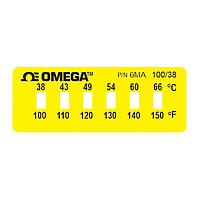
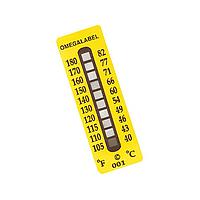
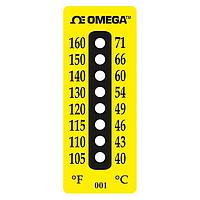
This category includes several label layouts to match different mounting spaces and monitoring needs. Single-point micro-dot styles are helpful when only one threshold matters and installation space is limited. Circular multi-point labels and strip-style indicators are a practical option when users want to track progression across several temperature points instead of only a single trigger value.
Examples from OMEGA illustrate this range well. The MD-150F-30 and MD-300F-30 are compact single-point micro-dot labels for simple pass/fail monitoring at fixed temperatures. For broader visibility across a temperature band, models such as the TL-C-130, TL-C-290, TL-3-150-30, TL-3-300-30, TL-E-330, and TL-8-410-30 provide multiple indication points in circular or strip formats.
Where these labels are commonly used
Non-reversible temperature labels are widely used anywhere an over-temperature event can affect reliability, safety, or product quality. Common examples include motors, transformers, pumps, compressors, power electronics, switchgear, bearings, and heated process equipment. They are also useful in building services and HVAC systems, where maintenance teams may need a simple visual confirmation of abnormal heating.
Some label ranges in this category are also suitable for aeronautics and aerospace, air and HVAC, building and maintenance, and general-purpose inspection work. Low-temperature variants can help monitor chilled or temperature-sensitive assets, while higher-range labels support hot-surface monitoring on process lines and industrial machinery.
Choosing the right label for your application
The best choice depends on how much temperature detail you need and how the label will be checked in practice. A single-point indicator is often enough when the question is simply whether a defined limit was exceeded. If you need a better understanding of how far the temperature progressed, a 3-point, 4-point, or 8-point label can provide more context while still remaining easy to read on site.
Temperature range is equally important. In this category, available examples cover low values such as the TL-CC/9C for chilled conditions, mid-range options such as the TL-C-130 and TL-3-150-30, and higher-temperature labels including the TL-E-330 and TL-8-410-30. For compact surfaces, round or micro-dot formats may fit better, while strip labels are often preferred for elongated mounting areas or when multiple temperature steps are needed.
What to consider during installation and use
For reliable indication, the label should be applied to a clean surface with good thermal contact. Placement matters: the chosen location should represent the actual area of concern, such as a bearing housing, motor casing, pipe section, or enclosure hotspot. If the monitored surface has varying temperature zones, selecting the right mounting point is just as important as selecting the right temperature range.
Response time and readability also influence usability. Many labels in this category are designed for fast indication, which helps in identifying short-duration thermal events. Because they remain permanently changed after activation, they are particularly helpful for maintenance records, warranty inspection, and condition-based servicing where a visible historical marker adds value.
Examples of labels in this category
Several products in this range show how different monitoring requirements can be addressed. The OMEGA BUA2-180/82 Bulls-Eye label provides four temperature points in a compact circular layout, which is useful when more than one threshold must be observed in a small footprint. The TL-C series follows a similar multi-point concept, while the TL-3 and TL-8 strip formats extend that approach across 3 or 8 points for broader thermal tracking.
Where space is extremely limited, the MD series offers a small-format alternative for fixed threshold monitoring. At the other end of the range, labels such as the TL-8-410-30 support higher-temperature applications where a broader band of thermal escalation needs to be captured. If your process requires a different type of irreversible visual indicator, temperature lacquer may also be relevant for comparison.
Why these labels remain useful in industrial maintenance
In many facilities, not every asset justifies a permanently installed sensor, transmitter, or data logger. Temperature indicating labels offer a low-complexity way to monitor thermal exposure on assets that are numerous, distributed, mobile, or only checked periodically. They can complement handheld inspection methods and help maintenance teams narrow down which equipment needs further investigation.
This approach is particularly valuable in preventive maintenance programs, shutdown inspections, and field service work. A technician can quickly identify whether a unit has crossed a threshold and then decide whether more detailed measurement is necessary. That makes non-reversible labels a practical tool for screening and documentation rather than a replacement for full instrumentation.
Final considerations
If you need a permanent visual record of surface temperature exposure, non-reversible temperature labels are a straightforward and efficient choice. The category includes compact single-point options, multi-point circular labels, and strip formats for both low- and high-temperature applications, making it easier to match the label to the surface, temperature range, and inspection method.
For applications where a temporary color change is more appropriate, reversible alternatives may be worth reviewing. But when the requirement is to confirm that a threshold was reached and keep that evidence visible afterward, this category provides a practical solution for industrial monitoring, maintenance, and quality control.
Get exclusive volume discounts, bulk pricing updates, and new product alerts delivered directly to your inbox.
By subscribing, you agree to our Terms of Service and Privacy Policy.
Direct access to our certified experts