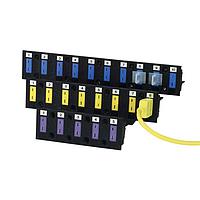
Jack Panels
In temperature measurement systems with many sensing points, clean signal routing becomes just as important as the sensors themselves. A well-organized Jack Panels setup helps technicians connect, identify, and service thermocouple or RTD channels more efficiently, especially in laboratories, pilot plants, test benches, and industrial monitoring panels.
Instead of running loose point-to-point wiring to instruments, jack panels create a structured interface for multiple sensor connections. This makes troubleshooting easier, reduces wiring confusion, and supports faster reconfiguration when channels need to be moved, checked, or isolated.

Why jack panels matter in multi-channel temperature measurement
When several thermocouple or RTD signals must be brought into a single enclosure or control station, panel-based connection hardware provides a practical way to keep the installation manageable. A jack panel groups multiple connection points into one front-accessible assembly, helping operators maintain clear channel organization and reducing the chance of wiring errors during maintenance.
This format is especially useful where instruments are shared, temporary measurements are common, or sensor circuits need to be switched and verified regularly. In these situations, panel organization and connector consistency can directly affect uptime, traceability, and service speed.
Typical configurations available in this category
This category includes 19-inch jack panel assemblies designed for thermocouple and RTD connector layouts. The listed OMEGA models show common capacities such as 20, 30, and 40 jack positions, arranged in multiple rows to suit different panel heights and channel densities.
Examples in this range include the OMEGA 19TJP2-20-K-OSW-MTR for 20-channel K-type applications and the OMEGA 19TJP4-40-T-OSW-MTR for higher channel count T-type installations. These examples illustrate how the category supports both moderate and larger multi-point measurement layouts without changing the overall panel form factor.
Thermocouple types and connector matching
One of the key selection points for jack panels is compatibility with the sensor type used in the system. The products shown in this category cover several common thermocouple calibrations, including J, K, T, E, and U, with ANSI color coding and matching connector formats. Correct alloy pairing matters because it helps preserve measurement integrity across the connection path.
For that reason, a panel intended for K-type thermocouples should not be treated as interchangeable with one configured for J or T type circuits. Even when the physical layout appears similar, the underlying contact and material pairing are part of the measurement chain. If your application uses multiple sensor styles across one installation, it may also be helpful to review related options such as panel mount connectors for distributed connection points.
How to choose the right jack panel
The first practical question is channel count. A 20-jack panel may be enough for compact test stations or smaller machine skids, while 30- or 40-jack assemblies are often better suited to central monitoring panels, environmental test systems, or research setups with many temperature points.
The next consideration is connector style and installation workflow. In this category, the products use 3-prong standard female thermocouple connector interfaces and include meter cutout configurations, which can be useful where front-panel access and instrument integration are part of the design. It is also worth checking whether your wiring approach is fixed or frequently changed; for more flexible site termination work, field wireable connectors may complement a panel-based setup.
Where these assemblies are commonly used
Jack panels are widely used anywhere multiple temperature signals must be brought together in an orderly and serviceable way. Common environments include process development labs, thermal performance testing, furnace and oven monitoring, data acquisition racks, and control cabinets that support commissioning or diagnostics.
They are also a strong fit for applications where operators need repeatable connection labeling and front-panel accessibility. Compared with ad hoc wiring, a dedicated jack panel can simplify documentation, reduce service time, and make future expansion more predictable. In broader connector ecosystems, users may also compare these solutions with DIN rail connectors when cabinet layout and modular wiring distribution are a priority.
OMEGA jack panel examples in this category
OMEGA is the featured manufacturer in this category, with multiple 19-inch panel assemblies designed around standardized thermocouple and RTD connection practices. The product selection reflects a practical spread of capacities and thermocouple types rather than a single one-size-fits-all format.
For example, the 19TJP2 series provides 20-jack configurations in a more compact panel height, while the 19TJP3 and 19TJP4 series extend capacity to 30 and 40 jacks respectively. Available variants for J, K, T, E, and U applications help buyers align the panel with the sensor chemistry already used in the measurement loop.
Integration considerations for B2B buyers and engineers
For OEMs, panel builders, and maintenance teams, connector hardware is not only a purchasing line item but also part of the long-term service strategy. Choosing the right panel means thinking about labeling practices, channel growth, operator access, and the risk of mismatched sensor connections during maintenance.
A consistent connector standard across the facility can simplify spare parts planning and reduce confusion between teams working on instrumentation, controls, and testing. When a project calls for structured multi-channel temperature access at the front of a rack or enclosure, these panel assemblies offer a straightforward way to support both installation quality and maintainability.
Final thoughts
For multi-point temperature systems, the value of a jack panel lies in clarity, consistency, and easier handling of measurement circuits over time. This category is best suited to users who need organized front-panel access for thermocouple or RTD connections and want to match channel density, connector format, and thermocouple type to the actual application.
By reviewing panel capacity, sensor compatibility, and integration needs up front, buyers can narrow the selection more effectively and build a more reliable measurement interface for daily operation, testing, and service.
Get exclusive volume discounts, bulk pricing updates, and new product alerts delivered directly to your inbox.
By subscribing, you agree to our Terms of Service and Privacy Policy.
Direct access to our certified experts