Infrared Temperature Sensor
When contact measurement is difficult, slow, or simply not practical, non-contact sensing becomes the preferred approach. In production lines, moving targets, hot surfaces, rotating equipment, and hard-to-reach installations often require fast and reliable temperature monitoring without touching the process. That is where Infrared Temperature Sensor solutions fit naturally into industrial temperature measurement systems.
Within this category, you will find non-contact sensors and transmitters designed for continuous monitoring, signal integration, and process control. These devices are commonly selected for applications where response time, installation flexibility, and reduced sensor wear are more important than direct-contact probe measurement.
Where infrared temperature sensors are used
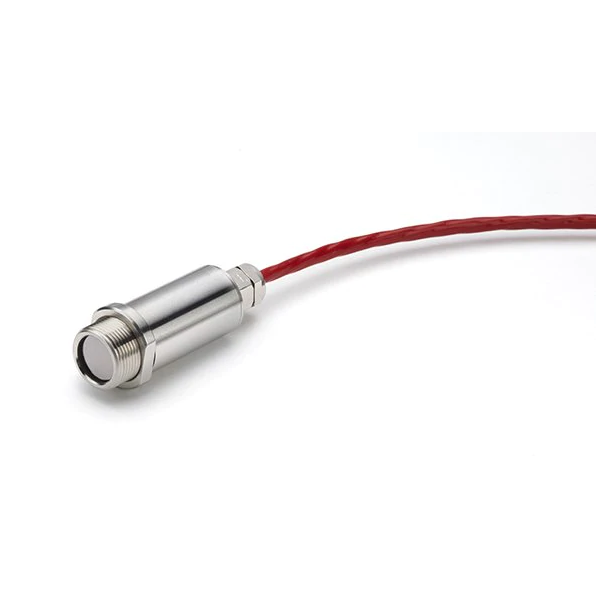
An infrared sensor measures thermal radiation emitted by a target surface and converts it into a usable temperature signal. In industrial environments, this makes it useful for monitoring hot metal, coated materials, plastics, ceramics, conveyors, rollers, packaged goods, and equipment surfaces where a contact probe may be too slow or intrusive.
Compared with many contact-based devices, non-contact temperature measurement helps reduce mechanical wear on the sensor itself and can simplify installation around moving or energized parts. It is especially helpful when the target is distant, contaminated, or operating at temperatures that are difficult for conventional contact probes to handle continuously.
Typical product formats in this category
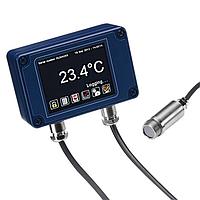
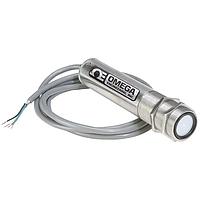
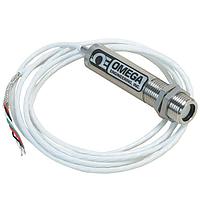
This category includes several common formats, from compact fixed sensors to transmitter-style units for PLC and control-system integration. A model such as the OMEGA OS212-MT is suited to fixed installation where adjustable emissivity and current output are needed, while the OMEGA OS554AM-MA-1 adds a display and alarm-oriented functionality for local monitoring scenarios.
For applications that require both process output and digital setup access, Modbus-capable models such as the OMEGA OS801A-2USB-MT, OS751A-2USB-MT, and OS251A-2USB-MT illustrate how infrared sensing can be integrated into broader automation architectures. The range also includes optics variants for close focus or longer-distance measurement, allowing users to match the sensor to the target size and installation distance rather than relying on a one-size-fits-all approach.
What to consider when selecting an infrared sensor
The first decision is usually the measurement distance and spot size. Optical ratio and field of view determine how much of the target is actually being measured. If the target is small or the sensor must be mounted farther away, a tighter optical ratio may be needed. If the application involves close-range measurement of a small area, close-focus optics can be more appropriate.
The second consideration is temperature range. The products shown in this category cover very different operating windows, from lower-range models such as the OMEGA OS151A-2USB-LT up to high-temperature transmitters like the OMEGA OS801A-2USB-HT and OS751A-2USB-HT. Selecting too broad a range can reduce optimization for the actual process, while selecting too narrow a range may limit future operating flexibility.
Output and communications are equally important. Some installations only need a standard 4-20 mA loop, while others benefit from voltage output, USB setup, or Modbus connectivity for diagnostics and configuration. Environmental factors such as enclosure rating, ambient temperature, mounting method, and available power supply should also be checked early in the selection process.
Why emissivity and surface condition matter
Infrared measurement depends not only on the sensor but also on the target surface. Materials with different finishes, oxidation states, coatings, or reflectivity can emit thermal radiation differently, which is why emissivity is a critical parameter in real applications. A sensor with adjustable emissivity can help improve measurement consistency when the target material is known and stable.
This is one reason models like the OMEGA OS212-MT are useful in industrial settings where surfaces are not all alike. In reflective or variable-surface applications, the measurement setup may also require attention to viewing angle, background radiation, and shielding from surrounding heat sources. Good sensor selection should therefore be paired with correct installation practice.
Integration with control and automation systems
Many buyers in this category are not just looking for a standalone temperature reading; they need a sensor that can fit into a broader control strategy. Current and voltage outputs support straightforward connection to controllers, indicators, and analog input modules, while USB and Modbus options provide a practical path for setup, commissioning, and diagnostics.
For plants standardizing on industrial instrumentation, products from OMEGA in this category show how infrared transmitters can bridge local sensing and centralized monitoring. If your application also includes contact-based sensing for comparison points or backup measurement, it may be useful to review related industrial temperature sensors for mixed measurement strategies.
Examples of application-driven selection
In general-purpose monitoring, a model such as the OMEGA OS301A-USB offers a balance between optical performance and broad temperature capability. For smaller targets at closer distances, the OMEGA OS801A-USB and OS801A-2USB-MT highlight the role of close-focus optics in improving measurement precision on compact areas.
Where installation requires a narrower field of view over longer distances, 75:1 models such as the OMEGA OS751A-2USB-MT or OS751A-2USB-HT can be more suitable. In hotter industrial processes, the higher-range HT variants help address applications where standard mid-range infrared sensors may not be sufficient. Accessories also play a role: the OMEGA OS36-APC Cooling Jacket Kit is an example of a supporting component used to help protect compatible infrared thermocouples in demanding thermal environments.
How infrared sensors fit within a broader temperature sensing system
Infrared devices are often selected alongside contact sensors rather than replacing them in every case. Contact technologies remain important for embedded measurement, fluid monitoring, and applications where direct thermal contact is required. Depending on the process, engineers may combine infrared units for surface or moving-target measurement with other sensor types for internal or reference-point readings.
For example, some projects also compare options such as K-type temperature sensors for high-temperature contact measurement or thermistor sensors where sensitivity in narrower temperature bands is important. Understanding that system context helps narrow down whether an infrared sensor should serve as the primary measurement device or as part of a multi-sensor architecture.
Choosing the right category for your application
If your priority is fast response, no physical contact with the target, and easier measurement of hot, moving, or inaccessible surfaces, this category is a strong starting point. The available range includes compact fixed sensors, configurable transmitters, display-equipped units, and accessory options for more demanding installations.
Selection should ultimately be based on target material, distance, optical requirements, temperature range, and the type of output your control system expects. By matching those practical factors to the right infrared sensor format, it becomes much easier to build a temperature monitoring setup that is accurate, maintainable, and aligned with the process environment.
Get exclusive volume discounts, bulk pricing updates, and new product alerts delivered directly to your inbox.
By subscribing, you agree to our Terms of Service and Privacy Policy.
Direct access to our certified experts