Pin Gauge
When hole size, slot width, or small bore accuracy needs to be checked quickly and repeatably, simple contact gauges are often more practical than relying on visual estimation or general-purpose measuring tools alone. Pin gauges are widely used in machining, toolmaking, quality control, and inspection workflows because they provide a direct way to verify dimensional fit on small internal features.
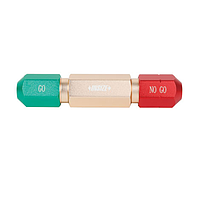
In this category, you can explore individual pins and gauge sets used for go/no-go style checks, comparative inspection, and fine dimensional verification. This makes the range especially useful for workshops and inspection departments working with precision components, jigs, molds, dies, and machined parts where small diameter accuracy matters.
What pin gauges are used for
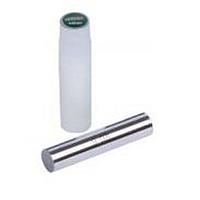
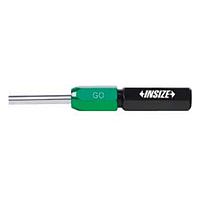
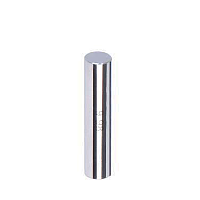
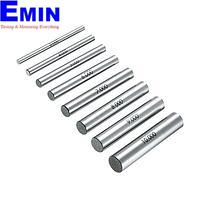
A pin gauge is a precision cylindrical standard used to check the size of a hole or gap by physical fit. In daily inspection work, operators use them to confirm whether a feature is within tolerance, compare bore size during machining, or verify tooling wear over time. Their value comes from speed, consistency, and the ability to assess small internal dimensions that may be awkward to measure with calipers alone.
They are commonly applied in metalworking, fixture validation, mold and die maintenance, and incoming or final QC. For many users, the main advantage is straightforward decision-making: if a specific pin enters the feature correctly and the next size does not, the approximate dimension can be determined quickly with minimal setup.
Common formats in this category
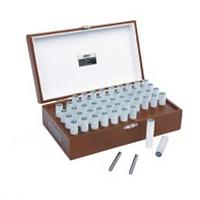
This range includes both individual steel pin gauges and multi-piece sets. Individual sizes are useful when a production line repeatedly checks one known diameter, while sets are more suitable for toolrooms, laboratories, or inspection benches that handle a wider variety of parts.
Examples in this category include compact single-size options such as the Niigata Seiki AA 0.10mm Steel Pin Gauge, Niigata Seiki AA 0.200mm Steel Pin Gauge, Niigata Seiki AA 0.300mm Steel Pin Gauge, and Niigata Seiki AA 1.000mm Steel Pin Gauge. For broader coverage, MOORE & WRIGHT offers set-based options such as the MW725 series, including ranges like 3.01-4.00mm, 4.01-5.00mm, 5.01-6.00mm, 6.01-7.00mm, 7.01-8.00mm, 8.01-9.00mm, and 9.01-10.00mm in fine increments.
How to choose the right pin gauge
The first selection factor is the diameter range you need to inspect. If your process repeatedly checks one feature size, a single pin can be efficient and economical. If parts vary across multiple diameters, a matched set helps reduce downtime and gives inspectors more flexibility during setup, troubleshooting, and batch verification.
The second factor is increment and tolerance requirement. A set with fine step progression is useful when you need closer comparison between nearby bore sizes. It is also worth considering how the gauge will be used in production: routine shop-floor checking may call for a robust, easy-to-handle set, while higher-precision inspection may require a more tightly managed gauge inventory and careful storage discipline.
Finally, think about the inspection method itself. Pin gauges are excellent for direct fit checking, but they are often part of a broader metrology workflow. Depending on the application, users may also work with setting rings or other dimensional standards to maintain confidence in measurement systems across different tool types.
Representative brands and product examples
Several well-known manufacturers are associated with precision gauging and mechanical measurement. Within this category, brands such as MOORE & WRIGHT and Niigata Seiki are particularly relevant based on the available product range, while other recognized names in the broader gauging ecosystem include Mahr, MITUTOYO, EISEN, Vermont Gage, VOGEL, and SOKUHANSHA.
For users needing a broad inspection range in one package, the MOORE & WRIGHT MW725 steel pin gauge sets are practical examples of organized set-based gauging. For highly specific diameter checks, Niigata Seiki AA series pins illustrate the role of single-size gauges in repetitive inspection tasks. Where internal dimensions are larger and need a comparative contact tool rather than a fixed cylindrical standard, a product such as the MOORE & WRIGHT MW315-01 Telescopic Gauges Set (8-150mm) can complement pin-based inspection rather than replace it.
Where pin gauges fit in a measurement workflow
Pin gauges are rarely used in isolation in a professional inspection environment. They often sit alongside micrometers, bore measurement tools, gage blocks, and thread or profile checking tools. Their main role is to provide a fast physical reference for internal dimensions, especially when repeatability and operator efficiency are important.
If your work also involves thread identification or template-style comparison, it can be helpful to review related tools such as pitch gages. For applications involving broader gauge standards and setup references, other precision categories can support a more complete inspection routine without overcomplicating day-to-day checks.
Good handling and storage practices
Because these tools are used as dimensional references, proper care directly affects reliability. Pin gauges should be kept clean, protected from corrosion, and returned to their case or designated storage after use. Dirt, oil residue, or accidental impact can influence fit and lead to incorrect inspection decisions, particularly on very small diameters.
Users should also avoid forcing a pin into a hole that appears undersized, as this can damage the workpiece, the gauge, or both. In precision environments, it is good practice to verify handling condition regularly and separate worn or questionable gauges from production use until they can be checked against appropriate standards.
Choosing by application instead of by catalog alone
The most effective way to select from a pin gauge range is to start with the actual inspection problem: the feature size, expected tolerance band, inspection frequency, and whether you need a single reference size or a progressive set. This approach is usually more useful than choosing only by brand or by the longest specification list.
For high-mix production, a gauge set may offer the flexibility needed for setup and verification across many parts. For repetitive production with stable dimensions, a dedicated single-size pin may streamline inspection and reduce unnecessary handling. In both cases, the goal is the same: dependable dimensional confirmation with a simple, repeatable tool.
Conclusion
Pin gauges remain one of the most practical tools for checking small internal dimensions in precision manufacturing and quality control. Whether you need a single steel pin for a repeat dimension or a multi-piece set for wider inspection coverage, the right choice depends on how your parts are made, how often they are checked, and how fine the size differentiation must be.
By comparing format, range, and intended inspection use, buyers can narrow the selection to gauges that support faster checks and more consistent decisions on the shop floor or in the QC room. If your measurement process also depends on related dimensional standards, it may be worth exploring categories such as angle gage blocks where relevant to your broader setup and inspection workflow.
Get exclusive volume discounts, bulk pricing updates, and new product alerts delivered directly to your inbox.
By subscribing, you agree to our Terms of Service and Privacy Policy.
Direct access to our certified experts