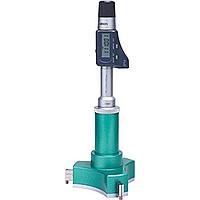
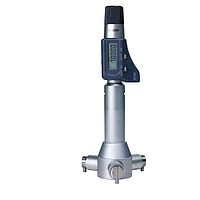
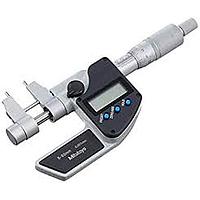
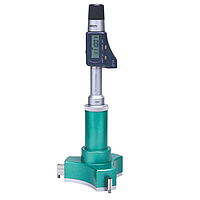
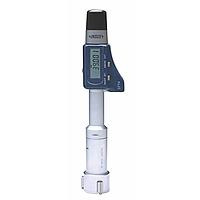
Digital inside micrometer
Accurate bore and internal diameter measurement is essential in machining, toolmaking, maintenance, and quality control. When operators need fast readings, easy unit conversion, and clear display feedback, a digital inside micrometer becomes a practical choice for checking holes, sleeves, bushings, and other internal features where small dimensional errors can affect fit and performance.
This category brings together digital instruments designed for internal measurement across small and larger diameter ranges. Whether the task involves routine workshop inspection or more repeatable dimensional verification in production, these tools help users read measurements quickly while maintaining the fine resolution expected from precision micrometer systems.
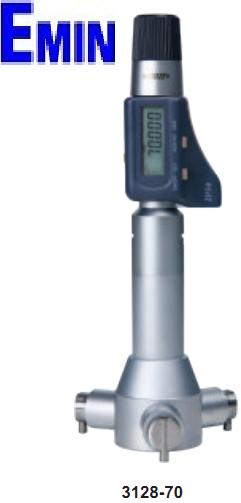
Where digital inside micrometers are typically used
Internal measurement often requires more control than external gauging because contact points must be positioned correctly inside a bore. In applications such as checking bearing seats, machined housings, cylinders, or precision components, digital readout reduces interpretation errors and helps operators work more efficiently.
Compared with standard mechanical internal measuring tools, digital models are often preferred when the workflow benefits from easier reading, metric and inch display, or functions such as zero setting and data handling. For teams comparing internal and external dimensions during inspection, it may also be useful to review related outside micrometers for shaft and surface measurement tasks.
Key features to look for in this category
One of the most important factors is measuring range. In this category, available examples cover compact ranges such as 5-30 mm and 25-50 mm, as well as larger internal measuring solutions extending into wider diameters. Choosing the correct range matters because micrometers deliver their best usability and accuracy when matched closely to the expected bore size.
Another core point is resolution and accuracy. Several featured models offer 0.001 mm resolution, which supports fine adjustment and detailed dimensional control. Accuracy values vary by size range, so users should evaluate the instrument not only by digital display resolution but also by the actual measurement tolerance required by the part drawing or inspection plan.
For some applications, contact design also matters. Sets based on 3-point internal measurement can provide stable centering and repeatable contact inside the bore, while extension-based systems are useful when measuring larger diameters or deeper internal features.
Examples of available product types
The category includes compact digital inside micrometers from MOORE & WRIGHT, such as the MW280 series, with examples covering 5-30 mm, 25-50 mm, 50-75 mm, 75-100 mm, 100-125 mm, and 125-150 mm ranges. These examples illustrate a structured range progression that helps users choose a tool close to the bore sizes they inspect most often.
For broader internal measuring requirements, MITUTOYO appears in this category with solutions such as the 339-301 Inside Micrometers for 200-1000 mm measurement and digital 3-point internal micrometer sets including 468-975 and 468-978. These examples show that the category is not limited to one measuring format; it also supports users who need modular or set-based solutions for different bore sizes and inspection routines.
Some listed items also include accessories such as extension rods, which play an important role in extending the usable range of an internal measuring system rather than acting as standalone primary instruments.
How to choose the right instrument
Start with the bore size range you need to cover most frequently. If the work is focused on smaller diameters, a compact digital inside micrometer with a narrower range may be the simplest and most efficient option. If measurement tasks span many bore sizes, a set or an extension-based system may be more practical.
Next, consider the required measurement method. A 3-point internal micrometer is often selected when users want stable positioning and good repeatability inside the bore. For larger internal dimensions, systems with extension pipes or rods can be more suitable, especially when a single instrument must adapt to multiple measurement spans.
It is also useful to think about the operating environment. In workshop or production use, buyers may prefer digital models with features such as easy display reading, battery-powered operation, and data output where traceability matters. If your inspection process also includes non-digital methods, you may want to compare this category with standard inside micrometers to determine which reading style best fits your team.
Why digital readout can improve measurement workflow
The main advantage of digital display is not only convenience, but also consistency in daily use. Operators can read values more quickly, switch between units on compatible models, and reduce the chance of misreading a scale during repetitive inspection. This is especially helpful when several parts must be checked in sequence or when results need to be recorded efficiently.
In more advanced inspection setups, some digital internal micrometers also support data output or additional electronic functions depending on the model. These features can be helpful in controlled quality processes where measurement values need to be transferred, logged, or verified as part of a broader dimensional control routine.
Brand and range considerations
This category highlights recognized metrology brands including Mahr, MITUTOYO, and MOORE & WRIGHT. While the currently featured product examples are concentrated around MITUTOYO and MOORE & WRIGHT, the broader brand context is useful for buyers who standardize measurement equipment by manufacturer, service preference, or compatibility with existing inspection practices.
Rather than selecting by brand alone, it is better to compare instrument style, range coverage, and measuring method. A compact single-range model may suit a dedicated workstation, while a larger set with accessories is often better for maintenance departments or inspection teams handling varied bore sizes across multiple parts.
Related measuring tools in the same workflow
Internal diameter control is rarely performed in isolation. In many machining and QA environments, engineers check bores together with shafts, wall thickness, or assembled fits. That is why digital internal measurement often sits alongside digital outside micrometers and other precision measuring tools within the same inspection process.
Supporting accessories can also improve handling and repeatability during manual measurement. For bench use or repeated verification at one station, a micrometer stand may help stabilize the setup and reduce operator fatigue when measuring multiple parts over time.
Find the right digital inside micrometer for your application
This selection is intended for users who need dependable internal measurement across different bore sizes, from smaller precision work to larger diameter inspection. By focusing on range, measurement method, readout preferences, and workflow needs, it becomes easier to narrow the category to the most suitable instrument or set.
If you are comparing options, use the listed products as practical reference points for available measuring spans and system styles. A well-matched digital inside micrometer supports faster reading, clearer measurement control, and more efficient inspection where internal dimensions matter most.
Get exclusive volume discounts, bulk pricing updates, and new product alerts delivered directly to your inbox.
By subscribing, you agree to our Terms of Service and Privacy Policy.
Direct access to our certified experts