Urea meter
In many industrial and automotive applications, checking urea concentration is a simple step with significant operational impact. Whether the goal is verifying DEF quality, monitoring AdBlue concentration, or selecting a practical handheld instrument for routine field checks, choosing the right urea meter depends on how and where the measurement will be used.
This category brings together instruments designed around light refraction measurement for urea-based liquids. The range includes compact analogue and digital refractometers suited to fast verification, incoming inspection, maintenance work, and general liquid testing where speed, portability, and easy handling matter.
Where urea meters are commonly used
Urea concentration measurement is especially relevant in diesel exhaust fluid control, where fluid quality directly affects SCR system performance. In practice, users often need a quick way to confirm whether the liquid is within the expected concentration range before use, during storage checks, or as part of service and maintenance procedures.
Some instruments in this category are tailored to broad-range urea measurement, while others focus on the narrower concentration window typically associated with AdBlue or DEF verification. For teams that also handle biological samples, a dedicated urine refractometer category may be more appropriate for that application.
Digital and analogue options for different workflows
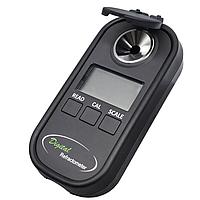
The most practical difference between models is often the display and operating method. Digital units are useful when users want a direct numeric reading, quick stabilization, and less interpretation by the operator. This is helpful in maintenance departments, incoming quality control, and routine testing where repeatable reading is important.
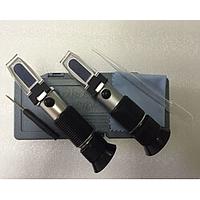
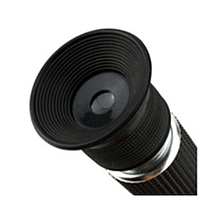
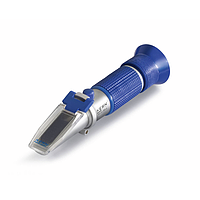
Analogue refractometers remain relevant when simplicity, low power dependence, and straightforward field use are priorities. Models such as the KERN ORA 1UA and KERN ORA 4UB illustrate this approach well, offering handheld measurement for urea-focused applications without the need for a more feature-rich digital interface.
Examples of instruments in this category
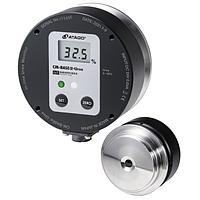
Several well-known manufacturers are represented here, including ATAGO, KERN, PCE, and Holani. Each brand contributes a slightly different style of instrument, from compact pocket meters to handheld digital refractometers and analogue tools intended for fast spot checks.
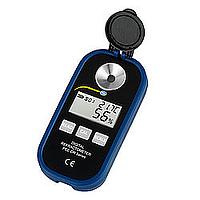
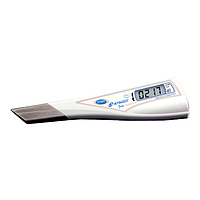
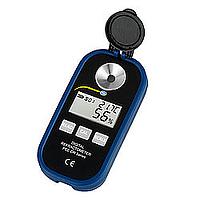
For example, the ATAGO PAL-UREA is a digital pocket refractometer built for measuring urea concentration across a broad range, making it suitable for rapid verification in portable use. The PCE DRU 1 is another handheld digital option for Urea / AdBlue measurement, while Holani models such as the D-602, MDR-602, and CS55-616 show how digital refractometers can be selected according to range, portability, and preferred measurement format.
For narrower application-specific checks, products such as Holani AD-2, Holani AD-3, and KERN ORA 4UB are useful examples of handheld instruments intended for DEF or AdBlue related measurement. Rather than comparing devices only by brand, it is usually more helpful to match the instrument to the required concentration range and the working environment.
How refractometer-based urea measurement works
Most products in this category use the refractive index of a liquid sample to estimate concentration. In practical terms, the user places a small amount of sample on the prism or sensor area, starts the reading process if required, and the instrument converts the optical response into a urea concentration value or a related scale.
This method is popular because it requires only a small sample volume and delivers fast results. Many digital models also include automatic temperature compensation, which helps maintain measurement consistency within a specified ambient temperature range. That makes refractometer-based devices a convenient choice for on-site checks, workshops, service vehicles, and general industrial handling.
What to consider when selecting a urea meter
The first point is the measurement range. Some instruments cover a wide urea range, such as 0 to 51% or 0 to 55%, while others focus on the narrower window used for AdBlue or DEF verification, such as 30 to 35% or 0 to 40%. The correct range depends on whether you need general concentration measurement or a pass/fail style check around a target operating zone.
The second point is the measurement format. Digital models can improve readability and speed in repetitive testing, while analogue models may be enough for occasional field checks. Environmental factors also matter, including temperature compensation range, ingress protection, battery type, and how easy the device is to clean and carry.
It is also worth considering whether the same team handles multiple liquid testing methods. In some maintenance or lab workflows, urea concentration checks may sit alongside quick screening tools such as test paper or other consumables depending on the process.
Choosing by application instead of by brand alone
Brand can be a useful starting point, but in B2B purchasing the application usually matters more than logo preference. ATAGO is often considered when users need compact digital handheld refractometers for straightforward routine checks. Holani provides several digital and handheld options across broader and narrower urea-related ranges, while PCE and KERN offer alternatives that may better fit specific operating habits or budget structures.
For procurement teams standardizing equipment, it can be helpful to review the wider portfolio of Holani or compare available handheld formats from other listed manufacturers before deciding. The best fit is typically the model that aligns with sample type, target range, user skill level, and frequency of testing.
Typical use cases in service, workshop, and inspection environments
In automotive and fleet maintenance, urea meters are commonly used to confirm DEF or AdBlue concentration before filling or troubleshooting. A fast handheld reading helps identify off-spec fluid, possible dilution, or storage-related issues without requiring a more complex lab setup.
In industrial settings, these instruments can also support incoming goods inspection, storage checks, and general liquid verification where a portable measuring tool is preferred. When combined with other liquid testing methods, such as other reagents used in broader analysis workflows, refractometer-based urea measurement becomes part of a practical on-site quality control routine.
Finding the right instrument for routine measurement
This category is best approached by thinking about the actual measurement task: broad-range urea testing, narrow-range DEF verification, analogue field checking, or digital handheld convenience. Looking at the required concentration range, reading method, environmental conditions, and operator workflow will usually narrow the options quickly.
If you are selecting a urea meter for workshop service, industrial inspection, or portable liquid testing, the models in this category provide several practical routes—from compact digital pocket instruments to traditional handheld analogue refractometers. A careful match between application and measuring range will lead to a more reliable and efficient testing process.
Get exclusive volume discounts, bulk pricing updates, and new product alerts delivered directly to your inbox.
By subscribing, you agree to our Terms of Service and Privacy Policy.
Direct access to our certified experts