Rubber Hardness Tester Calibrator
Consistent hardness measurement starts with reliable verification. In quality control for rubber, elastomers, and related materials, even small deviations in test force can affect inspection results, process decisions, and product acceptance. A Rubber Hardness Tester Calibrator helps technicians check whether a hardness tester is applying force within the expected range and accuracy, supporting more dependable testing routines.
For laboratories, production lines, and inspection departments, this category focuses on calibration equipment used to validate rubber hardness testing performance. It is especially relevant where traceable measurement, repeatability, and routine instrument checks are part of the quality workflow.
Why calibration matters in rubber hardness testing
Rubber hardness values are often used to confirm material consistency, compare batches, and support incoming or final inspection. If the tester itself is not performing correctly, the hardness result may not reflect the actual condition of the sample. That creates unnecessary risk in production, supplier evaluation, and compliance-related documentation.
Using a dedicated calibrator helps verify the force applied by the instrument and supports a more controlled testing process. In practice, this is important for teams that need measurement repeatability across shifts, operators, or multiple test stations.
What this category is used for
This category is intended for users who need equipment for checking and calibrating rubber hardness testers rather than for performing hardness measurement on the material itself. These instruments are typically used during scheduled maintenance, internal verification, or metrology-related checks before a tester is returned to service.
In many industrial settings, hardness testing is only one part of a broader calibration workflow. Depending on the application, users may also work with multifunction calibrators, pressure calibrator systems, or temperature calibrators for other measurement points in the same facility.
Typical selection criteria
When choosing a calibrator for a rubber hardness tester, the first consideration is the force range required for the instruments you need to verify. The resolution and stated accuracy also matter, especially where the calibration result must support internal quality records or more formal testing procedures.
Mechanical layout, stability, overload protection, and readability are also practical factors. A calibrator should fit the working environment, allow consistent positioning during checks, and be straightforward for trained personnel to use without adding unnecessary complexity to the verification process.
Units of measurement can also influence usability. In some environments, technicians prefer working in newtons, while others may rely on kilogram-based references. Equipment that supports both can simplify day-to-day operation and reduce conversion errors.
Representative product in this category
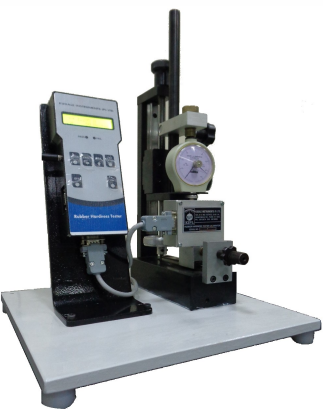
A notable example is the Kudale ERHTC Electronic Rubber Hardness Tester Calibrator (0 - 50 N). Based on the available product data, it is designed for force verification in a compact bench-format structure and offers fine resolution for controlled calibration work.
The stated measuring range of 0 to 50 N, least count of 0.001 N, and accuracy of ±0.5% of reading make it relevant for users who need a practical instrument for routine checking of hardness testers. Features such as overload protection can also be useful in environments where instruments are handled regularly by different operators.
Rather than treating a calibrator as just another accessory, it should be viewed as part of the broader quality assurance process around hardness measurement. Choosing a suitable model depends on the tester type in use, the required verification interval, and the level of control expected in your inspection workflow.
Where these calibrators fit in industrial workflows
Rubber hardness tester calibrators are commonly relevant in rubber product manufacturing, polymer processing, component inspection, and testing laboratories. They may be used before routine testing begins, after maintenance, or whenever there is doubt about the condition of the hardness tester.
In a structured metrology system, this equipment supports preventive verification rather than corrective troubleshooting alone. That approach can help reduce false rejects, avoid acceptance of out-of-spec material, and improve confidence in hardness data used for production release or technical evaluation.
How to evaluate suitability for your application
A good starting point is to review the hardness tester models currently in operation and identify the force verification requirements associated with them. From there, compare the needed range, resolution, allowable error, and physical setup against the calibrator under consideration.
It is also useful to think about frequency of use. A calibrator used occasionally in a lab may be selected differently from one used regularly on a busy production floor. If your team manages several measurement disciplines, related categories such as radiation meter calibration equipment or specialized color calibration equipment may also be part of the wider instrumentation ecosystem, even though their application is different.
Supporting consistent inspection results
Reliable calibration practices help hardness testing remain meaningful over time. When the test force is checked properly and the instrument condition is controlled, the resulting data is more useful for process monitoring, material comparison, and customer-facing documentation.
This Rubber Hardness Tester Calibrator category is intended for buyers who need dependable verification tools for hardness testing equipment, with product options suited to technical quality environments. If you are selecting a unit for routine checks, focus on the real operating range, required precision, and how the calibrator will fit into your maintenance and inspection procedure.
Get exclusive volume discounts, bulk pricing updates, and new product alerts delivered directly to your inbox.
By subscribing, you agree to our Terms of Service and Privacy Policy.
Direct access to our certified experts