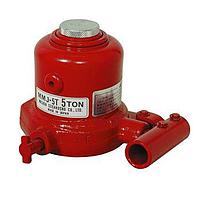
Bottle jack
When lifting heavy loads in maintenance bays, workshops, transport fleets, or industrial service environments, the right jack has a direct impact on safety, access height, and working efficiency. Bottle jack models are widely used where a compact footprint and high lifting force are needed, especially for vehicles, machinery frames, and load-support tasks in confined spaces.
On this category page, you can explore bottle jacks across different load ranges and actuation methods, from standard mechanical or hydraulic concepts to air-assisted variants for faster repetitive work. The selection also fits broader lifting systems where operators may combine jacks with a hydraulic pump or other lifting tools depending on the application.
Why bottle jacks remain a practical lifting solution
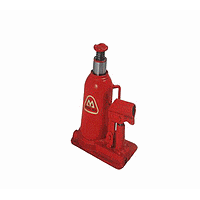
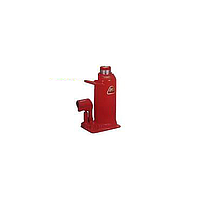
A bottle jack is valued for its high lifting capacity in a compact body. Its vertical design makes it suitable for applications where floor space is limited but upward force is critical. Compared with larger lifting structures, this format is often easier to position under a chassis point, machine base, or support area with a suitable minimum height.
In industrial and automotive settings, buyers typically compare not just tonnage, but also retracted height, lifting stroke, extended height, and operating method. These factors determine whether the jack can physically fit the load point and whether it provides enough travel to complete the lift without additional blocking or repositioning.
Common bottle jack types in this category
This category includes examples ranging from conventional hydraulic units to air hydraulic jack and pneumatic-assisted designs. That matters because not every lifting task has the same duty cycle. For occasional maintenance, a straightforward hydraulic bottle jack may be sufficient. For repeated lifting in workshops or tire service operations, air-assisted models can reduce operator effort and speed up workflows.
Compact low-height options are often selected where access under the load is limited, while taller models are useful when more lift range is needed. In some jobs, a bottle jack is only one part of a larger hydraulic setup that may also involve a hydraulic cylinder for pushing or lifting in a more controlled or integrated system.
Representative products and load ranges
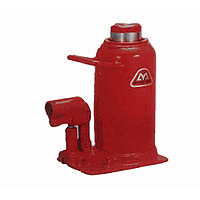
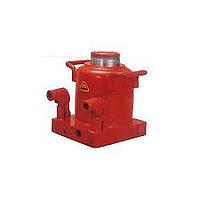
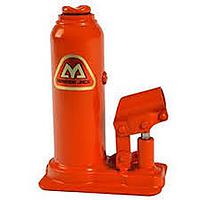
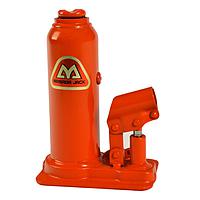
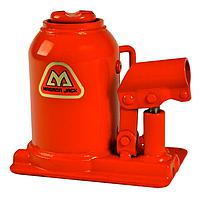
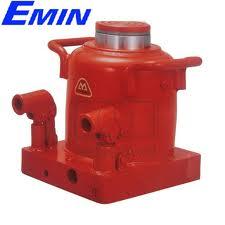
The range shown here reflects different lifting capacities and form factors. For example, the BEGA CJ100 Jacks offer a 10-ton format with a compact height range, which can be useful where installation space is tight. For heavier-duty requirements, the MASADA MH-50Y Bottle Jack provides a 50-ton class option suitable for demanding lifting tasks where higher load reserve is necessary.
AIRTEC expands the category with several air hydraulic and pneumatic models aimed at workshop productivity. Examples include the AIRTEC 1215 and AIRTEC 1217 in the 40/20-ton class, the AIRTEC 1312 and 1315 in the 60/30/15-ton and 60/30/18-ton configurations, and portable solutions such as the AIRTEC 3214 and 3217. For lighter automotive lifting, AIRTEC 1132 and 1203 pneumatic jacks provide 2-ton handling in a more service-oriented format.
How to choose the right bottle jack
The first selection criterion is rated capacity. Buyers should choose a model that matches the real lifting requirement with an appropriate margin, while also considering how the load is distributed. A higher tonnage jack is not automatically better if its closed height prevents correct positioning under the load point.
The second factor is height geometry. Minimum height determines access, while maximum height and stroke determine whether the lift can be completed in one operation. Models such as the BEGA CJ100 emphasize compact retracted dimensions, while higher-capacity units like the MASADA MH-50Y offer a different balance between capacity and lifting range.
The third factor is power source and work frequency. Manual hydraulic designs are often preferred for straightforward lifting needs, while air-assisted units can be more efficient in service centers or industrial workshops with compressed air available. If the job involves separation, spreading, or multi-point lifting, related tools such as a hydraulic spreader/lifting solution may also be relevant.
Where bottle jacks are commonly used
In vehicle maintenance, bottle jacks are frequently used for trucks, buses, agricultural equipment, and other heavy vehicles where substantial lifting force is required in a small package. In industrial maintenance, they are also applied for machine leveling, support during repair, and controlled raising of structural components during installation or servicing.
Air hydraulic models are especially relevant in environments with repetitive lifting cycles. A workshop handling commercial vehicles may benefit from reduced manual pumping effort, while portable air hydraulic units can support mobile service teams that need lifting power without overly bulky equipment.
Brand coverage and product ecosystem
This category is supported by established lifting and tool brands, including AIRTEC, MASADA, and BEGA among the highlighted examples. The broader brand landscape also includes manufacturers such as ENERPAC, SATA, YATO, JINSAN, and VIMET, giving buyers a useful starting point when comparing lifting methods, size constraints, and operating preferences.
For many industrial users, the purchasing decision is not limited to a single jack. Bottle jacks are often chosen alongside pumps, cylinders, or specialized lifting devices depending on maintenance procedures, available space, and the type of load being handled. That broader view helps ensure the selected equipment fits the actual workflow rather than only the nominal capacity on paper.
Key points to review before ordering
- Check the required lifting capacity against the actual load and lifting point.
- Confirm minimum height so the jack can fit under the load safely.
- Review maximum height and stroke to avoid incomplete lift travel.
- Consider whether manual, pneumatic, or air-hydraulic operation suits the job frequency.
- Match portability, weight, and workshop conditions to the intended use.
Find the right bottle jack for your lifting task
A well-matched bottle jack improves both safety and workflow by providing the right balance of capacity, access height, and lifting travel. Whether the need is a compact 10-ton unit, a heavy 50-ton bottle jack, or an air-assisted lifting solution for repeated workshop use, this category is designed to help narrow the options based on practical operating requirements.
Review the available models with attention to capacity, closed height, and actuation method, and compare them with the load conditions in your application. That approach leads to a more reliable selection and a lifting setup that works efficiently in real maintenance and industrial environments.
Get exclusive volume discounts, bulk pricing updates, and new product alerts delivered directly to your inbox.
By subscribing, you agree to our Terms of Service and Privacy Policy.
Direct access to our certified experts