
Capacitor Kits
When engineers need to evaluate capacitance ranges, compare dielectric options, or build prototypes quickly, having the right kit on the bench saves time and reduces sourcing friction. Capacitor Kits are especially useful in R&D, repair, lab work, and low-volume assembly, where flexibility matters more than ordering a single value at a time.
On this page, you can explore kits suited to different capacitor technologies and use cases, from general-purpose selection sets to more application-oriented assortments for precision, ceramic, or tantalum requirements. The category is relevant not only for design engineers, but also for test teams, maintenance departments, and technical buyers looking for an efficient way to stock commonly used values.
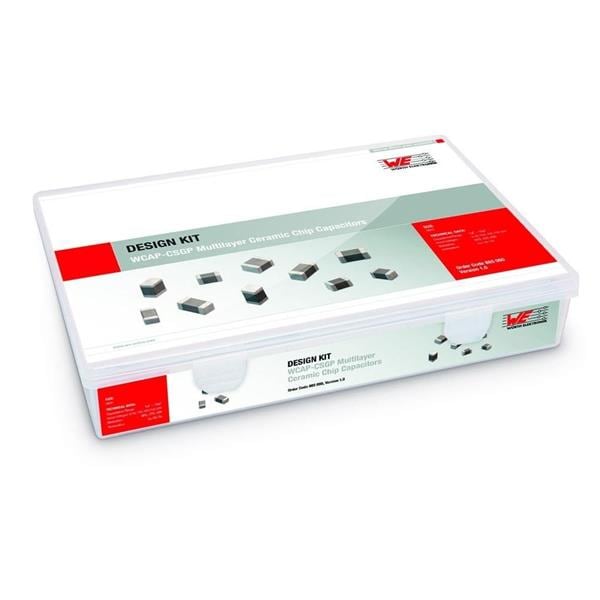
Why capacitor kits are useful in engineering workflows
A well-structured kit helps teams shorten the gap between concept and validation. Instead of pausing a design review or troubleshooting session to order individual parts, engineers can select from a prepared assortment and continue testing immediately. This is particularly practical during circuit tuning, tolerance checks, filter adjustments, and replacement work.
Capacitor kits also support better comparison across capacitance values, package styles, and material types. In many projects, early-stage decisions are based on how a circuit behaves in real conditions, so having multiple options available in one package can simplify iteration and reduce delays caused by fragmented procurement.
Common types found in this category
Although all products in this category are grouped as kits, they may serve different technical purposes. Some are intended as broad assortment packs for development and evaluation, while others are better aligned with a specific capacitor family such as ceramic or tantalum. The right choice depends on whether your priority is general bench availability, technology comparison, or application-specific testing.
For example, ceramic-focused options such as the KEMET CER-ENG-KIT-43, KEMET CER ENG KIT 37, and Murata GJM03-KIT-TTOL-DE can be relevant when stable small-value selection is important in compact electronic designs. For teams working with tantalum technologies, kits like KEMET TAN ENG KIT 29, KEMET TAN ENG KIT 30, and KEMET TAN ENG KIT 34 provide a more targeted route for evaluation. If you want to browse the full capacitor kit range, this category page brings those options together in one place.
Representative products in the range
Several products in this category illustrate how capacitor kits can support different technical scenarios. The TDK C-MVGC01-E3-KIT and KYOCERA AVX TS0002 are examples of kit-based procurement for component evaluation and prototype work, where access to multiple values can make design decisions faster and more practical.
For high-accuracy measurement and calibration contexts, the KEYSIGHT 16380A Standard Air Capacitor Set stands out as a different kind of solution within the broader category. With nominal values spanning 1 pF to 1000 pF through its included standards, it is more aligned with controlled test environments than with general component stocking. Buyers looking for broader component portfolios from KEYSIGHT may also use it as a reference point when selecting precision-oriented capacitance tools.
How to choose the right kit
The first selection factor is the intended application. For breadboarding, quick replacement, and early-stage prototyping, a general assortment may be enough. For RF, timing, filtering, or precision analog work, it often makes more sense to choose a kit centered on a specific capacitor technology or tolerance profile rather than maximizing quantity alone.
The second factor is how the kit will be used in your workflow. Design teams may prefer assortments that help compare values quickly, while purchasing teams may look for kits that support recurring maintenance needs or internal lab stock. If your projects frequently involve ceramic capacitor evaluation, brands such as Murata and KEMET are often considered for this part of the component ecosystem based on the product examples available in this category.
Selection criteria that matter in practice
Beyond the product name, it helps to review a kit through the lens of engineering usability. Consider whether you need a wide range of values, whether consistency within one dielectric family is important, and whether the kit is intended for general development or more controlled lab work. In many cases, a narrower but better-matched assortment is more useful than a larger kit with values you rarely use.
It is also worth checking how the kit fits your storage and handling process. In busy technical environments, organized packaging and clear identification are important for reducing selection errors and preserving traceability during testing. These practical details can influence productivity just as much as the nominal capacitance spread.
Typical users and application environments
This category serves a broad range of technical users. Design engineers use kits during circuit development, tolerance studies, and proof-of-concept assembly. Test and calibration teams may use selected sets to support measurement validation, while maintenance personnel rely on assortments to speed up service work and reduce downtime when replacement values are needed quickly.
Capacitor kits are also relevant for educational labs, contract manufacturers handling varied assemblies, and industrial teams supporting legacy equipment. In these environments, the value of a kit is not just the components inside it, but the ability to respond faster to changing requirements without building a parts list from scratch each time.
Brands and ecosystem context
This category includes products associated with established names used across electronics design and industrial supply chains. From the examples available here, KEMET, KYOCERA AVX, Murata, TDK, PANASONIC, and KEYSIGHT each reflect different use cases, from practical development assortments to precision-oriented sets for measurement environments.
That variety matters because capacitor selection is rarely one-dimensional. A buyer may be balancing application fit, internal qualification preferences, and stock strategy at the same time. Having multiple manufacturer paths within one category helps support those different decision models without forcing every project into the same component approach.
Final considerations before ordering
The most effective choice usually comes from matching the kit to the stage of work: early evaluation, repeated bench use, lab calibration, or maintenance support. Looking at the capacitor family, usable value range, and expected workflow will usually provide a clearer answer than choosing by brand alone.
If your team needs fast access to assorted values, a simpler sourcing process, and better support for prototype or test activities, Capacitor Kits are a practical category to review. The products shown here can help narrow down the right format for your bench, lab, or production support environment without overcomplicating the selection process.
Get exclusive volume discounts, bulk pricing updates, and new product alerts delivered directly to your inbox.
By subscribing, you agree to our Terms of Service and Privacy Policy.
Direct access to our certified experts


