
Inductors
Stable current handling, noise suppression, and energy storage all depend on choosing the right magnetic component for the circuit. In practical design work, inductors are used across power conversion, filtering, RF paths, and signal conditioning, so the right part selection affects efficiency, thermal behavior, size constraints, and long-term reliability.
This category brings together a broad range of inductor options for electronic design and industrial sourcing, from compact surface-mount parts for dense PCB layouts to wirewound and through-hole styles used in more traditional assemblies. Whether you are comparing low-profile parts for switching regulators or evaluating RF choke options for high-frequency sections, it helps to look beyond the nominal inductance value and consider the full electrical role of the component.
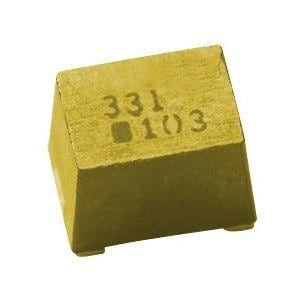
Where inductors fit in electronic circuits
An inductor resists changes in current and stores energy in a magnetic field. That makes it useful in DC-DC converters, input and output filtering stages, EMI mitigation, impedance matching, and resonant circuits where behavior at frequency matters as much as the basic inductance rating.
In many assemblies, inductors work alongside capacitor components and resistor products to shape voltage, current, and frequency response. Looking at the wider passive network is often the best way to decide whether a design needs a power inductor, an RF choke, or a smaller chip inductor for localized filtering.
Common inductor types in this category
This range includes both surface-mount inductors and through-hole designs, covering applications from automated PCB assembly to legacy or mechanically robust builds. Wirewound constructions are common where stable inductance and useful current capability are needed, while compact chip inductors are often selected for RF or space-constrained layouts.
Some parts in the selection are better suited to power circuitry, while others are optimized for higher-frequency signal paths. For example, a model such as the Bourns SDR0604150YL or Coilcraft SER1052432MLC fits the general need for surface-mount energy storage and filtering, whereas parts like the Coilcraft 1206CS-122XJLB or Bourns 74F826AP-RC illustrate the role of smaller RF choke and RF chip inductors in tuned or high-frequency sections.
What to consider when selecting an inductor
The first comparison point is usually the target inductance, but that value alone is not enough. In real applications, buyers and engineers should also check rated current, DC resistance, tolerance, mounting style, operating temperature range, and how the part behaves at the intended test or switching frequency.
For power circuits, current capability and DCR strongly influence efficiency and heat generation. A part such as the Bourns SPB0705-R12M, with a notably high rated current, may be more relevant for power stages than a compact RF part designed for smaller signal-level currents. By contrast, a component like the Bourns PM1608-681M shows how higher inductance values can come with lower current handling, which is important when balancing filtering needs against load demands.
Frequency-related characteristics also matter. In RF and signal applications, engineers often pay close attention to Q factor and self-resonant frequency because these directly affect insertion loss, tuning behavior, and overall circuit stability. That is why a device such as the Bourns 9310-10-RC or Coilcraft 1206CS-820XJBB should be evaluated in the context of the operating band rather than by inductance value alone.
Surface-mount vs. through-hole: choosing the right package
Mounting type has practical consequences for manufacturing, mechanical stability, and available board space. Surface-mount inductors are the standard choice for high-volume electronics production, compact converter boards, and multilayer PCB designs where placement density matters. Examples in this category include the Bourns PM1008S-100M, Bourns SDR1005-6R8M, and several Coilcraft chip and molded parts.
Through-hole inductors remain useful when stronger mechanical anchoring is needed or when the design follows a conventional assembly method. A product such as the Bourns 74F826AP-RC or Bourns 9310-10-RC can be relevant in prototypes, serviceable equipment, or applications where leaded components are preferred for layout or handling reasons.
Representative manufacturers and product examples
Two of the most visible names in this category are Bourns and Coilcraft, each represented by products that cover different electrical priorities. Bourns appears across power bobbin core inductors, shielded and unshielded surface-mount parts, and RF choke formats, giving buyers options for both power conversion and signal filtering tasks.
Coilcraft examples in this category highlight compact surface-mount and RF-oriented designs, including the 1206CS series and larger SER-family options. Looking at these brands side by side can help narrow down the shortlist based on package style, intended frequency range, and how the inductor will function within the wider passive network.
Typical applications across industrial and electronic design
Inductors are widely used in switching power supplies, DC-DC regulator stages, EMI filters, communication modules, sensor electronics, and embedded control boards. In these environments, the component may serve as an energy-storage element, a choke for blocking AC while passing DC, or part of a resonant and impedance-control network.
For sourcing teams, this means the right selection process should begin with the application role rather than with part number familiarity alone. A compact chip inductor is not automatically interchangeable with a molded power inductor, and a part intended for RF tuning should not be treated as a direct substitute for a higher-current converter inductor simply because the inductance values appear close.
How to compare options more efficiently
A practical way to filter this category is to start with the circuit function, then narrow by inductance range, mounting style, and current requirement. After that, compare tolerance, DCR, temperature capability, and any frequency-related characteristics that are relevant to the design. This approach usually produces better results than selecting on physical size alone.
It is also helpful to review the overall passive bill of materials when choosing replacements or alternate sources. If your design depends on coordinated filtering or timing behavior, the interaction between the inductor and nearby inductor options in the same family, along with matching resistor and capacitor values, can affect performance more than expected.
Final thoughts
A well-matched inductor supports electrical stability, efficient power handling, and predictable frequency behavior across many types of circuits. By comparing construction style, current rating, resistance, frequency characteristics, and package format, buyers can narrow this category to the parts that make sense for their actual design constraints.
If you are selecting parts for new development, maintenance, or volume sourcing, this category provides a useful starting point for evaluating both general-purpose and application-specific inductors from established manufacturers. A careful review of the component’s role in the circuit will lead to a more reliable shortlist and a better fit for production.
Get exclusive volume discounts, bulk pricing updates, and new product alerts delivered directly to your inbox.
By subscribing, you agree to our Terms of Service and Privacy Policy.
Direct access to our certified experts
