MIL Spec Rectangular Connectors
Reliable interconnects are critical in aerospace, defense, transportation, and other demanding electronic systems where vibration, density, and long service life all matter at the same time. In these environments, MIL Spec Rectangular Connectors are widely selected when designers need structured contact layouts, modularity, and repeatable performance in panel, rack, board, or cable assemblies.
This category brings together rectangular military-style connector solutions used across signal and power interconnection schemes, including board-level and modular formats. Whether you are comparing interface types for a new design or looking for a replacement within an established platform, the range here helps narrow down options by form factor, mating style, and application context.
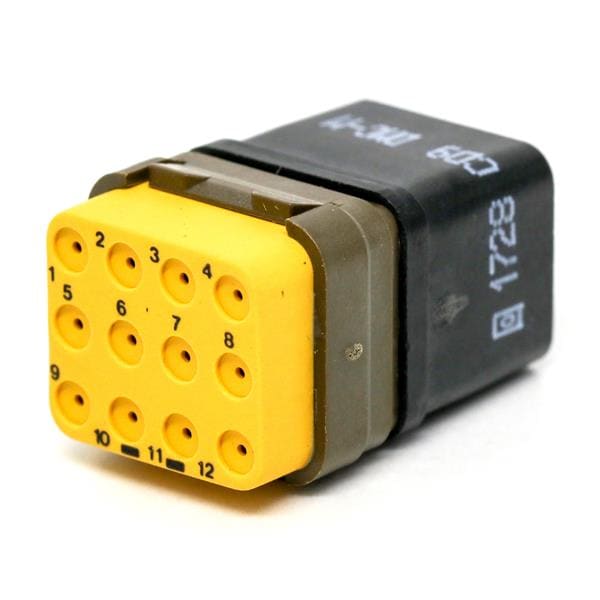
Where rectangular MIL-style connectors fit best
Rectangular connector formats are often chosen when a system needs an organized pin layout in a compact envelope. Compared with round interfaces, they can be especially useful in backplane architectures, motherboard-to-daughterboard connections, modular housings, and equipment with defined mounting geometry.
They are commonly used in applications where engineers need a balance of contact density, mechanical stability, and maintainability. In practical terms, that makes them relevant for avionics electronics, communication equipment, mission systems, ruggedized computing, and other assemblies where connector selection has a direct impact on system reliability.
Typical connector styles in this category
This category covers more than one rectangular connector approach. Some parts are designed as modular rectangular interconnects for cable or equipment interfaces, while others are intended for board-level architecture such as motherboard, daughter board, or I/O connections built around military standards including MIL-DTL-55302.
Examples from this range include modular options from DEUTSCH - TE Connectivity such as the DMC-MD80B50W01 and DMC-MD82B64, as well as board interconnect solutions from Amphenol Aerospace including MB3-201W, MB2-140P (722), IO3-273P (721), and DB4-204P (716). These product examples illustrate the breadth of the category without reducing it to a single interface family.
What to evaluate when selecting a connector
The first step is to match the connector format to the electrical and mechanical role in the system. A cable-to-equipment interface may call for a shielded modular rectangular connector, while a high-pin-count internal assembly may be better served by a motherboard, daughter board, or I/O style connector.
It is also important to review the contact arrangement, row configuration, mating style, and mounting constraints early in the design process. Products such as the Amphenol Aerospace MB2-086P (719), MB2-142P (719), and IO4-112P (721) show how row count and contact count can vary significantly depending on the architecture.
For replacement or maintenance projects, consistency with the original standard and physical interface is just as important as nominal compatibility. That is particularly relevant in regulated or mission-critical systems, where connector changes can affect assembly fit, harness routing, or qualification workflows.
Why standards matter in rugged applications
Military-style connector categories are often selected not only for durability, but also for standardization. When a connector is aligned with a recognized military specification, buyers and engineers can work from a clearer framework for interchangeability, design intent, and system-level integration.
Several products in this category reference MIL-DTL-55302, which is commonly associated with board-level rectangular connector systems. In real-world sourcing, this helps procurement teams compare suitable options more efficiently while giving design teams a stronger basis for reviewing mating compatibility, packaging constraints, and long-term support.
Related connector families for broader system design
Rectangular interfaces are only one part of a complete interconnect strategy. Some systems combine them with MIL Spec Circular Connectors for cable harnesses, or with MIL Spec D-Sub Connectors where shielded multi-contact I/O is required in a familiar format.
For programs that include mixed-media transmission, it may also be useful to review MIL Spec Fiber Optic Connectors. Looking across these related families can help teams choose the right interface at each point in the system rather than forcing one connector type into every role.
Representative products in this range
The selection includes modular rectangular MIL-spec connectors and high-density board interconnect products suited to demanding electronic assemblies. DEUTSCH - TE Connectivity models such as DMC-MD42B42 and DMC-MD42B06 highlight compact modular receptacle configurations, while DMC-MD80B50W01 illustrates a multi-module plug format with shielding.
On the board-interconnect side, Amphenol Aerospace offers a range of motherboard, daughter board, and I/O formats, including MB3-201W, DB3-108P (714), and DB4-204P (716). These examples are useful for understanding how the category supports both external rugged interconnection and internal high-density electronic packaging.
How to compare options more efficiently
When browsing this category, it helps to start with the actual connection point in your design: cable-to-panel, panel-to-equipment, or board-to-board. From there, narrow the shortlist by standard family, row count, contact count, shielded or unshielded construction, and the physical mating arrangement required by the assembly.
If your project is in an early design phase, reviewing manufacturer ecosystems can also be useful because families from Amphenol Aerospace and DEUTSCH - TE Connectivity may support different integration approaches. For sourcing teams handling ongoing maintenance, the priority is usually closer matching to the installed part rather than broad platform changes.
Finding the right fit for long-life programs
Connector choice in military and harsh-environment electronics is rarely just about form factor. It affects serviceability, packaging efficiency, qualification effort, and long-term availability across the full lifecycle of the equipment.
This MIL Spec Rectangular Connectors category is intended to support that evaluation process with a focused range of rectangular military-style interfaces from recognized manufacturers. If you are comparing board-level interconnects, modular housings, or rugged rectangular mating systems, reviewing the available options here can help you identify a connector family that fits both the technical design and the operational environment.
Get exclusive volume discounts, bulk pricing updates, and new product alerts delivered directly to your inbox.
By subscribing, you agree to our Terms of Service and Privacy Policy.
Direct access to our certified experts