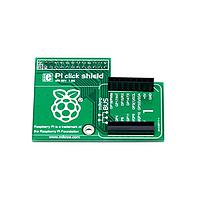
Raspberry Pi Hats / AddOn Boards
Expanding a Raspberry Pi beyond its base I/O is often the fastest way to turn a compact board into a practical HMI, edge AI node, display controller, or application-specific prototype. Raspberry Pi Hats / AddOn Boards help bridge that gap by adding dedicated interfaces, acceleration, display capability, and user input functions without moving to a completely different computing platform.
For engineers, developers, and technical buyers, this category is useful when a standard Raspberry Pi needs to support a clearer user interface, specialized communication, or a more focused embedded workload. Depending on the project, an add-on board may be the simplest route to shorten development time, validate a concept, or prepare for a more integrated embedded design later.
Where Raspberry Pi add-on boards fit in embedded design
In embedded computing, Raspberry Pi expansion hardware is commonly used to adapt a general-purpose single-board computer to a more specific task. That may mean adding a touchscreen display, connecting a serial display module, extending local input capability, or offloading AI processing to dedicated hardware.
This makes add-on boards especially relevant for prototyping kiosks, local control panels, vision-assisted systems, lab setups, and compact industrial interfaces. In some applications, they also serve as a practical stepping stone before moving to more integrated platforms such as computer-on-modules or fully enclosed systems.
Typical product types in this category
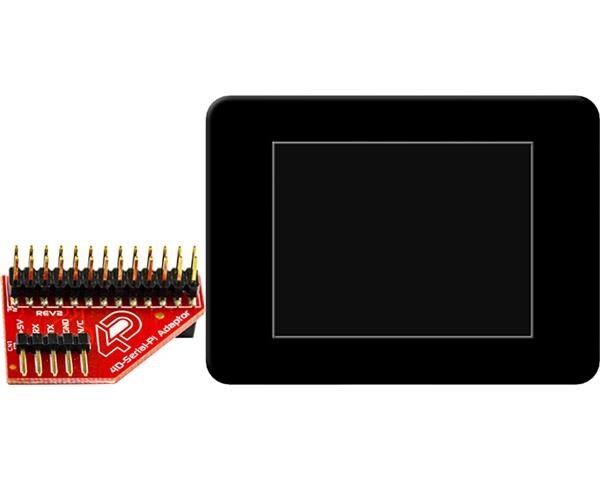
The category spans several types of expansion hardware rather than one single device class. A large portion of the range is focused on display integration, including LCD packs for Raspberry Pi with different screen sizes, touch options, and interface arrangements. These are useful when the project needs a built-in human-machine interface without designing a custom display subsystem from scratch.
Other boards target more specialized roles. For example, the Raspberry Pi SC1468 Hailo AI Accelerator Raspberry Pi AI HAT+ 26 TOPS CN is intended for workloads that benefit from local AI acceleration, while products such as the Adafruit 2129 Computer Add-On Pack support broader user input or peripheral expansion. This variety allows teams to match the add-on board to the intended function instead of overcomplicating the base platform.
Display-oriented add-on boards for HMI and visualization
Many Raspberry Pi projects ultimately need a reliable visual interface. That is why display-focused add-on boards are one of the strongest segments in this category, with solutions from 4D Systems covering compact and larger-format LCD options for Raspberry Pi integration.
Examples include the gen4-uLCD-32DCT-CLB-PI for compact capacitive touch applications, the gen4-uLCD-50D-SB-PI for non-touch display requirements, and larger 7.0-inch and 9.0-inch options for dashboards, operator screens, or information display panels. Across these variants, the practical selection criteria usually come down to screen size, touch versus non-touch operation, available interface method, and the physical space available in the final enclosure.
For projects where the front-end display experience is central, a dedicated add-on board can reduce integration effort significantly. Instead of building a custom display path from multiple separate components, developers can evaluate screen responsiveness, viewing format, and UI behavior on a ready-to-use hardware base.
Boards for AI, control, and application-specific expansion
Not every Raspberry Pi add-on board is display-centric. Some options are designed to extend processing capability or support a specific subsystem within a larger embedded design. The Raspberry Pi AI HAT+ is a good example of an add-on board that addresses edge AI acceleration for local inference tasks, helping developers evaluate machine vision or intelligent sensing workflows directly on the Raspberry Pi platform.
Other boards in the wider ecosystem may focus on signal handling, power-related functions, or evaluation of a particular IC. The Semtech EBK-GN1160-OPT00 Power Management board, for example, is built around a laser driver use case and reflects how add-on hardware can support targeted development scenarios. In a similar way, evaluation kits from Renesas Electronics or Analog Devices may be relevant when a project includes display processing, signal-chain evaluation, or subsystem-level validation around a Raspberry Pi-based setup.
How to choose the right Raspberry Pi add-on board
The most effective way to choose is to start with the application, not the board format. If the project needs a local screen, compare display size, touch technology, and interface needs. If it needs higher compute efficiency for inference, AI acceleration becomes more relevant. If the goal is easier prototyping with additional user controls or peripherals, a broader accessory-style board may be enough.
It is also important to check mechanical compatibility, operating conditions, and how the board fits into the overall system architecture. Consider available power, enclosure depth, cable routing, and whether the add-on will remain in the final design or only be used during development. For some projects, a Raspberry Pi with add-on hardware is ideal for prototyping, while production deployment may later move toward panel PCs or other embedded hardware that integrates display and compute in one unit.
Representative manufacturers and ecosystem context
This category brings together expansion options from suppliers known across embedded development, including Raspberry Pi, 4D Systems, Adafruit, Semtech, STMicroelectronics, Analog Devices, and Renesas Electronics. Each tends to contribute from a different angle, whether that is display hardware, accessory expansion, AI enablement, or evaluation-oriented boards.
That ecosystem matters because Raspberry Pi projects rarely exist in isolation. A display add-on may sit alongside accessories, external controllers, or a broader embedded platform strategy. If your application needs related hardware beyond the board itself, it can also be useful to review compatible Raspberry Pi accessories for power, connectivity, or installation support.
When this category is the right starting point
Raspberry Pi Hats and add-on boards are a practical starting point when the base Raspberry Pi needs a defined hardware role quickly. That may involve building an HMI prototype, testing a display concept, adding local AI capability, or simplifying integration for a proof-of-concept system.
For B2B buyers and engineering teams, the value of this category is not just in the board itself, but in how quickly it can reduce development friction. A well-matched add-on board can help validate interfaces, shorten hardware integration time, and clarify the path from prototype to deployable embedded solution.
When comparing options, focus on the actual function the system must perform, then narrow the selection by compatibility, interface method, and installation constraints. That approach usually leads to a more reliable choice than selecting purely by board format or headline features.
Get exclusive volume discounts, bulk pricing updates, and new product alerts delivered directly to your inbox.
By subscribing, you agree to our Terms of Service and Privacy Policy.
Direct access to our certified experts