Fingerprint Sensor Modules
Reliable identity verification is increasingly built directly into embedded devices, kiosks, access terminals, and smart electronics. In these applications, Fingerprint Sensor Modules help designers add biometric input without building the sensing and interface stage from scratch, making integration faster for both prototyping and production.
Within embedded systems, fingerprint modules are used where secure user recognition, local authentication, or touch-based biometric input is required. Depending on the project, selection may focus on interface type, mounting style, power requirements, environmental range, or how easily the module fits into an existing hardware platform.

Where fingerprint sensor modules fit in embedded design
These modules sit at the intersection of biometric sensing, embedded control, and human-machine interaction. They are commonly considered for access control panels, industrial terminals, development boards, portable electronics, smart lockers, attendance systems, and specialized OEM equipment where password-free identification can improve workflow or device security.
Compared with more general sensing categories such as capacitance touch sensor modules or proximity-based sensing, fingerprint modules address a different need: confirming user identity rather than simply detecting presence or touch. That distinction matters when a design must tie user input to permissions, audit trails, or personalized device behavior.
Common module types and integration approaches
Fingerprint sensing in this category includes several implementation styles. Optical modules are often chosen for straightforward panel integration and proof-of-concept projects, while capacitive approaches may be preferred in compact products where form factor and sensing method are important. There are also board-level and flex-based options intended for tighter hardware integration.
Interface choice is a practical starting point. UART and serial interfaces are common when working with microcontrollers and rapid embedded development, while SPI or I2C can be relevant in more tightly coupled designs. USB-connected readers also appear in dedicated terminals and panel PCs, especially where the sensor is intended for a specific host platform rather than general-purpose standalone use.
Representative products in this category
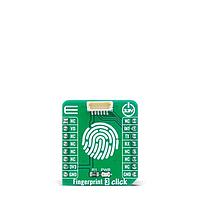
Several products in this range illustrate how broad the ecosystem can be. The Mikroe MIKROE-4265 Fingerprint 3 Click is a compact UART-based option designed for embedded development workflows, making it suitable for engineers who want to evaluate biometric input within a modular hardware environment.
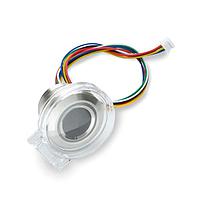
For compact biometric designs, the SparkFun SEN-21210 miniature fingerprint sensor provides a small-format UART-based approach, while the Adafruit 4690 Basic Fingerprint Sensor represents a panel-oriented optical option for straightforward integration. At the other end of the spectrum, Fingerprints AllKey modules and Infineon CYFP10020 series devices point toward more embedded, component-level implementations for OEM designs.
Platform-specific readers are also part of the category. Advantech offers dedicated fingerprint readers such as UTC-542P-F01E, UTC-300P-FP11E, and UTC-510P-F01E for use with compatible terminal systems, which is useful when the design target is a known hardware family rather than a custom board.
Key selection criteria for engineers and buyers
When comparing modules, it helps to look beyond the basic product name and focus on integration requirements. Start with interface compatibility: UART and serial options can simplify microcontroller projects, SPI may suit higher-performance embedded communication, and USB is often the most direct choice for host-based terminals. Supply voltage is equally important, particularly in low-power designs centered around 3.3 V logic.
Mechanical fit should be reviewed early. Some products are intended for panel mount or bracketed terminal installation, while others are SMD/SMT, flex-based, or compact board-level modules. This affects enclosure design, cable routing, and serviceability. If the product must operate in harsher or wider-temperature environments, checking the stated operating range can help narrow the shortlist.
It is also worth considering whether the sensor is a general-purpose biometric module or a platform-specific accessory. A developer board add-on, an ESP32-oriented design, and a reader built for a dedicated kiosk system will each fit different procurement and engineering paths even if all belong to the same category.
Examples by application scenario
For prototyping and educational development, modules from brands such as SparkFun and Adafruit are often relevant because they align well with board-level experimentation and fast proof-of-concept work. A compact UART-connected sensor can be enough to validate enrollment, matching flow, and user interface behavior before a product moves into custom hardware.
For industrial terminals and kiosk-style deployments, Advantech readers are more aligned with fixed systems where the biometric function is part of a larger operator interface. In contrast, OEM-focused parts such as Fingerprints AllKey LGA or AllKey Pro modules are more suited to products where the biometric sensor needs to be embedded deeply into the final hardware architecture.
If a project combines identity sensing with broader environmental or motion input, related categories such as acceleration sensor modules or distance sensor ICs and embedded modules may also be useful during system planning.
What to review before specifying a module
In B2B sourcing, the right choice usually depends on how the fingerprint function will be deployed in the finished system. Review whether the device will handle user enrollment locally, act as a sensor front end to a host processor, or serve as a reader accessory for a dedicated terminal. That system-level role influences the best interface, form factor, and integration effort.
Buyers should also align module selection with manufacturing and lifecycle needs. A development-friendly module can accelerate early testing, but a compact SMT or flex-based device may be more appropriate for production. Likewise, a standalone optical unit may simplify installation in panel equipment, while a dedicated accessory may reduce risk in a pre-defined platform environment.
Choosing the right fingerprint module for your project
This category supports a wide range of biometric integration needs, from development boards and compact embedded products to industrial terminals and platform-specific readers. The most effective way to narrow options is to match the module to the intended host system, preferred interface, mounting method, and deployment environment.
Whether you are evaluating a simple serial fingerprint reader, a compact capacitive module, or an OEM-oriented embedded sensor, a clear view of system architecture will lead to better selection decisions. Exploring the available range by interface style, application fit, and manufacturer ecosystem can make it easier to identify the most suitable module for your next design or procurement cycle.
Get exclusive volume discounts, bulk pricing updates, and new product alerts delivered directly to your inbox.
By subscribing, you agree to our Terms of Service and Privacy Policy.
Direct access to our certified experts