Single Board Computing Enclosures
Protecting a single board computer is often the step that turns a development platform into a usable device. Whether the project is a Raspberry Pi-based controller, an Arduino interface, a BeagleBone deployment, or a compact embedded computing node, the right enclosure helps with physical protection, cable management, mounting, and day-to-day reliability.
Single Board Computing Enclosures are designed for compact computing hardware where board fit, port access, and installation practicality matter as much as appearance. For engineers, integrators, and B2B buyers, this category is less about generic boxes and more about choosing housings that align with the board format, operating environment, and final application.
Why enclosure selection matters for single board computers
A single board computer may perform well on the bench, but exposed electronics are vulnerable to impact, dust, accidental contact, and installation issues. An enclosure creates a more stable platform for prototyping, pilot builds, and finished equipment, especially when the system needs to be mounted in a cabinet, carried in the field, or used in shared workspaces.
Good enclosure choice also supports practical integration. Openings for connectors, space for power wiring, and compatibility with accessories can reduce rework during assembly. If your application extends beyond small SBC housings, it may also be useful to review broader enclosure boxes and cases for other electronics packaging needs.
Common enclosure types in this category
This category covers several enclosure approaches rather than one single format. Some products are tailored to a specific board family, while others are general-purpose housings suitable for embedded computing projects with custom cutouts or internal mounting arrangements.
Board-specific options are often the fastest path when port alignment and compact fit are priorities. Examples in this range include Raspberry Pi case components from Adafruit, such as the 5292 zipper sleeve for Raspberry Pi 400 and 500, the 2370 lid for Raspberry Pi Model A+, and the 2246 lid for Raspberry Pi Model B+, Pi 2, and Pi 3. These items are especially relevant where transport protection or replacement case parts are needed rather than a fully custom housing.
There are also dedicated housings for other popular platforms. Hammond Manufacturing offers enclosure solutions for boards such as BeagleBone White and Arduino Due or Mega 2560, helping users move from exposed PCB assemblies toward more protected embedded builds.
Materials, protection, and mechanical considerations
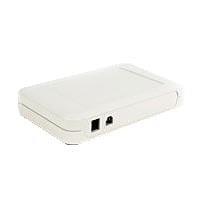
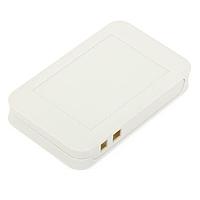
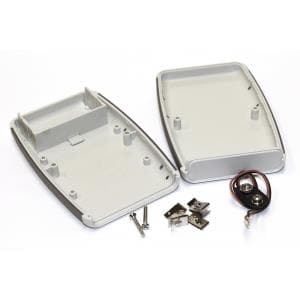
Material choice has a direct effect on durability, weight, and installation suitability. ABS and polycarbonate are common for lightweight electronics housings, while aluminum designs are often selected when a more rigid or rugged body is preferred. In this category, examples include ABS handheld-style enclosures, polycarbonate Raspberry Pi housings, and extruded aluminum options for compact electronics assemblies.
Ingress protection and flammability ratings can also influence selection. Some enclosures listed here include IP20 or IP54 protection levels, which may be relevant depending on whether the unit is intended for cleaner indoor environments or more exposed operating conditions. Ratings should always be considered alongside the real installation context, including cable entry points, ventilation needs, and whether the board will operate continuously.
Dimensional fit remains one of the most important checks. A housing may match the board footprint but still fall short if there is not enough space for connectors, cooling clearance, HATs, battery compartments, or internal adapters. For applications that sit closer to panel-based or cabinet-mounted control systems, readers may also want to compare options in industrial automation enclosures.
Examples of products in the range
The products in this category illustrate the variety of enclosure roles used in embedded computing. On the board-specific side, PHOENIX CONTACT offers Raspberry Pi-compatible parts such as the 1139227 UCS housing for RPi 4B and the 2202906 adapter accessory for Raspberry Pi applications. These types of products are useful when the enclosure is part of a broader modular installation concept.
Hammond Manufacturing appears strongly in the range with practical enclosure formats for handheld use, battery compartment integration, and board-specific packaging. Examples include the 1593HAMDOGGY for BeagleBone White, the 1593HAMAR3TBU for Arduino Due and Mega 2560, and battery-door enclosures such as the 1553BGYBAT, 1553CBKBAT, and 1599HSGYBAT where portable or self-contained systems are being developed.
The category also includes more specialized chassis-style options such as the Kontron S26361-F5000-J004 mini-STX chassis. While not every project needs this format, it shows how single board and compact embedded computing can extend into structured system builds where mechanical compatibility and board family support are closely linked.
How to choose the right enclosure for your application
Board compatibility should be the first filter. Start by confirming the exact board model, revision, and any attached modules that affect height or connector location. A Raspberry Pi 4B enclosure, for example, serves a different mechanical need than a case element for Raspberry Pi 400 or a housing intended for BeagleBone or Arduino boards.
Next, look at the installation environment. For desktop use, lab work, and light-duty indoor deployment, a simple plastic housing may be sufficient. For mobile devices, operator-held equipment, or systems that require onboard power, battery-door and handheld styles can be more appropriate. If the enclosure is part of a larger computing installation, it may also help to explore related rack solutions for supporting infrastructure.
Finally, think about assembly workflow. Access to ports, ease of opening the enclosure, mounting method, and allowance for future maintenance can all affect the total cost of integration. A mechanically convenient enclosure can save time during prototyping and reduce downstream modifications in low-volume production.
When a board-specific enclosure is the better choice
Board-specific enclosures are usually the right fit when you want predictable alignment for USB, Ethernet, power, GPIO, or display interfaces. They are also helpful when the goal is to deploy quickly without machining a general-purpose box. This is especially common for Raspberry Pi, BeagleBone, and Arduino-based systems used in gateways, HMI panels, test fixtures, and educational or industrial pilot projects.
General-purpose enclosures still have value, particularly when the board is only one part of the assembly and there are extra power supplies, interface modules, or custom wiring inside. In those cases, a larger electronics housing may provide more flexibility than a tightly fitted SBC case.
Choosing with long-term integration in mind
For B2B purchasing, enclosure choice should support the full lifecycle of the device, not just the first assembly. That includes ease of replacement, consistency across builds, and suitability for repeated maintenance. Product lines from suppliers such as Adafruit, PHOENIX CONTACT, Hammond Manufacturing, and Kontron can serve different stages of development, from prototyping and accessory use through to more structured embedded installations.
A well-matched enclosure helps protect the board, simplify integration, and present the system more professionally in operation. If you are comparing options in this category, focus on the board platform, mechanical fit, protection level, and installation method first. That approach usually leads to a more practical selection than choosing by appearance alone.
Get exclusive volume discounts, bulk pricing updates, and new product alerts delivered directly to your inbox.
By subscribing, you agree to our Terms of Service and Privacy Policy.
Direct access to our certified experts