Digital Potentiometer Development Tools
When you need to evaluate programmable resistance, fine-tune analog signal paths, or prototype adjustable control circuits, the right development hardware can save significant design time. Digital Potentiometer Development Tools help engineers explore device behavior, verify interface compatibility, and test control schemes before moving into a production design.
These tools are especially useful in embedded systems, analog front ends, calibration circuits, user-adjustable settings, and mixed-signal applications where resistance must be changed electronically rather than with a mechanical trimmer. Depending on the project, that may mean a compact breakout board for bench testing, a click board for fast microcontroller integration, or a dedicated evaluation kit for a specific IC.
What these development tools are used for
A digital potentiometer is typically used to adjust voltage, gain, offset, contrast, threshold, or other analog parameters under software control. Development tools in this category make it easier to test how a device responds across its resistance range, how it communicates over interfaces such as I2C, SPI, GPIO, or serial, and how it behaves within the intended supply-voltage window.
In practical terms, these boards help shorten the path from component selection to proof of concept. Engineers can quickly connect a target device, write basic firmware, and validate whether a chosen digital potentiometer fits the resolution, control method, and electrical environment required by the application.
Common formats in this category
The category includes several hardware styles because development needs vary by workflow. Some products are full evaluation boards built around a specific IC, intended for detailed device testing. Examples include the Analog Devices EVAL-AD5245DBZ for the AD5245 and the EVAL-AD7376EBZ for AD7376, both designed to support structured evaluation of programmable resistance behavior.
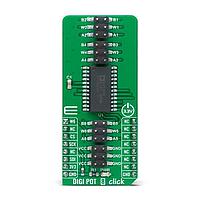
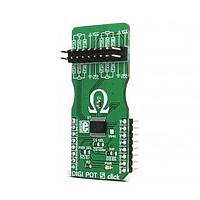
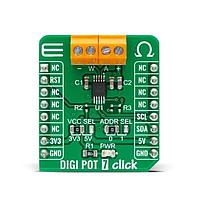
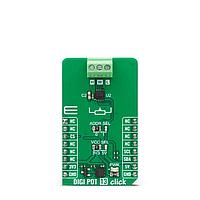
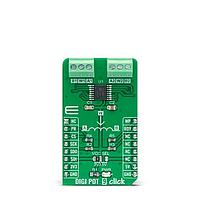
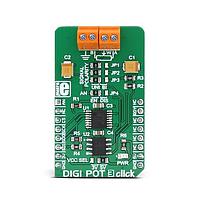
There are also more integration-friendly modules and add-on boards for rapid prototyping. Mikroe offers options such as MIKROE-2332 DIGI POT 2 click, MIKROE-4414 DIGI POT 7 Click, and MIKROE-5318 DIGI POT 11 Click, which are useful when you want to bring a digital potentiometer into a microcontroller-based setup without building a custom PCB first. Smaller breakout-style solutions such as the Soldered 333091 board can also be a practical fit for quick lab experiments.
Interfaces, control methods, and system integration
One of the first things engineers usually check is the communication interface. In this selection, I2C and SPI appear frequently because they are widely used in embedded control and allow programmable adjustment from a host MCU or controller. The choice matters not only for firmware development but also for bus sharing, pin count, and response requirements in the larger system.
For example, the Analog Devices MAX5389EVKIT+ uses I2C for evaluating the MAX5389M, while the Mikroe MIKROE-2332 board uses SPI for a TPL0501-based setup. If your project already includes digital control over converters or analog signal conditioning, it may also be useful to browse related data conversion IC development tools to build a more complete prototype environment.
How to choose the right tool for your project
The most effective way to choose from this category is to start with the target device and development goal. If you already know the exact IC under evaluation, a dedicated board is usually the most direct option because it is built specifically around that component. The Intersil ISL95310UIU10ZEV1Z board, for example, is intended for evaluation of ISL95310UIU10Z, while the Analog Devices EVAL-AD5245DBZ is focused on AD5245.
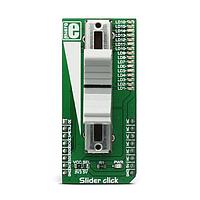
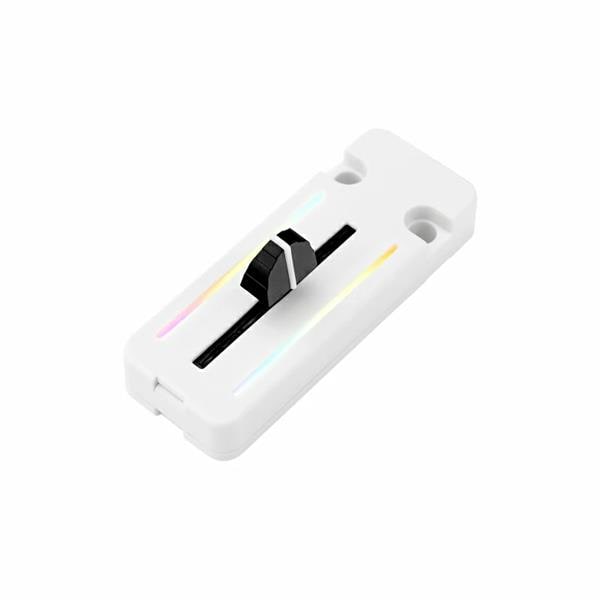
If your goal is broader prototyping rather than IC-specific characterization, an add-on board may be the better choice. Products such as the Mikroe Slider click or DIGI POT series can help with user input, software-controlled adjustment, and interface testing in an application-level prototype. It is also worth checking resistance range, supported supply voltage, and board-level connectivity before selection, especially when you need compatibility with 3.3 V or 5 V systems.
Representative manufacturers and product ecosystems
This category brings together development tools from widely recognized suppliers, including Analog Devices, Intersil, Mikroe, Adafruit, and Soldered. Each serves a slightly different need. Analog Devices and Intersil evaluation boards are typically chosen for focused IC evaluation, while Mikroe modules are often used in faster embedded prototyping workflows.
Adafruit products in this category, such as 10 kOhm slide potentiometer modules, are useful where hands-on input and physical adjustment are part of the experiment or user interface concept. Although a slide potentiometer is different from an IC-based digital potentiometer, these supporting modules can still play a role in comparison testing, control demonstrations, or interactive proof-of-concept setups.
Typical application scenarios
Digital potentiometer development tools are commonly used in signal calibration, gain control, tunable references, threshold setting, display or backlight adjustment, and parameter trimming without mechanical wear. They can also support educational labs and R&D teams working on analog control loops, sensor conditioning, and programmable front-end circuits.
In many projects, a digital potentiometer is not evaluated in isolation. It may sit alongside amplifier stages, filters, or audio signal chains. If your design includes adjacent analog building blocks, related categories such as amplifier IC development tools or audio IC development tools can help extend the prototype into a more realistic test platform.
Points to review before ordering
Before selecting a board, review a few practical details: the resistance range, the control interface, the operating supply voltage, and whether the board is tied to a specific target IC. These factors directly affect how easily the tool will fit into your bench setup and how closely it reflects the final application conditions.
It is also helpful to consider whether you need a compact module for quick embedded testing or a more formal evaluation kit for deeper electrical analysis. For teams using standardized add-on ecosystems, a Mikroe click board may simplify integration. For engineers validating a particular Analog Devices or Intersil part, a dedicated evaluation board may offer a more direct path to characterization.
Supporting faster analog and mixed-signal prototyping
This category is built for engineers who need a practical way to test software-controlled resistance in real hardware. From dedicated evaluation boards like EVAL-AD5245DBZ and MAX5389EVKIT+ to application-oriented modules such as DIGI POT click boards and compact breakout solutions, the available options support both focused component evaluation and broader system prototyping.
If you are narrowing down a design, compare the interface, voltage compatibility, and intended use of each tool first. That approach makes it easier to choose development hardware that fits your workflow, reduces bench rework, and helps move from concept to validated circuit with more confidence.
Get exclusive volume discounts, bulk pricing updates, and new product alerts delivered directly to your inbox.
By subscribing, you agree to our Terms of Service and Privacy Policy.
Direct access to our certified experts