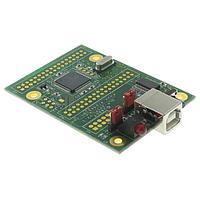
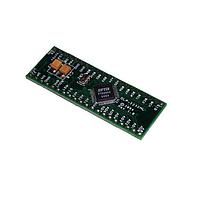
Interface Development Tools
When you need to evaluate communication behavior early in the design cycle, the right hardware can save a great deal of time. Interface Development Tools help engineers test, prototype, and validate how controllers, sensors, boards, and embedded subsystems exchange data before a design moves into production or deeper integration.
In practical terms, this category supports development work around embedded communication and device connectivity. It is relevant for design engineers, firmware teams, test labs, and system integrators who need a reliable platform for bring-up, debugging, proof-of-concept work, or learning a specific device ecosystem.
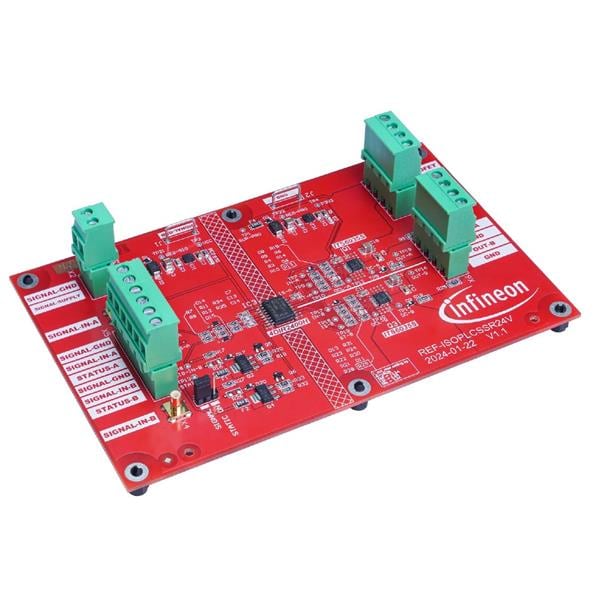
Where interface development tools fit in a design workflow
Many projects do not fail because of core processing power, but because of problems at the connection layer. Signal handoff, board compatibility, firmware interaction, and peripheral communication often need to be verified with real hardware. That is where evaluation and development platforms become useful: they reduce uncertainty during prototyping and help teams move from concept to repeatable testing.
Depending on the task, an interface-oriented tool may be used to explore microcontroller connectivity, validate sensor communication, test expansion options, or build a quick development environment around a known IC or module. If your work is more specific to analog front ends or signal conditioning, it may also be useful to review related categories such as active filter development tools for more focused evaluation needs.
Typical products found in this category
This category can include starter kits, sensor boards, evaluation boards, and supporting development hardware intended to simplify interface testing. Some products are broad platforms for experimentation, while others are built around a particular device, controller, or application approach.
Examples from this range include the Adafruit 795 MENTA Arduino-compatible starter kit built around the ATMega328P and designed for use with the Arduino IDE, as well as compact development options such as the Adafruit 20 ATtiny2313V-10PU Microcontroller Development Kit. For embedded prototyping tied to expansion or board-level development, the Advantech PCM-3644-08A1E development tool is another representative example. Sensor-oriented development can also be part of interface work, as seen with the Adafruit 1981 Flora UV Index Sensor board based on the Si1145.
Common applications for interface prototyping and evaluation
Engineers use these tools in a wide range of environments, from education and rapid proof-of-concept projects to industrial embedded design and lab validation. A starter kit may be enough for testing firmware logic and basic peripheral communication, while a more specialized board can help confirm device behavior in a target architecture.
Typical use cases include MCU bring-up, peripheral communication checks, sensor integration, shield or daughterboard compatibility testing, and early software-hardware interaction. In mixed-signal or embedded control projects, these tools often sit alongside other specialized resources such as data conversion IC development tools when signal acquisition and interface validation need to be addressed together.
How to choose the right interface development tool
A useful starting point is the target device or platform you need to evaluate. If your workflow already centers on Arduino IDE development, a board such as the Adafruit MENTA kit may be appropriate for quick iteration. If the goal is to test a smaller microcontroller environment, a dedicated kit like the ATtiny2313V-10PU development board may better match the task.
It is also important to consider the software environment, the physical form factor, and the kind of interfaces you need to access during development. Some teams prioritize simple learning and rapid prototyping, while others need boards that fit into a larger embedded test bench or align with an existing industrial computing workflow. For users working across multiple embedded platforms, products from Adafruit and Advantech can illustrate two different but complementary approaches to development hardware.
Manufacturer landscape in this category
The available range includes products from well-known suppliers in embedded hardware and electronic development. Adafruit is strongly represented here with starter kits, sensor boards, and general-purpose development tools that are often suitable for prototyping, education, and early-stage embedded experiments. Advantech appears in contexts that are more closely aligned with board-level and industrial computing development.
Other relevant names in the broader ecosystem include Allegro MicroSystems and American Power Conversion, each contributing to different types of supporting hardware or evaluation scenarios depending on the application. The right choice depends less on brand preference alone and more on the exact development objective, compatibility requirements, and the level of testing detail needed.
Related development paths for more specialized needs
Interface work is often part of a larger design and validation process. Once communication and connectivity are stable, many projects move into deeper testing around timing, analog performance, signal conversion, or audio behavior. That is why adjacent development categories can be useful during system expansion or troubleshooting.
If your work focuses on timing relationships, peripheral synchronization, or oscillator-related behavior, clock & timer development tools may be a better fit for the next stage of evaluation. Likewise, designs involving signal chain performance may benefit from a more specialized toolset than a general interface platform alone can provide.
Why these tools matter in B2B sourcing and engineering teams
For purchasing teams, R&D groups, and technical buyers, development tools are not just accessories. They help reduce engineering risk, shorten debugging cycles, and support more informed component selection. A suitable board or kit can make it easier to verify compatibility before larger procurement decisions are made.
That makes this category useful not only for engineers building prototypes, but also for organizations standardizing internal evaluation workflows. Whether the requirement is a compact MCU kit, a sensor development board, or a board-level evaluation platform, selecting the right tool can improve both testing efficiency and project handoff between design, validation, and deployment teams.
Final considerations
Choosing from this selection is easiest when you start with the interface problem you need to solve: controller development, sensor communication, board expansion, or general embedded experimentation. From there, platform compatibility, software support, and testing scope usually narrow the shortlist quickly.
This category is designed to support that decision process with practical hardware for evaluation and prototyping. By matching the tool to the real development task, teams can build faster, debug earlier, and move toward integration with greater confidence.
Get exclusive volume discounts, bulk pricing updates, and new product alerts delivered directly to your inbox.
By subscribing, you agree to our Terms of Service and Privacy Policy.
Direct access to our certified experts