Switch IC Development Tools
When you need to evaluate an analog switch, multiplexor, high-side switch, or related signal-routing IC before committing to a full design, a dedicated development board can save significant engineering time. Switch IC Development Tools make it easier to verify control interfaces, measure switching behavior, and confirm whether a device fits the voltage, channel count, and protection needs of your application.
On this category page, you can explore evaluation boards and kits used for switch IC testing across lab, embedded, industrial, and power-distribution workflows. These tools are especially useful during early prototyping, design verification, and firmware bring-up, where quick access to device functionality matters more than building a custom test fixture from scratch.
What these development tools are used for
Switch IC development tools are designed to help engineers assess how a switching device behaves in real operating conditions. Depending on the target IC, that may include checking on-resistance trends, interface control through SPI, I2C, serial, or parallel connections, channel switching logic, fault handling, or matrix routing performance.
In practical terms, these boards shorten the path from datasheet review to bench-level validation. Instead of creating a custom PCB just to test one component, teams can work with a ready-made platform to evaluate functions such as SPST switching, mux configuration, signal path selection, and power-side switching behavior.
Typical device types covered in this category
This category spans several kinds of switch-related IC evaluation platforms. Some boards focus on analog switches for signal routing, while others are intended for multiplexers and demultiplexers that help consolidate measurement channels or select between multiple inputs and outputs.
There are also tools for more specialized switching applications. For example, power distribution and high-side switch evaluation kits are relevant when designers need to control loads, manage automotive or industrial power rails, or examine current-handling behavior under realistic supply conditions. If your project also includes neighboring signal-chain functions, related sections such as amplifier IC development tools or data conversion IC development tools may also be useful during system-level prototyping.
Representative evaluation boards in this range
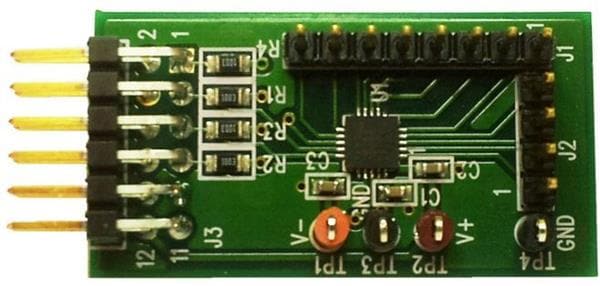
Several boards in this category illustrate the variety of switch IC evaluation needs. From Analog Devices, the MAX14724PMB1# supports evaluation of an 8:4 matrix multiplexor approach, while the EVAL-ADG6436EBZ provides a platform for analog multiplexer testing. For lower-level switch evaluation, boards such as the EVAL-ADG6412EBZ and EVAL-ADG5421FEBZ are suited to checking switching behavior in SPST-based designs, including cases where fault protection is an important consideration.
For configurable and digitally controlled switching, the EVAL-ADGS1412SDZ and EVAL-ADGS5414SDZ highlight the role of SPI-managed analog switch devices in more complex systems. In another application area, NXP’s KIT25XS6300EKEVB is aimed at power distribution evaluation, showing how this category also supports designs beyond low-level signal routing. Evaluation platforms from Dialog Semiconductor, such as the SLG59M1748C-EVB and SLG59H1127V-EVB, are also relevant where switch IC development needs intersect with compact programmable or application-specific switching functions.
How to choose the right switch IC development board
A useful starting point is the switch architecture you need to evaluate. If the end design depends on a simple on/off signal path, a single or dual SPST evaluation board may be enough. If you need channel selection across several signals, a multiplexor or matrix-switch evaluation platform will be a better fit. For load control or protected power paths, a high-side switch kit is more appropriate than a signal-switch board.
Next, check interface and supply requirements. Some boards expose SPI, I2C, serial, or parallel control, which can matter during firmware development and host integration. Supply range is equally important, especially when your target application operates across industrial rails or mixed-voltage environments. It is also worth considering whether you need to observe protection behavior, fault detection, or mux-configurable operation rather than basic switching alone.
Why evaluation boards matter in the design cycle
In many engineering teams, switch ICs are selected as support components, but their impact on the overall system can be substantial. A poorly matched analog switch can affect signal integrity, while an unsuitable power switch can introduce thermal, protection, or control issues. Development tools reduce this risk by allowing early measurement and comparison before layout is finalized.
They also improve communication between hardware, firmware, and test teams. With a working board on the bench, it becomes easier to verify digital control sequences, characterize response under expected supply conditions, and decide whether the selected device should move into the next design revision. For broader mixed-signal prototyping, engineers often review adjacent categories such as clock & timer development tools or active filter development tools alongside switching solutions.
Common application contexts
These tools are relevant in a wide range of B2B design environments. In test and measurement systems, switch and mux evaluation boards help engineers route multiple analog channels efficiently. In embedded control systems, they support validation of digitally controlled switching paths used for sensor selection, interface routing, or subsystem isolation.
In industrial and automotive-adjacent designs, evaluation kits can also be used to review switching behavior under wider temperature ranges, different supply levels, or protected load-control scenarios. Even when a final application is highly customized, using an evaluation platform first often helps teams narrow down the right IC family much faster than starting from schematic capture alone.
Finding a practical fit for your project
The best choice usually depends on what you are trying to prove at the bench: signal-path quality, digital controllability, matrix routing, or power switching behavior. Looking at the target IC, interface method, and intended system voltage will usually narrow the field quickly. From there, it becomes easier to compare whether a compact analog switch board, a mux-focused platform, or a power distribution kit is the more relevant starting point.
This category brings together evaluation options that support early-stage verification for a broad range of switching functions. If you are selecting parts for a new design or validating a candidate device before integration, these development tools provide a practical way to move from component selection to measured results with less risk and less setup effort.
Get exclusive volume discounts, bulk pricing updates, and new product alerts delivered directly to your inbox.
By subscribing, you agree to our Terms of Service and Privacy Policy.
Direct access to our certified experts