Bluetooth Development Tools - 802.15.1
Wireless prototyping often moves fastest when engineers can validate connectivity, power behavior, and integration strategy before committing to a full custom RF design. Bluetooth Development Tools - 802.15.1 help shorten that path by giving teams practical hardware for evaluation, firmware bring-up, interoperability testing, and early application development across embedded and IoT projects.
For product teams working on sensors, wearables, gateways, industrial nodes, or connected consumer devices, this category supports the transition from concept to implementation. It is especially useful when comparing Bluetooth Low Energy and classic Bluetooth options, checking module suitability, or building proof-of-concept systems around established wireless components.
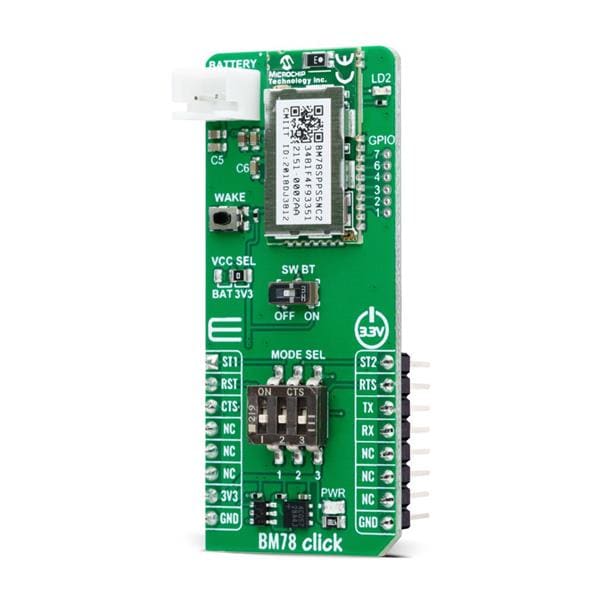
Where Bluetooth development tools fit in the design process
Development platforms in this category are commonly used to evaluate wireless performance, confirm software stacks, and reduce risk in early-stage design. Instead of starting with a custom PCB and RF layout, engineers can test communication range, pairing behavior, throughput expectations, and basic application logic on ready-to-use hardware.
These tools also help when a project depends on ecosystem compatibility. Whether the target application is a battery-powered beacon, an HMI accessory, a portable medical device, or an industrial logger, development hardware gives teams a practical way to explore firmware flow, host interfaces, and power constraints before selecting the final module or system architecture.
Typical applications for Bluetooth prototyping
Bluetooth development tools are relevant across many embedded use cases where short-range wireless connectivity is required. Common examples include asset tracking, health and fitness devices, smart home products, security accessories, portable user interfaces, and low-power sensor nodes that exchange data with phones, tablets, gateways, or local controllers.
Some modules represented in this category illustrate that range well. The Microchip BM70BLE01FC2-0B04AA aligns with BLE-oriented IoT and wearable scenarios, while the Microchip BM64SPKS1MC1-0001AA and BM20SPKS1NBC-0001AA reflect use cases where audio or classic Bluetooth features may be more relevant. For compact embedded designs, parts such as the Infineon CYBLE-222005-00 or Murata WSM-BL241-ADA-008 show how low-voltage, space-conscious wireless integration can be approached during evaluation.
How to compare modules and platforms effectively
When reviewing Bluetooth development hardware, it helps to begin with the communication requirement rather than the module name. The first decision is usually whether the project needs Bluetooth Low Energy only, classic Bluetooth, or a combination of LE with BR/EDR. That choice influences power budget, software complexity, user experience, and interoperability with the target device ecosystem.
From there, engineers typically compare factors such as operating voltage range, receive sensitivity, transmit power, package style, and intended integration path. For example, the Microchip RN4020-V/RM and RN4020BCN-V/RM120 are suitable reference points when assessing BLE-centric embedded designs, while the Infineon PBA31308/2V1.11 can be useful when older Bluetooth implementations or legacy compatibility considerations are part of the design discussion.
Examples of devices found in this category
This category may support projects built around modules from manufacturers such as Infineon, Microchip, Murata, and Broadcom. The value of these platforms is not just in the radio itself, but in how they help engineers evaluate firmware behavior, interface options, and product feasibility before final hardware is locked.
Representative products include the Infineon CYW20835PB1KML1GGFT, the Infineon BCM4343WKUBGT WLAN + Bluetooth module for combined connectivity concepts, and the Broadcom BCM53347A0IFSBLG. In practice, these examples are most useful as starting points for architecture decisions: choosing between standalone Bluetooth connectivity, mixed wireless functionality, or module strategies that simplify RF implementation in production designs.
Development workflow and related tool categories
Bluetooth projects rarely exist in isolation. Many teams move between firmware evaluation, antenna tuning, and broader wireless platform decisions as the design matures. If your work also includes RF layout optimization or matching considerations, antenna development tools can complement Bluetooth bring-up and help improve real-world radio performance.
Likewise, some connected products need more than one wireless protocol during development. In that case, multiprotocol development tools may be relevant when evaluating broader embedded connectivity strategies, especially in systems where Bluetooth is only one part of the communication stack.
Key selection points for engineers and buyers
For technical buyers, selecting the right development tool is usually a balance of engineering fit and project timeline. A good starting point is to confirm whether the platform supports the intended Bluetooth version, power class, and operating conditions needed for the target product. It is also useful to consider how closely the evaluation hardware reflects the final deployment model, especially if the end product must meet size, power, or environmental constraints.
From a procurement perspective, teams should also think about continuity between prototyping and production. Tools built around production-oriented modules can reduce redesign effort later, particularly when the same vendor ecosystem supports both development and volume supply. That approach is often more efficient than validating an idea on generic hardware and then reworking the design around a different wireless module.
Choosing the right starting point
The best fit depends on what you need to prove first. If the project is centered on low-power embedded communication, BLE-focused modules such as the RN4020 family, BM70BLE01FC2-0B04AA, or Murata WSM-BL241-ADA-008 may be a practical place to begin. If the design involves audio, higher output power, or legacy interoperability, modules like the BM64SPKS1MC1-0001AA or BM20SPKS1NBC-0001AA may be more relevant for early evaluation.
For teams that are still refining the overall system concept, GNSS/GPS development tools or other related wireless categories can also become important when Bluetooth is part of a larger connected platform. In all cases, the goal is the same: reduce uncertainty early, validate the communication path, and move toward production with clearer technical direction.
Bluetooth development work is easier when hardware selection reflects the real application, not just a generic feature list. By comparing module type, wireless mode, power profile, and integration path, engineers can use this category to identify practical tools for prototyping, testing, and design validation across a wide range of embedded wireless projects.
Get exclusive volume discounts, bulk pricing updates, and new product alerts delivered directly to your inbox.
By subscribing, you agree to our Terms of Service and Privacy Policy.
Direct access to our certified experts