RF Development Tools
Designing and validating high-frequency signal chains usually requires more than a datasheet review. Engineers often need hardware that makes it easier to characterize gain, switching behavior, attenuation, modulation, detection, and conversion performance under real test conditions. That is where RF Development Tools become especially useful, helping teams shorten evaluation time and move more confidently from concept to prototype.
Why RF development tools matter in practical design work
In RF design, small changes in layout, biasing, frequency range, or test setup can have a noticeable effect on measured behavior. Development and evaluation boards give engineers a structured way to assess an RF component in a known configuration before committing to a custom PCB. This is particularly valuable when working with amplifiers, switches, attenuators, detectors, modulators, and frequency conversion stages.
Compared with building a test platform from scratch, dedicated evaluation hardware can reduce setup effort and help teams focus on performance verification. It also supports faster comparison between device options, whether the goal is improving signal integrity, validating a receive path, or checking how a transmit chain behaves across a target band.
Typical product types found in this category
This category covers a broad set of tools used to evaluate RF signal-chain components. Rather than serving a single application only, these tools are often used across lab characterization, proof-of-concept work, and early-stage product development. Engineers may use them to explore insertion loss, output power, dynamic range, detector response, or the behavior of conversion stages at different frequencies.
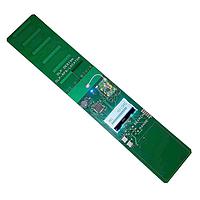
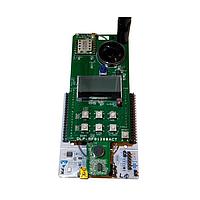
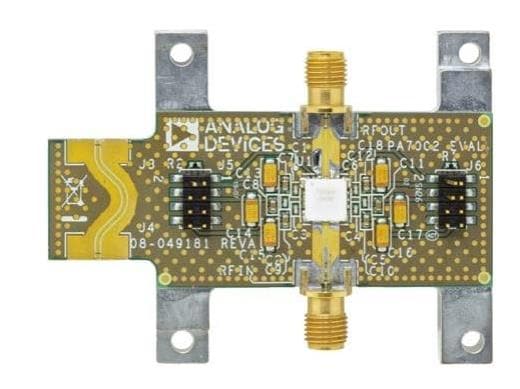
Examples from this range include amplifier evaluation boards, modulator tools, RF detector boards, attenuator evaluation hardware, switch evaluation boards, and frequency multiplier platforms. For instance, the Analog Devices ADPA7006-EVALZ is relevant for amplifier evaluation at millimeter-wave frequencies, while the Infineon BGSC2341ML10E6327XTSA1 RF Switch represents the type of switching device engineers may assess when routing signals through compact front ends.
Representative evaluation platforms and use cases
Several products in this category illustrate how RF development tools support different parts of the design flow. The Analog Devices ADL5375-05-EVALZ can help teams investigate RF modulation behavior, while the Analog Devices ADL5507-EVALZ is suitable for evaluating detector response in measurement and monitoring applications. For signal conditioning, boards such as the Analog Devices EV1HMC629ALP4E and 119197-HMC656LP2 provide a practical way to examine attenuation performance across wide frequency ranges.
Other tools support frequency conversion and signal generation tasks. The Analog Devices EV1HMC7912LP5 evaluation PCB assembly is relevant for I/Q up-conversion work, and the 115223-HMC577LC4B evaluation PCB supports frequency multiplier evaluation at very high frequencies. In switching applications, the Analog Devices EVAL-ADG918EBZ offers a way to assess RF switch behavior in mux or SPDT-style signal routing scenarios.
How to choose the right RF development tool
Selecting the right platform usually starts with the target frequency range. A tool intended for a few gigahertz may not be suitable for microwave or millimeter-wave evaluation, so frequency coverage should be checked first against the intended signal chain. It is also important to consider supply requirements, connector and fixture compatibility, and whether the board is designed for quick bench evaluation or deeper characterization work.
Next, match the evaluation tool to the function you are trying to validate. If you need to examine gain stages, an amplifier board is the logical fit. If the design challenge is path selection or front-end routing, a switch-focused platform makes more sense. Detector, modulator, attenuator, and up-converter tools each support different measurement goals, so choosing by function can prevent unnecessary test complexity.
Engineers working across broader wireless projects may also want to review related areas such as antenna development tools or cellular development tools when the RF board is only one part of a larger system validation workflow.
Leading manufacturers in this category
This category includes solutions from recognized suppliers used in embedded, wireless, and high-frequency design. Analog Devices is especially prominent here, with evaluation hardware covering amplifiers, modulators, detectors, attenuators, converters, and other RF building blocks. These tools are often used when teams need a practical starting point for bench testing and performance exploration.
Infineon also contributes relevant RF components and development options for switching and front-end design scenarios. In a broader engineering environment, buyers may also be familiar with suppliers such as Microchip Technology, Mini-Circuits, NXP, Nordic Semiconductor, and Maxim Integrated, depending on whether the project focuses on discrete RF stages, embedded wireless integration, or mixed-signal system development.
Where RF development tools fit in the wider wireless workflow
RF evaluation rarely happens in isolation. A team may begin by validating a switch, amplifier, or detector stage, then continue into protocol-specific or application-specific testing. That is why these tools are often used alongside more specialized resources for positioning, connectivity, or multi-standard communication development.
If your project extends beyond core RF building blocks, it may be useful to explore related categories such as GNSS/GPS development tools or multiprotocol development tools. These complementary categories can help bridge the gap between component-level RF validation and full wireless system development.
What to review before ordering
Before choosing a board, check whether the tool is intended for direct component evaluation, functional proof-of-concept, or broader development support. Some items are clearly evaluation boards for a specific IC, while others act as more general development hardware around a defined RF function. This distinction matters because it affects setup effort, measurement flexibility, and how closely the board matches your intended design path.
It is also wise to confirm operating conditions and lab compatibility. Supply voltage, temperature range, and expected test equipment all influence whether a platform will fit smoothly into an existing bench setup. For B2B buyers, this step helps avoid mismatches between purchasing, engineering expectations, and actual validation requirements.
Supporting faster RF design decisions
Choosing the right RF development hardware can make early design decisions more evidence-based and less dependent on assumptions. Whether you are assessing a detector, validating a switch topology, or exploring gain and attenuation behavior across a defined band, the right evaluation tool can reduce uncertainty and improve test efficiency.
This category is best approached as a practical resource for RF prototyping, measurement, and component-level verification. By comparing function, operating range, and intended evaluation purpose, engineering teams can identify tools that align with both immediate lab work and longer-term wireless product development.
Get exclusive volume discounts, bulk pricing updates, and new product alerts delivered directly to your inbox.
By subscribing, you agree to our Terms of Service and Privacy Policy.
Direct access to our certified experts