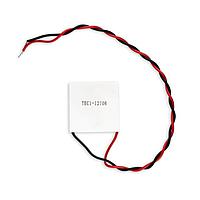
Thermoelectric Peltier Modules
Precise temperature control often depends on more than simple airflow or passive heat sinking. In compact electronics, optical systems, laboratory instruments, and embedded industrial assemblies, active heat pumping can be the more practical approach when stable cooling or controlled heating is required. That is where Thermoelectric Peltier Modules fit into a thermal management design.
These modules use the thermoelectric effect to move heat from one side of the device to the other when DC power is applied. Because they have no refrigerant and no mechanical compressor, they are widely used in systems that need localized temperature control, small form factors, and straightforward electrical integration. This category brings together module options for engineers, OEM buyers, and maintenance teams looking for reliable building blocks for thermal regulation.
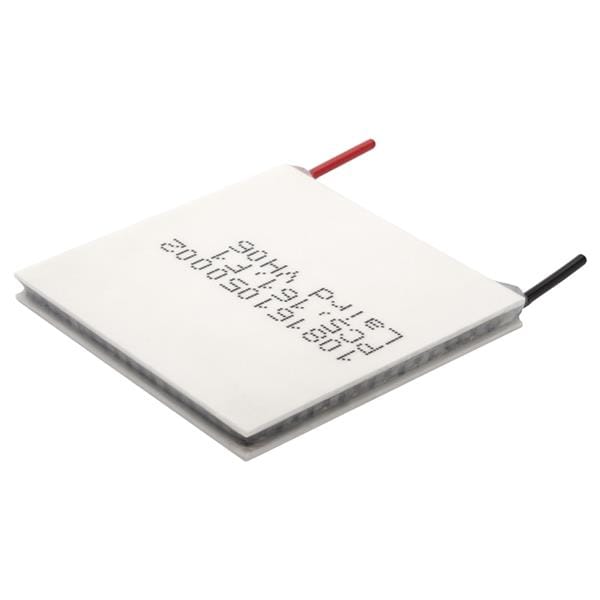
Where thermoelectric modules are typically used
A Peltier module is commonly selected when a design needs to cool a component below ambient, stabilize a sensitive sensor, or create a controlled thermal differential in a confined space. Typical use cases include instrumentation, medical and laboratory devices, imaging equipment, telecom hardware, portable cooling assemblies, and industrial enclosures for sensitive electronics.
In many applications, the module itself is only one part of the thermal chain. Designers often combine it with heat sinks, control electronics, and airflow devices such as fans and blowers to remove heat efficiently from the hot side. Good system performance depends not only on the module rating, but also on how effectively the full assembly manages heat transfer.
How a Peltier module works in practical terms
The operating principle is straightforward: current passing through the module transfers heat, creating a cold side and a hot side. Reversing polarity reverses the direction of heat flow, which makes these devices suitable for both cooling and heating functions in the same assembly. This flexibility is useful in equipment that must hold a narrow temperature window across varying ambient conditions.
From a design perspective, the key advantage is solid-state temperature control. There are no moving parts inside the module itself, which supports quiet operation and compact integration. However, performance still depends heavily on power input, thermal interface quality, heat sinking, and control strategy.
What to consider when selecting Thermoelectric Peltier Modules
Module selection should start with the thermal load and the target temperature difference. If the application requires removing only a modest amount of heat but needs accurate stabilization, a smaller module may be appropriate. If the load is higher or the temperature lift is more demanding, a larger or differently configured module may be necessary.
Mechanical footprint is also important. Engineers typically review the module dimensions, mounting method, and contact surfaces to ensure proper compression and heat transfer. In addition, environmental conditions, duty cycle, and long-term reliability expectations should be considered early, especially in industrial or continuously operating equipment.
For closed-loop control, designers often pair these modules with feedback components such as thermistors or industrial temperature sensors. This makes it easier to maintain a stable setpoint and protect temperature-sensitive assemblies.
Representative module options in this category
This category includes several widely referenced modules from Laird Technologies, giving buyers a useful range of form factors and device configurations for different thermal design goals. Examples include the Laird Technologies CP2-31-10L Peltier Module, CP1.0-31-08L Peltier Module, and CP2-127-06L Peltier Module.
Other notable options in the range include the CP1.0-127-05L-RTV, CP1.4-127-045L-RTV, CP2-71-06L, and compact variants such as the CP0.8-7-06L or CP0.8-17-06L. Rather than choosing by model name alone, it is better to compare modules according to thermal requirements, available space, electrical drive conditions, and the broader thermal architecture of the equipment.
System-level design matters as much as the module itself
A thermoelectric cooler will only perform as expected when both sides of the heat path are properly managed. The cold side must be well coupled to the load, while the hot side must reject heat efficiently to the ambient environment. If the hot side is undersized or poorly ventilated, cooling performance can drop significantly even when the module is correctly powered.
This is why engineers often evaluate the module together with interface materials, heat spreaders, and airflow components. In protective designs, complementary devices such as thermal cutoffs may also be relevant where overtemperature protection is needed. Looking at the complete thermal system usually leads to more stable operation and fewer field issues.
Brands and sourcing context
Within thermal management portfolios, buyers may also encounter related offerings from manufacturers such as Laird Thermal Systems, Laird Performance Materials, Honeywell, Wakefield Thermal, Same Sky (formerly CUI Devices), Advanced Thermal Solutions, Eaton, and Mikroe. In this category, however, the listed featured products are centered on Laird Technologies module options, making the range especially relevant for teams already standardizing on that product family.
For procurement and engineering review, it helps to assess not only immediate availability but also compatibility with existing thermal control hardware, mounting methods, and sensor strategy. This is especially important in B2B environments where serviceability, repeatability, and design consistency across builds matter as much as initial selection.
Choosing the right fit for your application
The most effective way to choose a module is to begin with the application objective: cooling, heating, stabilization, condensation control, or precision temperature maintenance. From there, narrow the selection based on thermal load, allowable power consumption, physical integration, and how the module will be controlled in the final system.
If your design requires localized, reversible, and compact active cooling, this category provides a practical starting point. Reviewing representative models such as the CP1.0-127-05L, CP0.8-31-06L, or CP0.8-71-06L can help identify a suitable direction before final engineering validation.
Final thoughts
Thermoelectric Peltier Modules are best understood as system components rather than standalone cooling parts. When matched correctly to the thermal load and supported by proper sensing, heat rejection, and control, they can deliver efficient and precise temperature management in a wide variety of compact industrial and electronic applications.
For buyers comparing options in this category, a careful review of operating conditions, physical constraints, and surrounding thermal hardware will lead to a more reliable selection. That approach is usually more valuable than focusing only on part naming or nominal module size.
Get exclusive volume discounts, bulk pricing updates, and new product alerts delivered directly to your inbox.
By subscribing, you agree to our Terms of Service and Privacy Policy.
Direct access to our certified experts