Bonding Ohmmeters
Low-resistance verification is a critical part of electrical safety, maintenance, and production quality. When continuity across metal bonds, grounding paths, or protective conductors must be confirmed with confidence, Bonding Ohmmeters provide the precision needed to measure very small resistance values that ordinary handheld meters may not resolve well.
On this category page, you can explore instruments designed for bond testing, low-resistance measurement, and continuity verification in applications where stable test current, repeatable readings, and clear pass/fail interpretation matter. These tools are commonly used in aerospace, industrial maintenance, equipment assembly, and environments where electrical bonding integrity must be documented.
Why bonding resistance measurement requires a dedicated instrument
A bond test is not simply a basic continuity check. In many installations, the objective is to verify that a connection between conductive parts remains low enough in resistance to support safe grounding, static dissipation, or reliable fault current paths. That means the instrument must resolve readings in milliohms or even lower while maintaining a defined test current.
This is where a bonding ohmmeter differs from a standard multimeter. General-purpose meters are useful for broad electrical troubleshooting, but dedicated bond meters and low-resistance ohmmeters are built to improve resolution, repeatability, and measurement confidence when testing cable bonds, aircraft structures, panels, grounding straps, and metallic joints.
Typical applications for bonding ohmmeters
These instruments are selected where low-resistance connections have a direct impact on safety, performance, or compliance procedures. Common use cases include checking protective bonding in electrical systems, verifying metal-to-metal continuity, and confirming the condition of grounding and interconnection points during maintenance or final inspection.
In field work, technicians often use bonding ohmmeters to identify degraded joints, corrosion-related resistance increase, or loose mechanical connections that may still appear continuous on a simple meter. In facilities focused on grounding performance, bond measurement is often considered alongside tools such as an earth resistance tester, since both contribute to a more complete view of electrical safety and grounding integrity.
What to look for when choosing a bonding ohmmeter
The first consideration is the measurement range. Some jobs focus on very low milliohm values, while others require a wider range that extends into a few ohms for broader continuity and bond checks. Resolution should match the level of detail needed in your procedure, especially if you are comparing small changes between repeated inspections.
Another key factor is test current. A controlled current helps produce more reliable low-resistance measurements and can be important when evaluating contact quality. Accuracy, display readability, battery operation, portability, and connector style also matter, particularly for mobile technicians who need to test in confined spaces or on large equipment.
If the instrument will be used in sensitive or hazardous environments, safety design becomes an important part of selection. Some models in this category are intended for intrinsically safe operation, while others emphasize wireless logging, higher display resolution, or rugged handheld portability depending on the workflow.
Representative instruments in this category
Several product families help illustrate the range of use cases covered here. From TEGAM, the TEGAM 720A is positioned as an intrinsically safe handheld bond meter for low-resistance measurement across a practical range from milliohms up to 100.00 Ω. For teams that need easier data capture in the field, the TEGAM 730A adds wireless datalogging capability while maintaining a similar low-resistance focus.
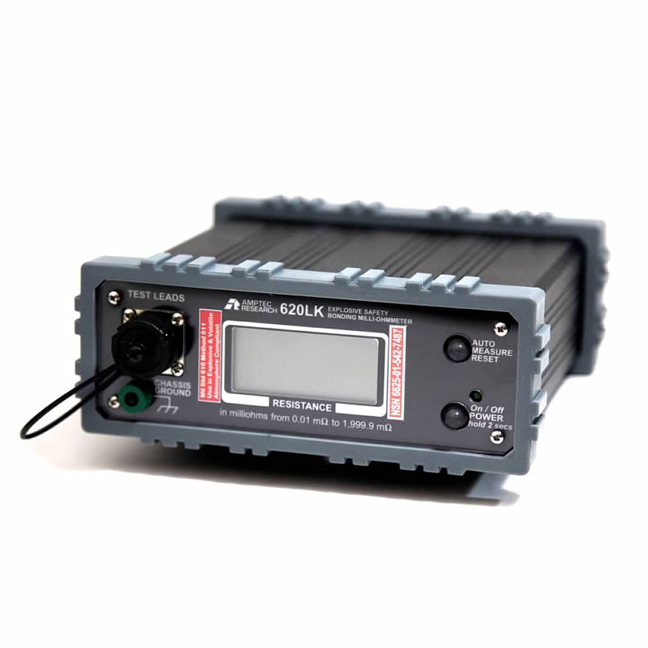
From AMPTEC RESEARCH, the 620 series highlights another common selection path. The AMPTEC RESEARCH 620LK and 620UK-B are designed for intrinsically safe bond testing, while the 620LK-HR emphasizes high-resolution measurement for applications that require finer detail at low resistance values. These examples show how the category supports both routine maintenance checks and more demanding low-ohm verification tasks.
Handheld, intrinsically safe, and high-resolution options
Not every bonding job requires the same instrument format. Handheld units are often preferred for plant maintenance, aircraft inspection, mobile service work, and general field use because they reduce setup time and are easier to carry between test points. Backlit displays, battery power, and auto-ranging functions can also improve productivity when tests are performed across multiple locations in one shift.
Where the work area introduces stricter safety requirements, intrinsically safe instruments may be more appropriate. In other situations, the deciding factor is not safety classification but the ability to detect very small changes in contact resistance. In those cases, a high-resolution bonding ohmmeter can help technicians trend connection quality more precisely over time.
How bonding ohmmeters fit into a broader test workflow
Bond measurement is often one step in a larger electrical verification process. A technician may begin with general troubleshooting, isolate wiring or connection issues, verify continuity, and then use a bonding ohmmeter to quantify low-resistance performance more accurately. This makes the category especially relevant for maintenance departments, OEM assembly teams, repair centers, and quality control environments.
Depending on the task, complementary instruments may also be part of the workflow. For example, bond testing can be associated with grounding checks, insulation-related diagnostics, or fault localization. In maintenance scenarios involving cable paths or protective conductor problems, a ground fault locator may support troubleshooting before final low-resistance verification is performed.
Choosing the right product for your application
If your priority is portable low-resistance testing with straightforward operation, a handheld bond meter may be the most practical starting point. If your procedures require documented readings across repeated inspections, models with datalogging or improved display capability can be helpful. Where the environment is controlled but measurement detail is critical, higher-resolution instruments may offer a better fit.
It is also worth considering how often the instrument will be used, the resistance range most often encountered, and whether your team needs a unit optimized for field mobility or bench-style consistency. Looking at actual test procedures, expected resistance levels, and safety constraints will usually narrow the selection more effectively than comparing specifications alone.
Find bonding ohmmeters suited to low-resistance verification
This category brings together instruments intended for reliable bond testing, continuity verification, and low-ohm measurement across industrial and technical applications. Whether you are evaluating portable handheld units, intrinsically safe models, or higher-resolution options, the goal is the same: obtain repeatable readings that help confirm the integrity of critical conductive paths.
Browse the available bonding ohmmeters to compare instrument styles, resistance ranges, and application fit. A well-matched tester can make low-resistance verification faster, clearer, and more dependable in both field and quality-control workflows.
Get exclusive volume discounts, bulk pricing updates, and new product alerts delivered directly to your inbox.
By subscribing, you agree to our Terms of Service and Privacy Policy.
Direct access to our certified experts